
594 billion parameters, only 17 billion at work: how Inkling 2 Small was trained
Thinking Machines' open model Inkling 2 Small is on Hugging Face under Apache 2.0. We walk through its mixture of experts, 68-hour pretraining and single joint RL run.

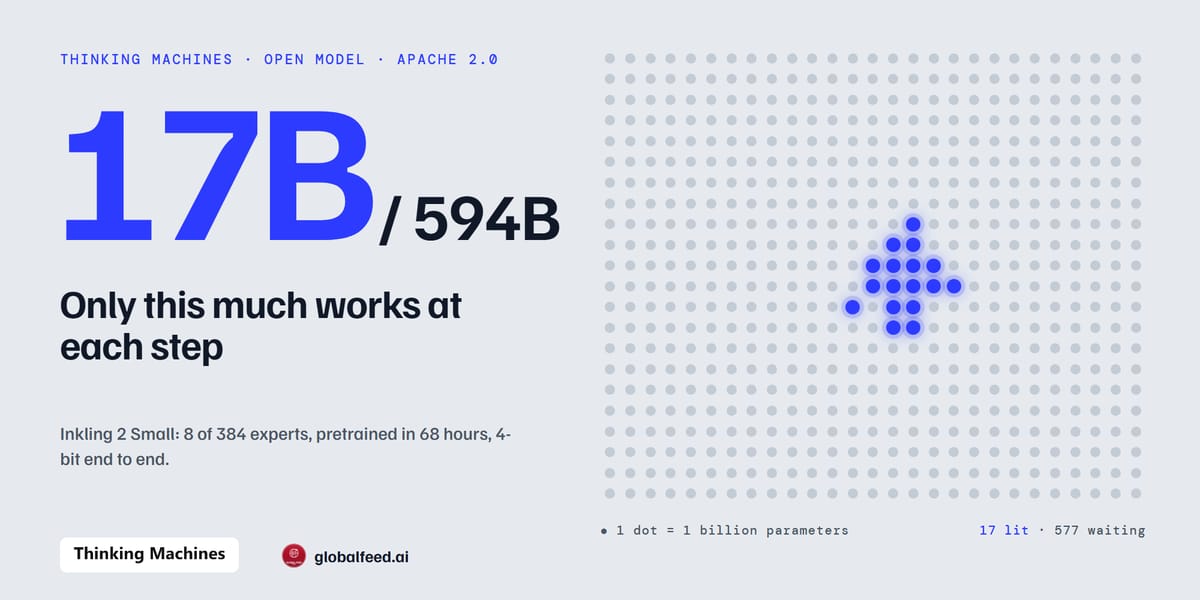
Picture a huge hospital with 384 specialists on staff, where each patient who walks in sees only 8 of them. The hospital knows a lot, yet every visit uses a small team. That is how Inkling 2 Small works. Thinking Machines announced it on 5 November and opened the model files on 12 November. It has 594 billion total parameters, but only 17 billion are active for each token. The model is on Hugging Face under Apache 2.0, so anyone can download it, run it on their own servers and fine-tune it.
The most interesting part is how it was built. Thinking Machines shared each training stage down to token counts, days and the share of time spent on each task type. A week ago we covered how the same model was trained with 4-bit numbers; here we look at the model itself, the full recipe and the results.
What is Inkling 2 Small?
Thinking Machines is the AI lab founded by former OpenAI CTO Mira Murati. Its first large model, Inkling, arrived on 15 July with 975B total and 41B active parameters, followed weeks later by Inkling Small (276B total, 12B active). Inkling 2 Small opens the second generation. It has 48 layers; each mixture-of-experts layer holds 384 experts and routes every token to 8 of them. Attention mixes local sliding-window layers with global layers. Context reaches 1 million tokens. A 292M-parameter vision encoder cuts images into 20x20-pixel patches and interleaves them with text. Output is text only, and unlike the first Inkling it has no audio support.
How it was trained
Every stage ran in NVFP4, a 4-bit number format the company calls the model's native precision. Pretraining used 8.4 trillion tokens of text, code and images and took 68 hours on NVIDIA GB300 NVL72 racks. A second stage added 3.8 trillion tokens of newer, higher-quality data at 512K context. Midtraining used about 320 billion tokens of reasoning and agent trajectories with replayed pretraining data at 1M context, and a final stage used 34 billion tokens of the best agent trajectories. Many trajectories came from earlier models, including Kimi K3 and the lab's own, filtered for correctness and alignment.
The biggest change is reinforcement learning. The first Inkling trained reasoning and agentic skills in separate runs and merged them through multi-teacher distillation. Inkling 2 Small used one joint run: 1,075 steps, more than 17 million rollouts, 2,048 GPUs for 9 days and over 3 trillion tokens. A median rollout ran 43K tokens and 8 minutes; the longest reached 1.5 million tokens and 4 hours. Coding took 65% of RL tokens, office and knowledge work 13.3%, STEM 7.6%, web and app building 7.2%. Graders ranged from hidden unit tests to rubric-based judge models and reward models comparing screenshots of rendered web apps. Effort was sampled per rollout with a length penalty, and a general alignment reward penalized misbehavior on every task, with environments that reward giving up on impossible tasks. On the lab's internal misbehavior eval the score fell from 66.8 for Inkling to 14.9 (lower is better), though the lab says it still trails OpenAI's GPT-6.1 Sol there.
Results and how to try it
Against 12 models including DeepSeek-V4.1-Flash, GLM 5.3, Kimi K3, Gemini 3.8 Flash and Claude Haiku 5.5, Inkling 2 Small tops the table on BrowseComp (90.2%) and Finance Agent (67.5%), ties Kimi K3 at 97.7% on SWE-Bench Pro v2 Full, and scores 81.3% on Terminal Bench 2.1. On the Artificial Analysis index it scores 30.6, behind Claude Haiku 5.5 (36.5) and DeepSeek-V4.1-Flash (32.6). Compared with the first Inkling, HLE rose from 29.7% to 44.1% and GPQA Diamond from 87.2% to 93%.
You can try it in the Tinker Playground or through NVIDIA, Fireworks, Together, Baseten, Nebius, Modal and Cloudflare. Self-hosting takes one command with vLLM (vllm serve thinkingmachines/Inkling-2-Small) or SGLang, but the NVFP4 checkpoint needs at least 500 GB of GPU memory (2x B300 or 4x H200) and MXFP8 needs 800 GB. The lab lists weaker spots too: answers are not always concise, tool choice can slip in repos with many skills, and it is less tuned for chat. All scores come from the announcement; for a fuller picture, follow evaluations from independent researchers as well.
Sources: Thinking Machines: Introducing Inkling 2 Small, Hugging Face model card, Thinking Machines model card

