AI that runs the same layers three times: how do looped transformers work?
Looped transformers through Inkling 2 Mini, GLM-5.4 and the Mixture-of-Loops paper: reusing layers, how they are trained, what they help with and how to try one locally.

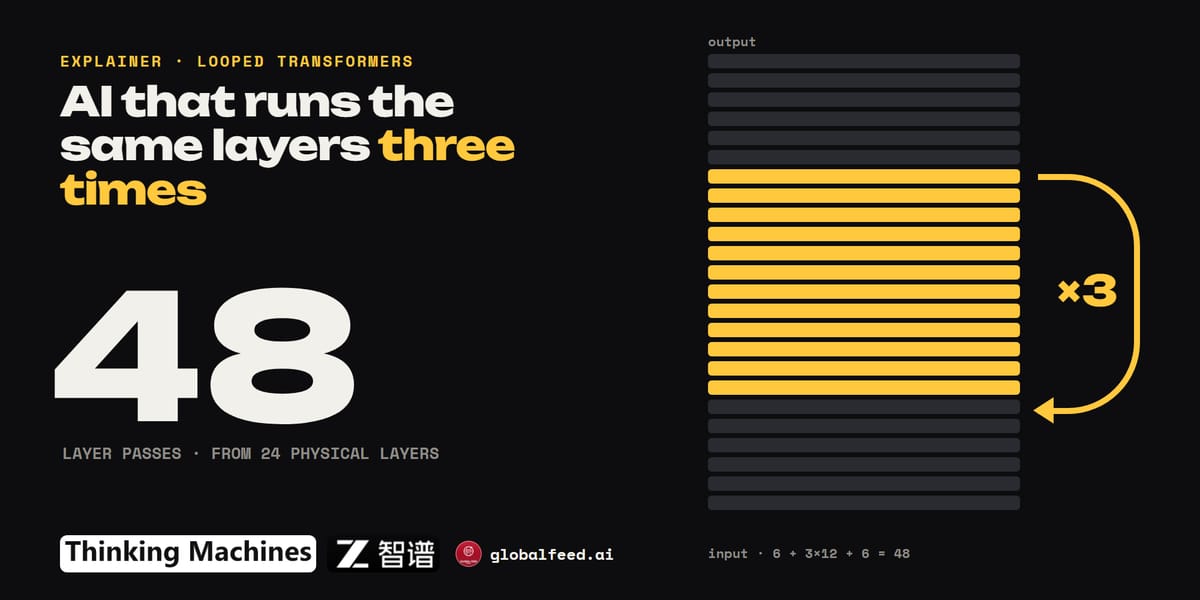
What do you do when a paragraph is hard? You rarely buy a new book; you read the same paragraph again, maybe a third time. Your brain is the same each time, but the understanding deepens. Three AI releases last week give language models that habit. Thinking Machines Lab's open Inkling 2 Mini (November 20) uses its 24 physical layers as 48 when it processes a token. Z.ai's GLM-5.4 (November 23) runs 28 layers twice. The Mixture-of-Loops Transformer paper (November 25) shows a smarter way to carry information between loops. Their shared name: the looped transformer.
The question: parameters or depth?
A language model is a stack of layers. Each token enters at the bottom, gets refined layer by layer and leaves at the top as a prediction. In an ordinary model every layer runs once and has its own parameters, so "thinking deeper" traditionally means adding layers, and every layer means more parameters, a bigger file and more memory. A looped transformer instead runs the same layers, with the same parameters, more than once per token. Stored parameters stay the same while depth per token grows. The cost is compute: Thinking Machines notes that per-token compute is higher than the active-parameter count suggests because the middle layers run three times.
The idea is not new. Universal Transformers (2018) and ALBERT (2019) shared parameters across depth. In 2025, Geiping and colleagues' Huginn, a 3.5B looped model trained from scratch on 800B tokens, gained most on math and code, and the authors of Ouro claimed 4-loop 1.4B and 2.6B models matched models up to 12B. What is new in November 2026 is production scale.
How the loop is wired in Inkling 2 Mini
Inkling 2 Mini is a 26.4B multimodal mixture-of-experts model. Its 24 layers form four blocks of six: blocks one and four run once, the middle two (12 layers) run three times, giving 6 + 3 x 12 + 6 = 48 layer applications. 3.4B parameters are active per token, each extra pass adds about 1B, for 5.4B effective. Passes two and three receive "messages" from the previous pass through four rank-64 gates, and a learned gate starts almost closed, so the loop first behaves like a non-looped model and learns to use extra passes gradually. Placement was measured: looping the middle layers gave a 1.51x to 1.91x compute-equivalent gain against 1.24x to 1.36x for the last layers, winning 27 of 28 evaluations. It scores 79.2% on SWE-bench Verified, against 77.8% for Qwen3.8-27B.
How looped models are trained
Inkling: prune, distil, reinforce. The model was trained with 8 of 384 experts per token, then two-thirds of the experts were pruned to the 128 most used per layer. One trillion tokens of distillation from a larger internal Inkling healed the loss, followed by SFT, reinforcement learning on 2.2T tokens over 2,000 steps and on-policy distillation. It ships in the precision it was trained in (NVFP4 and MXFP8), about 20 GB.
GLM-5.4: convert a finished model. Z.ai adapted its pre-trained 750B-scale GLM-5 base into a looped transformer through continued training, noting that looped models trained from scratch lag unshared ones at equal pre-training compute. "Gated progressive updates" let the first pass write conservatively and the second open the gates. A controlled 30B experiment with only about 10% more total training compute showed the biggest gains in math, scientific reasoning and long context, and answers on GPQA-Diamond and MMLU-Pro got 10% to 14% shorter. Z.ai places the model at the level of 2T to 3T parameter models.
MoLT: memory between loops. Researchers from HUST, ByteDance Seed and the University of Toronto pass keys and values from earlier loops as selectable memory. U-MoLT splits the model into a looped encoder that builds memory and a decoder that only reads it, reporting 1.7x token efficiency at 700M parameters over 400B tokens. On a 4,096-token prefill, a non-looped model takes 1,000.6 ms, a fixed two-loop model 1,974.3 ms and MoLT's hybrid decoding 996.6 ms. Experiments go up to 3B so far.
What loops help with, and what they do not
Loops add depth, not storage. Thinking Machines found that factual recall is set mostly by total parameters and extra passes barely move closed-book QA; gains without chain of thought flatten after three passes, except N-Hop Lookup, which kept improving to 10 loops. Weights are shared but caches are not: in Inkling each of the 48 visits keeps its own KV state, per the Hugging Face write-up. GLM-5.4 reuses the first loop's sparse KV selection and keeps only a sliding window for the second, so an extra loop costs one window rather than a full context cache. Both companies report overthinking: Z.ai calls it "marathon thinking".
How to try it
Inkling 2 Mini runs locally under Apache 2.0 on a 32 GB Apple silicon Mac, a DGX Spark or a GPU with 32 GB or more: llama serve -hf ggml-org/Inkling-2-Mini-GGUF:IQ4_NL starts an OpenAI-compatible server, and vllm serve "thinkingmachines/Inkling-2-Mini", Ollama, LM Studio and MLX also work. The research variant TML-d24-varloop-research lets you set the pass count and compare one loop with three on the same question. GLM-5.4 is available through Z.ai's GLM Coding Plan, ZCode and Z.ai Chat, with open files planned after safety work; MoLT code is on GitHub.
Sources: Thinking Machines: Inkling 2 Mini, Inkling 2 Mini model card, Z.ai: GLM-5.4, Mixture-of-Loops Transformer (arXiv), Huginn (arXiv), Ouro (arXiv)