
Training a model with 4-bit numbers without breaking it: how Thinking Machines did it
Thinking Machines trained its open model Inkling 2 Small with a 4-bit forward pass from pretraining through RL. We explain how 4 bits work and the four decisions behind the recipe.

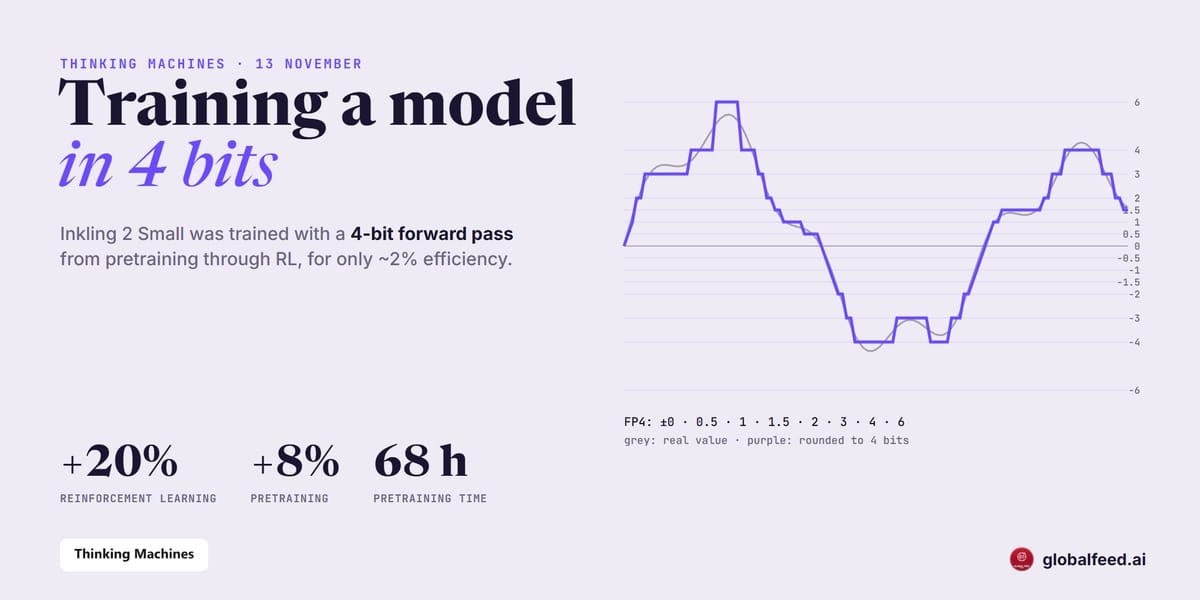
Training an AI model means computing and storing billions of numbers over and over. Store each number with fewer bits and memory shrinks while GPUs compute faster, but fewer bits mean coarser rounding and more error. The field's long-running question is how to get that speed without breaking learning. In a detailed technical post on 13 November, Thinking Machines gave a striking answer: its open model Inkling 2 Small was trained with a native 4-bit forward pass from the start of pretraining through the final reinforcement learning rollout, the largest model the company knows of trained this way. The gain is 8% faster pretraining and 20% faster RL; the cost is about 2% compute efficiency.
Rounding errors add up
Store 3.2 in a format that can only show 3 or 4 and you get a 0.2 quantization error. Small alone, such errors accumulate across layers and steps. The team uses three formats: BF16, MXFP8 and NVFP4. On NVIDIA GB300s, NVFP4 uses 3.6x fewer bits than BF16 and runs up to 6x faster, reaching 15 PFLOPS versus 5 for MXFP8 and 2.5 for BF16.
How 4 bits work
FP4 can show only 16 values: ±0, 0.5, 1, 1.5, 2, 3, 4 and 6. Block scaling stores a shared scale factor for each block of 16 values based on its largest value, and a second FP32 outer scale shifts the range for a whole tensor.
How it was done
Putting 4 bits in the right place. Mixture-of-experts layers carry most of the compute and tolerate quantization best. Full 8-bit MoE training barely hurt efficiency, but full 4-bit training hurt it too much, so NVFP4 is used only in the forward pass of the expert layers, with MXFP8 in the backward pass.
Fixing the backward-pass mismatch. Transposing tensors for the backward pass regroups each value with different neighbors, changing scales and rounding. NVIDIA's 16x16-tile fix proved too coarse, so the team de-quantizes, transposes in high precision and re-quantizes to MXFP8 with stochastic rounding, which keeps tensors equal in expectation and avoids bias. The idea draws on TetraJet-v2 and Quartet II.
Removing the communication bottleneck. Faster 4-bit math exposed expert-parallel communication as the limit: with 900 GB/s NVLink and 15 PFLOPS, a GPU can do up to 16,000 operations per byte received. Dispatch already travels in NVFP4; for combine, MXFP8 hurt accuracy, but a 32-dimensional random Hadamard transform followed by block-scaled S2F6, an 8-bit fixed-point format, cut traffic from 16 to 8.25 bits per value with no measurable accuracy loss.
Custom kernels. The in-house BBBK kernel stack fuses quantization work into the matrix multiplications to keep NVLink, ALUs and Tensor Cores busy at once, with fully deterministic computation. The last 16.6% of layers stay in MXFP8, activations use the Four Over Six technique, and the same settings run from pretraining through RL, so no post-training calibration is needed.
Results
Versus full MXFP8 training, the recipe gives 8% faster pretraining and 20% faster RL, at about 2% compute efficiency in pretraining and no discernible reward change in RL. More broadly, a run of this size once took weeks; Inkling 2 Small was pretrained in 68 hours on GB300 NVL72 racks. The team is now exploring 4-bit backward passes and NVIDIA's Vera Rubin systems. The post includes interactive tools for block scaling and the Hadamard transform, and Inkling 2 Small itself is Apache 2.0 on Hugging Face; the kernels were not released.
Sources: Thinking Machines: End-to-End 4-Bit Training, Inkling 2 Small, Hugging Face

