
Talk over it and it listens: how the open Haru-4B voice model holds a real conversation
higurashi's open Haru-4B listens and speaks at the same time. Here is how it was trained on 40 million hours of real speech.

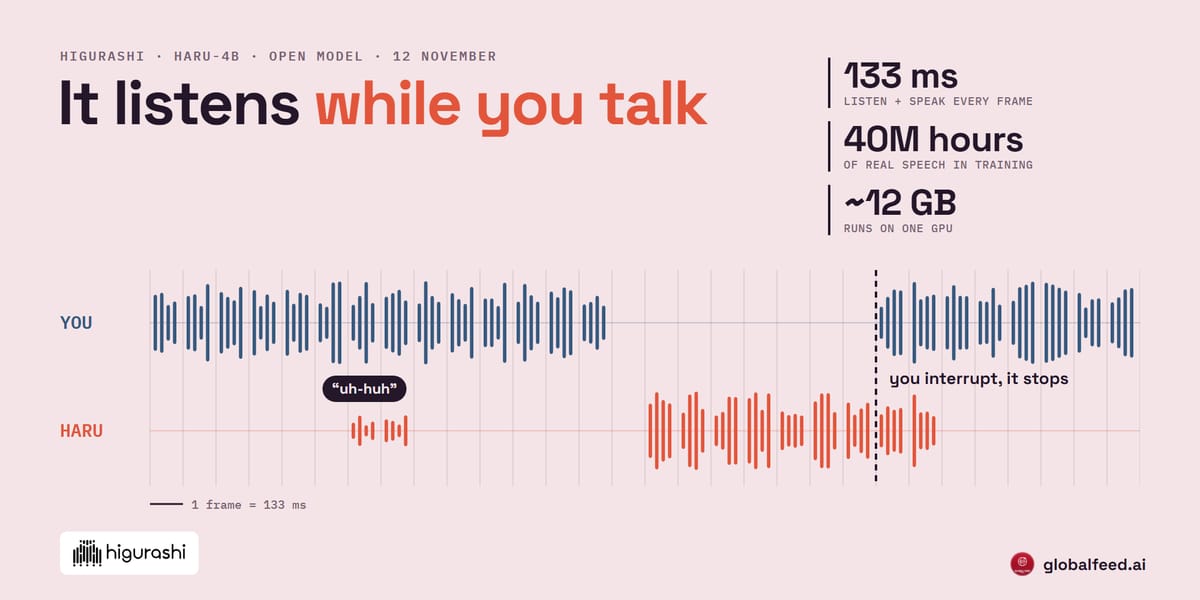
On a phone call you can cut someone off and they stop to listen. While you talk, they slip in an "uh-huh" or a "right, right" and start shaping their answer at the same time. That flow feels ordinary to people, yet most voice assistants still struggle with it. On 12 November, Tokyo speech AI startup higurashi released an open model built around exactly this problem: Haru-4B. It listens and speaks at the same time, its files and code are released under Apache 2.0, and it runs on an NVIDIA card with about 12 GB of memory.
Here is how Haru-4B works, how it was trained on 40 million hours of real speech, how fast it is and how to try it.
Walkie-talkie versus phone call
Most voice assistants work like a walkie-talkie: you talk, you stop, and once the system decides you have finished it takes its turn. Interrupting, backchannelling or briefly talking over each other does not fit that pattern. A phone call is full-duplex: both sides hear and speak at once. According to higurashi's technical blog, Haru-4B learns backchannels, interruptions and turn-taking from large-scale real-world speech instead of synthetic conversations or scripted turn-taking rules. The company's stated goal is to make talking to AI feel like a natural human conversation. We covered GPT-Live-1, which also listens while it speaks, as a closed API; Haru-4B can be downloaded and run on your own machine.
One frame every 133 milliseconds
The model card describes a simple rhythm. Haru-4B steps 7.5 times a second, once every 133 ms. In each step it takes one frame of the user's audio and produces one frame of its own audio plus the matching text. User audio, model audio and model text are summed into a single position of the language model, so listening and speaking never wait for each other. Think of a simultaneous interpreter in headphones who hears the speaker and their own voice while talking. The blog says summing the three streams, instead of interleaving them token by token, cuts the context length to a third and keeps the text stream uninterrupted.
Turning sound into numbers
Most spoken language models chop audio into discrete tokens from codebooks (a method called RVQ), with several codebook indices per frame. Haru-4B instead describes each 133 ms of sound with a continuous 64-number vector, a bit like mixing the exact shade of a colour instead of picking a number from a swatch book. The causal VibeVoice acoustic tokenizer turns every 3,200 samples of 24 kHz audio into one such vector and back. A small four-layer network then produces the next audio vector from the language model's hidden state in a single MeanFlow sampling step. There is no separate acoustic transformer and no iterative sampling.
How it was trained
Haru-4B starts from Alibaba's open text model Qwen3.5-4B, with 32 layers and a hidden size of 2,560. higurashi added the audio codec, two audio input projections and the small audio head, all stored in one model file on Hugging Face.
Data. The model was pretrained on more than 40 million hours of speech in over 160 languages, with nine primary languages: English, Spanish, Portuguese, German, French, Chinese, Japanese, Russian and Korean. The team deliberately left out LLM-generated dialogues and TTS-synthesized speech, because real recordings contain the spontaneous interruptions, hesitations, backchannels, overlaps and irregular turn boundaries that synthetic dialogue lacks. Most of the audio was cleaned with the open Sidon speech restoration model, and higurashi released its Triton kernels for it as Sidon-Triton.
Stage 1, single-channel speech. Qwen3.5-4B was adapted to speech with a mix of speech recognition, speech and text continuation, and text-only rehearsal to limit forgetting of what the language model already knew.
Stage 2, full-duplex speech. Full-duplex training needs each speaker on a separate, synchronized channel, while most real conversations are recorded as a single mixed channel. The team built FastDialogueSidon, a fast joint separation and restoration model that turns mixed recordings into aligned two-stream dialogue, and released it as well. That produced more than 13 million hours of separated dialogue, with training conversations up to 60 minutes long. For each sample the team generated a character prompt and used reference audio from the same speaker, which is why the model can now be steered with a character card and a short voice clip.
Head and alignment. The audio head was trained first with flow matching, then distilled with MeanFlow to run in one step. Text is aligned with audio in chunks, with padding positions and an end-of-padding token that signals when the model is about to speak, which keeps the streams in sync and reduces forgetting.
Compute and open problems. Pretraining took about 8 days on 256 NVIDIA B200 GPUs using Megatron-LM. The team chose not to interleave streams, not to use discrete codebook tokens and not to use synthetic dialogue. It also notes the cost of its approach: separation errors and noise can remain, especially where people talk over each other, so it is now fine-tuning on natively recorded two-channel conversations. According to the blog, the model reaches backchannels and overlapping speech without ever having seen such native recordings. A more detailed technical report and the training code are planned.
How fast it is
On a MacBook with an Apple M1 Max, higurashi's native Swift app with custom Metal kernels reaches about 65 ms end to end with int8 weights: 5.3 ms microphone input, 34.2 ms for one model step, 4.1 ms handoff, 13.3 ms output margin and 8.1 ms to the headphones. Framing audio into 133 ms chunks can add up to 133 ms. On an NVIDIA B300 with vLLM-Omni, audio encoding, decoding and one language model step take about 15 ms together. The repository's Triton codec kernels bring a frame's encode or decode time from about 6 ms to 0.7 ms.
How to try it
The GitHub repository ships a PyTorch version with a web demo, an MLX version with a native macOS app, and a vLLM-Omni plugin for many concurrent conversations. On an NVIDIA card with about 12 GB of memory, install with pip install -e ./haru, run python -m haru.server --hf-repo higurashi-ai/Haru-4B, open localhost:8998, pick a character, give the model a voice and talk. Characters are defined by a card with persona, name, relationship and situation. The model ships without voices: you upload a clean clip of one speaker, 3 seconds to 3 minutes long, and higurashi asks users to only use voices they have the right to use. Wired headphones are recommended; Bluetooth adds 100 ms or more.
Limits and what comes next
Haru-4B is a pretrained base model released for research. It holds a natural conversation, but it is not a reliable source of facts and does not follow instructions the way an assistant does. higurashi says the small backbone limits response quality and that it is already pretraining full-duplex models with more than 100 billion parameters, as well as adding real-time video input. Founded in Tokyo in October 2024, the company develops speech foundation models; Haru-4B was supported by AWS and Japan's GENIAC generative AI accelerator programme. For another open voice model, see our story on ZONOS3-Mini.
The latency and training figures are higurashi's own; no independent comparison has been published yet.
Sources: Hugging Face: Haru-4B model card, higurashi tech blog, GitHub: higurashi-ai/Haru

