
An open voice model that clones your voice and runs on a phone: inside Zyphra's ZONOS3-Mini
Zyphra's ZONOS3-Mini runs in real time in the browser, clones a voice from a few seconds of audio and speaks 43 languages. We explain how it was trained and measured, how to try it and what to watch for.

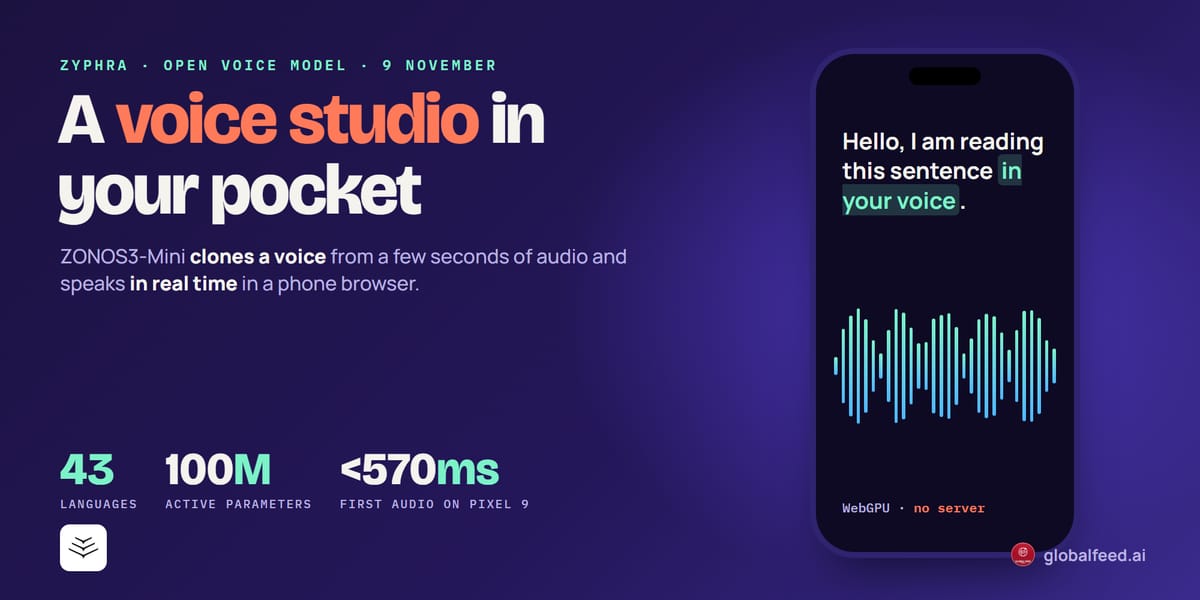
You open the browser on your phone, upload a few seconds of someone's voice, and half a second later that voice starts reading the sentence you typed. No server, no install, no service sending audio over the internet. The model runs on the phone's own GPU. That is exactly what ZONOS3-Mini, announced on 9 November by the California AI company Zyphra, does, and it speaks 43 languages.
ZONOS3-Mini is a text-to-speech (TTS) model: it turns writing into a human voice. What stands out is that it does the job of big cloud services with a very small compute load. The model has 800 million parameters in total, but only 100 million of them work at each step. According to Zyphra's measurements, the first audio arrives in under 570 milliseconds in the browser on a Pixel 9 and under 150 milliseconds on an M3 MacBook Air. The model files are on Hugging Face under Apache 2.0, free to use, commercial use included.
What it can do
The model has three main abilities. The first is voice cloning: give it a sample of up to 60 seconds and it captures the voice without even needing a transcript. The second is voice design: to create a character voice that does not exist, you can set age, gender presentation, accent and vocal texture (soft, raspy, bright, deep). In Zyphra's samples, the same speaker talks with American, Southern English and Australian accents, and as if 25, 45 and 75 years old.
The third, and perhaps the most interesting, is directing delivery word by word. In one sentence you can whisper only "she took the keys", read a line with relief, restrained anger or nervousness, and set pace, projection and liveliness separately. A single generation can run up to 10 minutes. Zyphra also released an edit model that changes a single word inside a generated sentence without disturbing the rest. For games, audiobooks and voice assistants, that is like fitting a voice studio in your pocket.
How it was trained
Zyphra trained the model on 112 NVIDIA H100 GPUs in 2.5 days. In its post, the team explains that its previous model, ZONOS2, used a mixture-of-experts (MoE) design to ease the trade-off between quality and speed, but did so with 8 billion parameters and an audio codec running at 86 frames per second. A model that large did not fit on a phone. ZONOS3-Mini changes four layers of the stack.
The first change is how sound is represented. A TTS model does not produce audio directly; it first uses a codec that turns sound into small pieces, a kind of "audio alphabet". The Descript Audio Codec used before gave very high fidelity, but at 86 frames per second it was hard to model and slowed real-time speech. Zyphra trained its own codec, Zyphra Audio Codec 1 (ZAC-1). It produces only 15 frames per second, each with 10 codebooks: one carrying meaning and nine carrying timbre and detail. The meaning codebook was distilled from a speech model called Wav2Vec2-BERT. By the team's measurement, with similar data a model trained on ZAC-1 makes ten times fewer word errors than one trained on DAC and sounds closer to the speaker.
The second change is the backbone. Methods developed for large language models were carried over to speech. The backbone has 11 layers: 9 are Gated DeltaNet layers, fast at long context, and 2 are classic global attention layers. The mixture of experts has 64 experts, with the best 2 used at each step. Two more techniques, Q balancing and attention residuals, were added; the team writes that they significantly improved performance at this scale. Text is split with an 8,192-entry SuperBPE vocabulary.
The third change is how the speaker is represented. ZONOS2 used Qwen3-TTS's speaker encoder; ZONOS3-Mini switches to a speaker verification model called MECT-B2. This improved the similarity of cloned voices and made it easier to shift a voice in age or accent. The model takes a voice in two ways: placing the sample clip directly in context (more natural, but it does not copy prosody exactly), or using a single numerical summary of the clip. The first was learned from the start of training, the second in a short stage afterwards. Finally the model went through two post-training stages: preference training (DPO), then Group Relative Policy Optimization (GRPO). The goal is robustness against errors such as skipped or repeated words.
Delivery control is built in an interesting way too. Emotion, pace, projection and liveliness are set with activation steering, which nudges the model's internal activations in chosen directions. For word-level control, the team uses attention heads that track which word the model is reading at each moment, so a whisper or emphasis turns on only on the chosen words.
How it was measured
Zyphra measured the model with its own new benchmark, ZTTS2-Eval. The benchmark includes clean read speech in 35 languages (FLEURS-R) and in-the-wild recordings in 20 languages (VoxBlink2). Generated audio is transcribed with Qwen3-ASR, and with Whisper Large v3 for lower-resource languages, to compute error rates; speaker similarity, rhythm and pitch are measured separately. All of this is combined into a capability index of 420 items. On that index ZONOS3-Mini ranks first among open models, followed by Fish S2 Pro and MOSS TTS v1.5. On a single H100 with 8 concurrent requests, the first audio arrives in 80 milliseconds; at peak throughput the card produces 457 seconds of audio per second.
How to try it
The easiest way is the browser. The Zonos Voice Studio page runs the model on your computer's or phone's GPU through WebGPU; the model downloads on the first visit and the browser keeps it afterwards. For quick voice cloning there is a lighter Lite version. Your browser needs WebGPU support.
For your own server, SGLang-Omni offers an OpenAI-compatible speech endpoint. After installing it, two commands are enough:
sgl-omni serve --model-path Zyphra/ZONOS3-Mini --port 8000

curl -X POST http://localhost:8000/v1/audio/speech \
  -H "Content-Type: application/json" \
  -d '{"input": "Merhaba, bu ses ZONOS3-Mini ile üretildi."}' \
  --output cikti.wav
To clone a voice, add the path of a reference clip to the request; to receive audio as it is generated, turn on streaming. Zyphra's GitHub repository also has a CUDA server for NVIDIA GPUs, an MLX server for Apple Silicon and a C++/GGML build that also runs on the CPU.
What to watch for in less covered languages
The 27 preset voices that ship with the model cover 10 languages; for other languages, cloning your own reference recording gives the best results. The normalizer that turns numbers and dates into spoken words works in nine languages only; in the others text goes to the model as written, so writing numbers and dates out in words is safer. When cloning, getting the voice owner's permission is the right path, ethically and legally.
All results shared are Zyphra's own measurements on a benchmark it built. A voice model that runs on a phone without a connection, speaks dozens of languages and is open for commercial use opens a new door for developers building voice apps; testing it with your own sentences will show its real quality best.
Sources: Zyphra: ZONOS3-Mini, Hugging Face model page, GitHub, ZTTS2-Eval

