
The pocket-sized voice model that runs without a graphics card: inside Kitten TTS 2 Mini
KittenML's 82 MB Kitten TTS 2 Mini speaks 16 languages with 118 built-in voices on an ordinary processor. Here is how to try it and how it was trained.

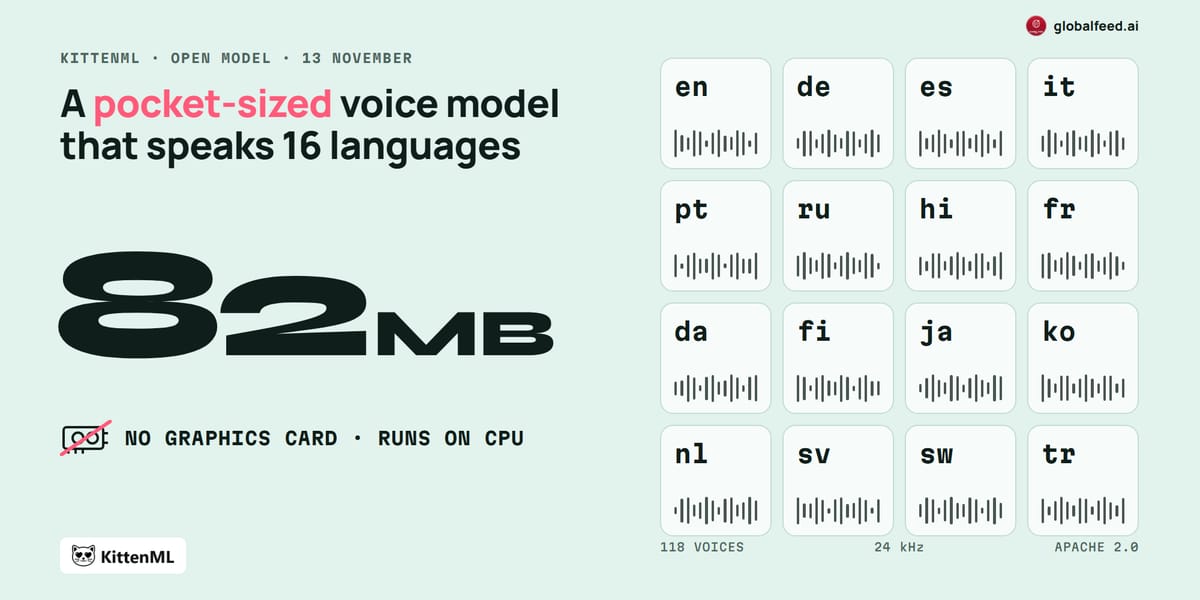
Text-to-speech that sounds natural usually means a powerful graphics card or a cloud service. On 13 November the KittenML team released Kitten TTS 2 Mini, a model that pushes the other way: 82 million parameters, 16 languages, 118 built-in voices and 24 kHz audio, in an int8 ONNX file of just 82.7 MB that runs on an ordinary processor. No GPU, and no PyTorch needed.
Why a tiny voice model matters
The most natural-sounding voice models have grown to billions of parameters, which puts them on expensive GPUs or behind an internet connection. A small model is the opposite: think of a pocket radio next to a concert hall. It goes anywhere, works offline and is easy on memory and battery, which opens the door to offline assistants, screen readers on old laptops, embedded devices and apps where the text never leaves the device.
Mini, nano and pico
KittenML shipped three small models the same day, each as an int8 ONNX graph for CPU and float32 PyTorch files. Mini is one 82M model for 16 languages. Nano uses a separate 17M model per language (17.4 MB each, 8 languages, 37 voices) and Pico goes down to 7.2M per language (8 MB each, 30 voices). Mini adds Danish, Finnish, Japanese, Korean, Dutch, Swedish, Swahili and Turkish to the eight languages of nano and pico. The larger 1.7B Kitten TTS 2 from September, with voice cloning and emotion control, sits above them under a different license.
Voices and how to try it
Each voice is a first name. The English voices come with characters, from a somber historian to an energetic sports announcer, and in Mini they can also speak German, Spanish, Italian, Portuguese and Russian under the same name. The voice sets the language. Trying it takes three steps: pip install kittenml, m = KittenTTS("KittenML/kitten-tts-2-mini"), then m.generate("Hello there.", voice="Eleanor") and save the result at 24 kHz. speed changes the pace, generate_stream reads long text in chunks of up to 350 phonemes, and backend="torch", device="cuda" runs the float32 version on a GPU. We recently covered ZONOS3-Mini, a small model that clones voices; Kitten TTS 2 Mini instead focuses on built-in voices and a tiny footprint.
How it was trained
KittenML has not published a technical report or the training data. The repository's configuration and documentation still show a lot. Text becomes phonemes first: for English, number and date normalisation, the misaki lexicon, CMUdict and a 0.75M BART model for unknown words; for other languages, espeak-ng. A 12-layer ALBERT-style encoder reads the phonemes in context, a prosody predictor estimates duration, pitch (F0) and energy, and an iSTFTNet decoder produces the 24 kHz waveform. Each voice is a 510 by 256 style pack. Checkpoint paths point to two training stages, the second saved at step 160,000, in a run dated 3 November 2026.
The int8 files come from quantization-aware distillation from the float32 model: the text side and prosody predictor first, then the decoder, each trained through the exact int8 rounding the graph uses. KittenML reports the same Whisper character error rate as float32, speaker similarity of about 0.999 and a median pitch difference of about zero. Dynamic int8 activation quantization, used in the 0.8 models, was tested and rejected because it caused audible spectral error and non-finite audio on some inputs.
Mini, nano and pico are released under Apache 2.0, covering the models, voice packs and pronunciation files. Independent quality tests have not been published yet; the figures here are KittenML's own. The code is on GitHub.
Sources: Hugging Face: Kitten TTS 2 Mini model card, KittenML on GitHub, KittenTTS 2 nano, pico and mini docs, Kitten TTS 2 Nano, Kitten TTS 2 Pico

