A 4B model turns one sentence into a game asset for Godot
An independent Qwen3.5-4B fine-tune draws assets in Three.js and exports them as GLB. Data and weights are open, and it runs on a home PC.

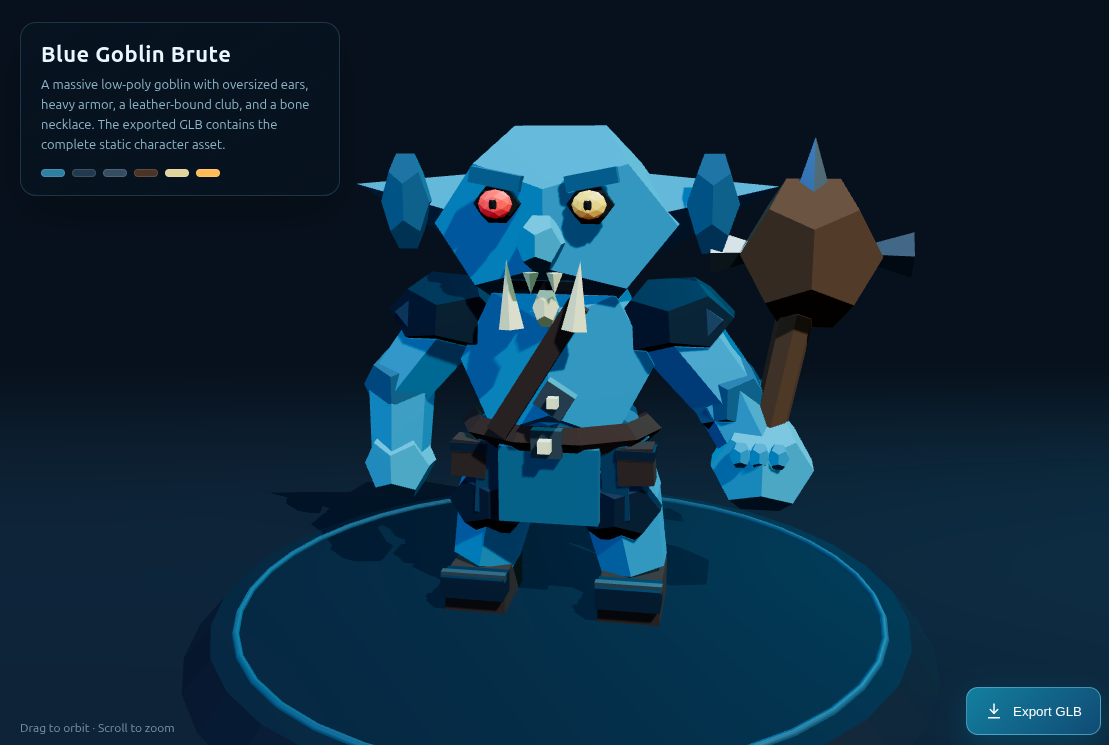
“Create a blue goblin brute.” You type a line that short, and a small 4-billion-parameter model gives you a game character, as a GLB file you can drop straight into the Godot engine. An independent developer who goes by CCORE on Hugging Face released a new preview checkpoint of GLB-3D-Coder, fine-tuned from Qwen3.5-4B, on the morning of 2 November. The model writes a single HTML file that draws the asset with Three.js; the page has an Export GLB button, and if the asset moves, the animation goes into the file too.
What this is about
One of the biggest time sinks for indie game developers is the stuff that fills a scene: platforms, towers, rocks, enemies. Modelling them one by one takes days, and buying asset packs costs money. Large AI models can write Three.js, but the result usually stays in the browser. CCORE’s model goes straight for that gap: a small model that runs on a home computer and produces assets you can carry into a game engine.
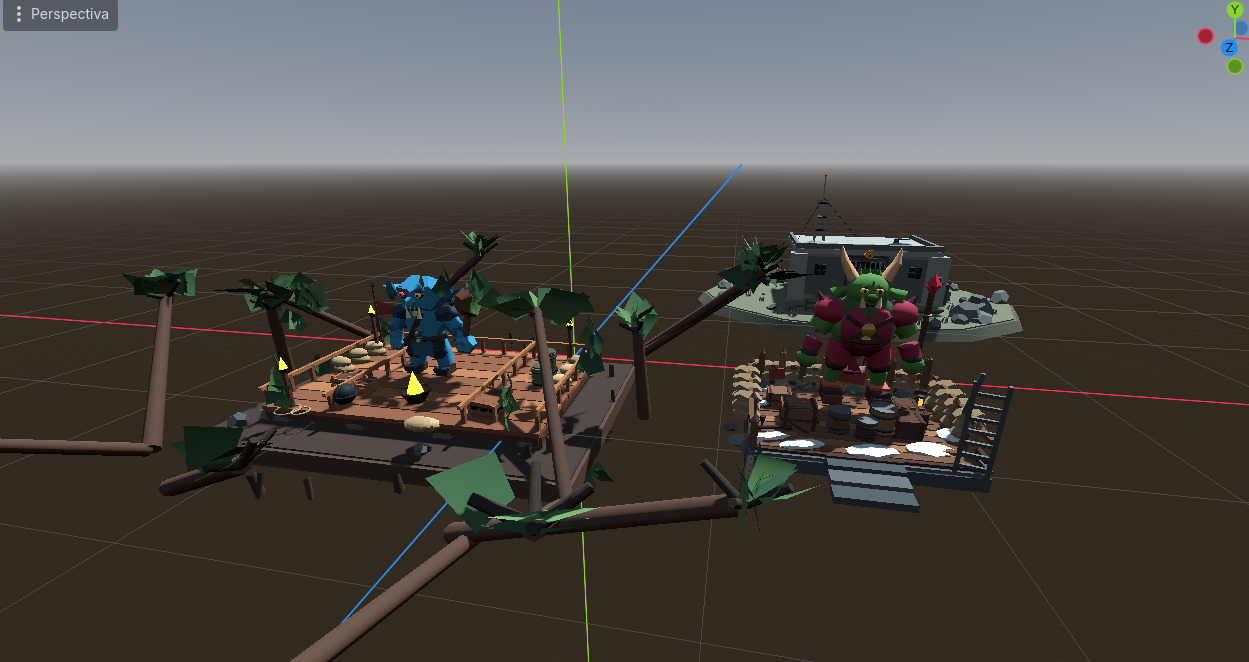
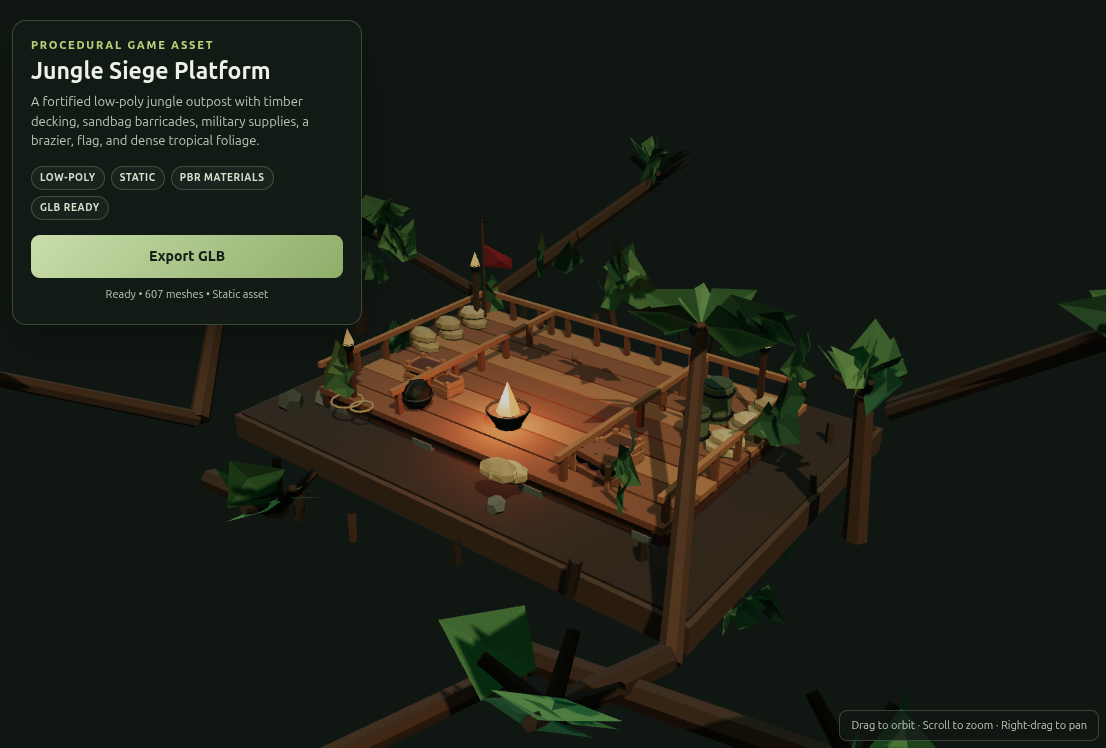
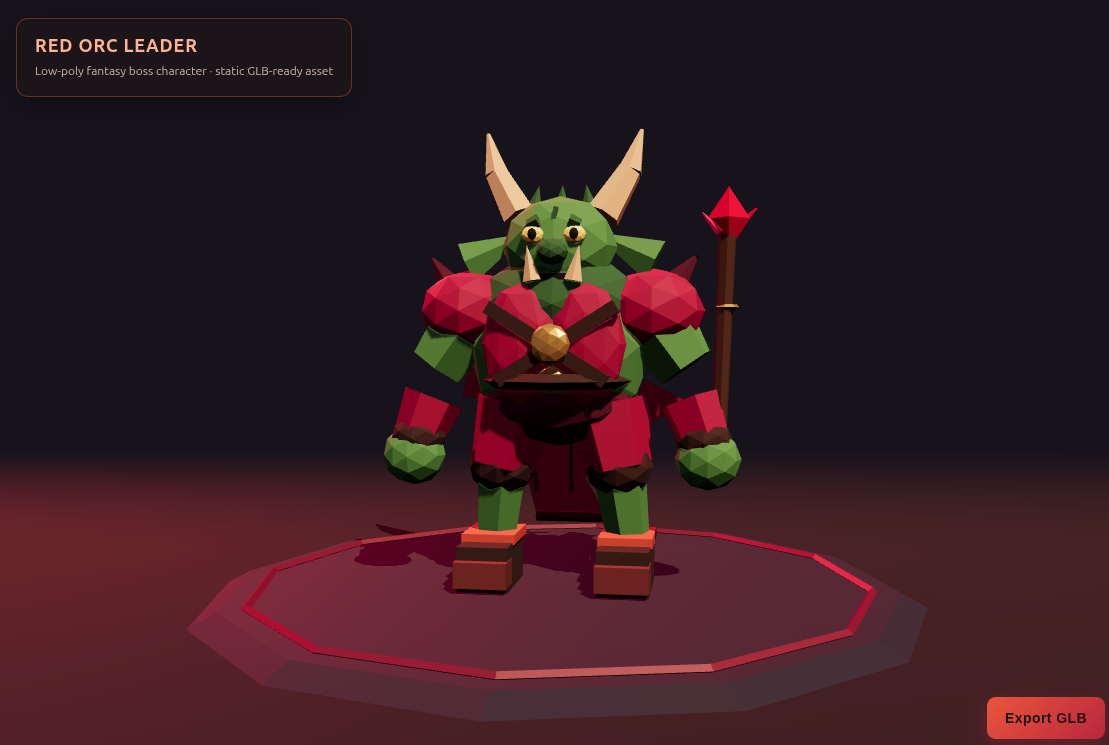
The examples on the model card show it: “Build a jungle siege platform”, “Build a weathered snow siege platform”, “Create a blue goblin brute”, “Create a red orc Leader”, “Make a reinforced mountain command post”. The developer says these prompts were not in the training data and that most generations work on the first attempt. The results are low-poly, in the clean style common in games.
How to use it
For now the model ships as two GGUF files, Q4_K_M and Q8_0, and runs locally in tools such as LM Studio or llama.cpp. You give it the system prompt from the card: create Godot-ready low-poly game assets using only Three.js in one standalone HTML file, with a working Export GLB button, and include animation when the asset needs it. Then a short English request is enough. Suggested settings are temperature 0.8, top-k 40, top-p 0.95. An optional 644 MB vision file lets you show an image and say “make this”. Some generations need a retry or a small code fix, and English prompts work best for now.
How it was trained
Training of the GLB version is still running; the developer plans to release the full weights and dataset when it ends. The method is described in detail in the technical report of the previous model, Qwen3.5-4B-3D-Coder, released on 25 October. That model drew 542 likes and over 63,000 downloads in a week.
Data. The training set has 4,146 examples generated with MiniMax M3.1 Flash: 3,933 for training, 213 for validation. Each holds the request, the model’s reasoning trace and a complete HTML/JavaScript answer. It grew in three steps, from 797 to 2,128 to 4,146 examples, covers 41 domains including objects, interiors, architecture, landscapes, mechanisms and voxel scenes, and tags each example with a complexity level from 1 to 10. The longest example is 71,229 tokens. The data is open under MIT. The developer first tried DeepSeek data and 2B models, then restarted from the official Qwen3.5-4B.
Training. The language part of the model was fully fine-tuned with the vision encoder frozen. There was no reinforcement learning, only supervised fine-tuning. Total time was about 59 hours 55 minutes: 59 hours 10 minutes of full fine-tuning and 45 minutes 20 seconds of LoRA. Each run used a single GPU, an NVIDIA RTX PRO 6000 Blackwell with 96 GB on Google Colab, with about 190 GB of system RAM for optimizer states. The chosen eighth checkpoint came after 1,956 updates and 112.9 million input tokens.
What didn’t work. This is the most candid part of the report. A short LoRA stage made it into the model, but longer LoRA branches improved at first and then got worse, with lower scene quality and more repeated variable declarations. The developer dropped them and went back to full fine-tuning. In evaluation all eight scenes were accepted after 18 calls, six with original code and two with a small fix, while eight calls were cut off because the model got stuck in a reasoning loop before producing HTML. The report counts those openly and calls its results exploratory.
For indie studios and students making games in Godot, this is a free tool worth trying: the 4-billion-parameter model runs on an ordinary gaming PC, and it is Apache 2.0, so commercial use is allowed. It is a good starting point for filling a scene fast, building a prototype or getting into 3D modelling. The developer asks people to share both successes and failures; the next checkpoint will be shaped by that feedback.
All examples are results the developer picked, and the model is still a preview. There is no independent measurement, and we have not run the model ourselves.
Sources: GLB-3D-Coder model card, Previous 3D-Coder, Technical report, Training data, Qwen3.5-4B