Exa Monitors v2 tells your AI agent what's new on the web, now 7x cheaper
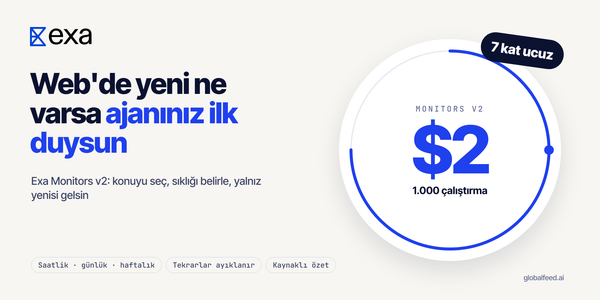
Exa's Monitors searches the web for your topic on a schedule, drops repeats and sends only what is new to your agent, with sources. It now costs $2 per 1,000 runs.

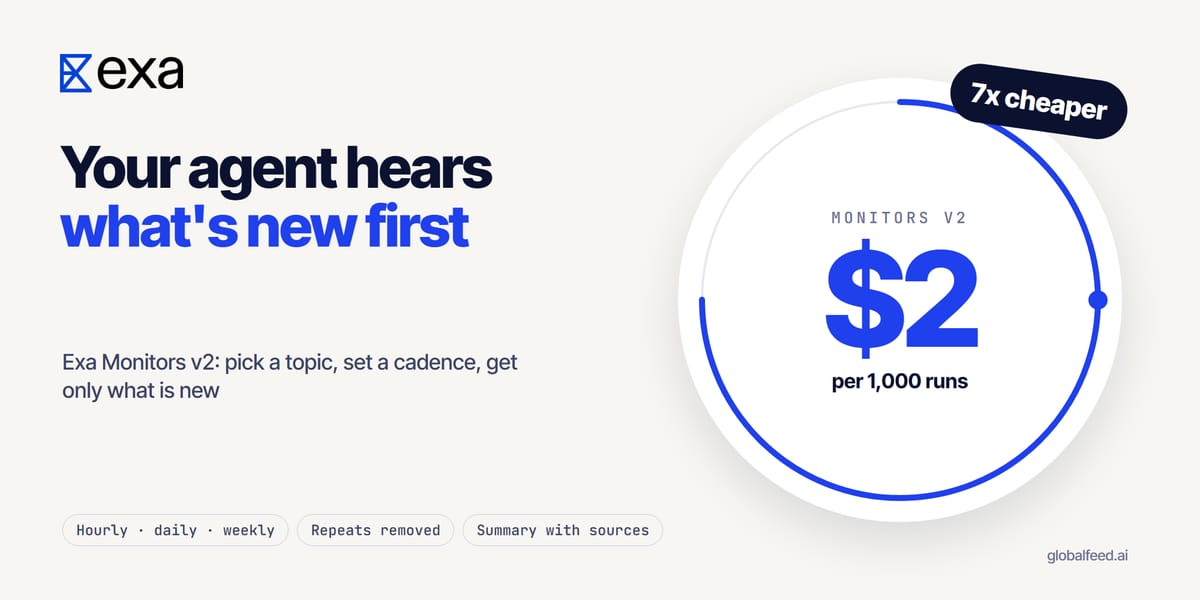
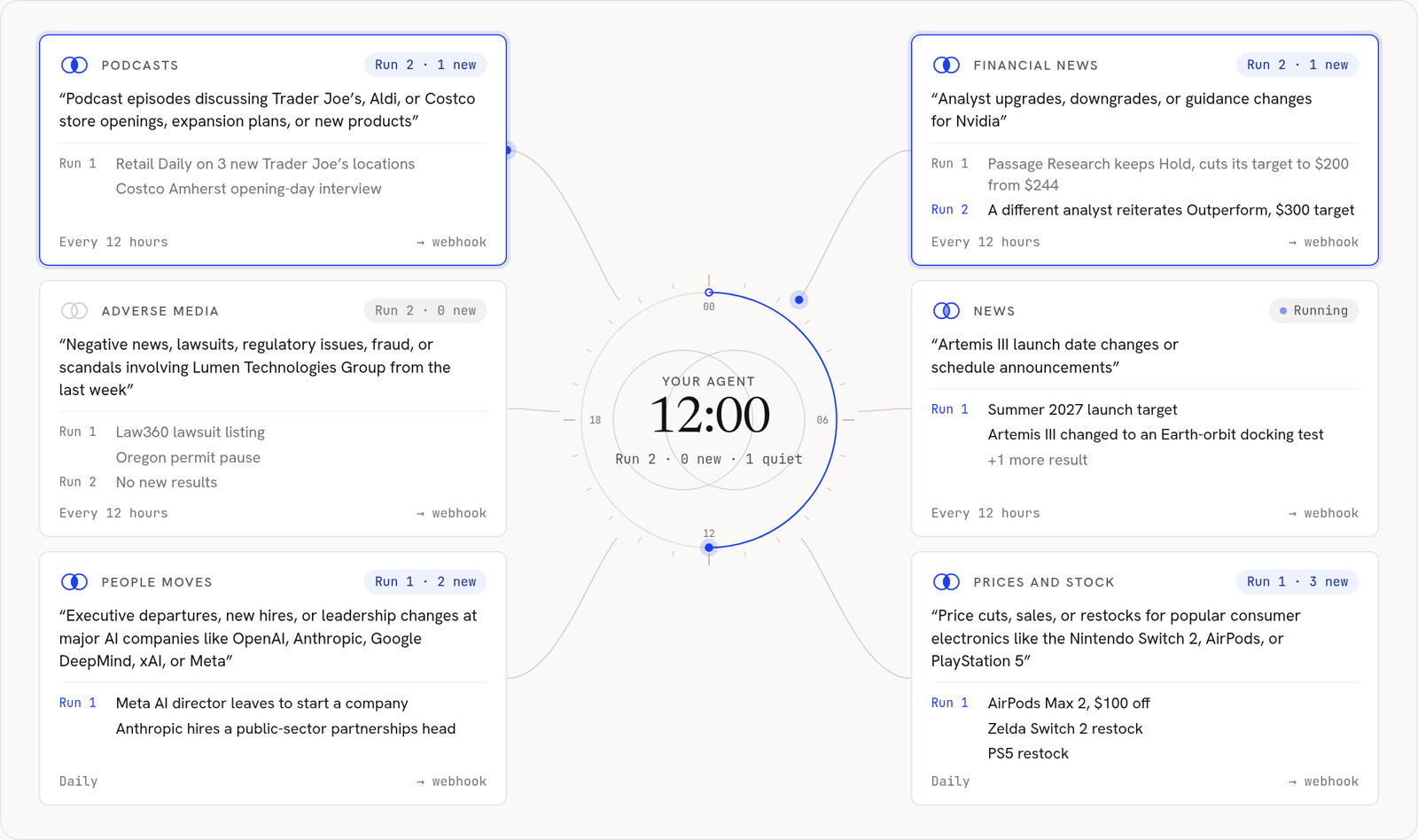
What if you were the first to know when a competitor changed prices, a company you follow hired a new executive or a new tender opened in your sector? Monitors, which AI search company Exa has just upgraded, does exactly that: it searches the whole web for a topic you choose on a schedule and sends only what is genuinely new to your AI agent or system. According to Exa’s 29 October blog post, Monitors v2 is both more accurate and over 7x cheaper: $2 per 1,000 runs, down from $15.
What this is about
Exa calls Monitors “web search on a schedule”; think of Google Alerts rebuilt for the AI era. Google Alerts sent you an email; Exa Monitors calls your agent directly. Teams that told their agents to “search this every morning” kept hitting the same problem: every run costs money but most find nothing new, the same story arrives again from different sites, and storing results, removing duplicates and delivering updates is left to the team. Exa says most commercial agents only allow 3 to 15 scheduled tasks anyway.
How it works
Per the blog post, every run goes through three stages:
- Retrieve: a search of Exa’s own web index over a time window matched to the monitor’s cadence.
- Judge: pages this monitor has already seen are dropped. The rest pass four checks: relevance, source legitimacy, new information and event timing. In the blog’s words, a new article about an old story with no new detail does not get through.
- Compose: a short summary, or JSON in a schema you define, with sources and a confidence level for each field.
The product page FAQ says repeats are filtered even when a different source reports the same news, and semantic search catches relevant stories written in different words. Running v1 and v2 side by side on real monitors, Exa says every update v2 delivered was relevant and monitors “got noticeably quieter”.
What you can watch
Exa’s examples cover a lot of ground: product prices and stock (headphones on sale, consoles back in stock), news and topics, competitors (down to a rival mentioned 34 minutes into a podcast episode) and people (executive changes, moves between companies). The blog lists portfolio intelligence for investment firms, sales triggers for sales platforms, adverse media screening for compliance teams and settling prediction markets. The product page adds lead generation, bids and RFPs and personal agents, and names HubSpot as a customer: HubSpot’s AI agents use Monitors to track funding and leadership changes and trigger CRM workflows.
The data behind it is large too: Exa says its index holds more than 130 billion web pages, 211 million business listings, 1.27 billion product listings and 3.2 million podcast episodes.
How to set it up
Monitors is part of the Exa API. Per the quickstart, one request creates a monitor: a search query, a cadence (at least hourly, such as 1 hour, 6 hours, 1 day, 7 days) and a webhook address for results. The example from the docs:
curl -s -X POST "https://api.exa.ai/monitors" \
  -H "Content-Type: application/json" \
  -H "Authorization: Bearer $EXA_API_KEY" \
  -d '{
    "name": "Battery recycling expansion",
    "search": {"query": "new battery recycling facilities announced in North America"},
    "trigger": {"type": "interval", "period": "1d"},
    "webhook": {"url": "https://example.com/webhooks/exa", "events": ["monitor.run.completed"]}
  }'
Results arrive by signed HTTPS webhook; you can trigger a monitor right away, pause it or manage many at once. Queries can include or exclude specific domains and return 1 to 100 results.
What it costs
As of 3 November 2026, the pricing page lists Monitors at $2 per 1,000 runs (up to 10 results included). By Exa’s own math, an hourly monitor costs $1.44 a month, a daily one 6 cents and a weekly one 1 cent. New accounts get $10 in free credits that renew monthly, with no payment method required.
Who Exa is
Exa builds search infrastructure for AI agents, with search, page contents, cited answers and agent APIs. In May 2026 it announced a $250M Series C led by a16z at a $2.2B valuation, and in October 2026 it said it had passed $100M in annualized revenue and serves 2 billion requests a month. Customers include Cursor, Cognition, HubSpot and OpenRouter.
For small teams in sales, marketing, investing or tender tracking, Monitors is a practical way to automate the scan an analyst does every morning for a few cents. The free credit is enough to start: one topic, one daily run and a webhook that drops results into your team chat.
Sources: Exa blog: Monitors v2, Monitors product page, Quickstart, Pricing, Series C announcement, $100M run rate