
Robots that pack pastries with tongs: how Google DeepMind's Gemini Robotics 2.5 works
Gemini Robotics 2.5 lifts success by 30% to 100% across 200+ tasks and hit 96% on a Mercedes-Benz line. Here is how it was developed.

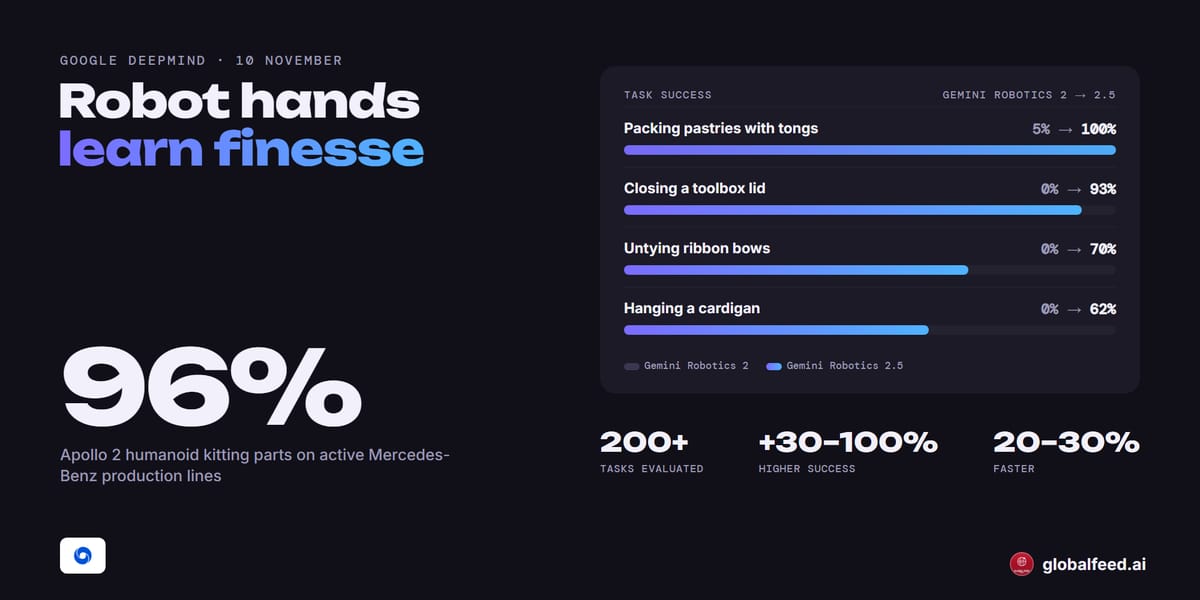
Packing pastries with tongs, tying a bow on a gift box, pipetting a liquid: simple for people, notoriously hard for robots. On 10 November Google DeepMind introduced Gemini Robotics 2.5, which it calls its most capable vision-language-action (VLA) model to date. Evaluated across more than 200 tasks, it reaches a 30% to 100% higher success rate than previous baselines, depending on the task, while finishing 20% to 30% faster.
What it does
A VLA model takes camera images and an instruction and turns them directly into arm and hand movements. DeepMind says Gemini Robotics 2.5 can control any type of robot, from tabletop arms to full humanoids, and reasons over multiple steps before acting. It works alongside Gemini Robotics ER, the "high-level brain" that plans and tracks the workflow. Against Gemini Robotics 2, DeepMind's charts show closing a toolbox lid rising from 0% to 93%, packing pastries with tongs from 5% to 100%, untying ribbon bows from 0% to 70% and hanging a cardigan from 0% to 62%.
On a real production line
Apptronik's Apollo 2 humanoid, fitted with the five-finger, 22-degree-of-freedom SharpaWave hand, performed automotive kitting on active Mercedes-Benz lines in Kecskemét, Hungary, and Sindelfingen, Germany, reaching a 96% success rate and correcting gaps as it picked. The model was also tested on the Franka Duo platform with parallel grippers.
How it was trained
DeepMind has not published a model card or technical report, so the architecture, base model and training data are not disclosed. What it does describe is the method that sped development: Gemini 4 Argon used as a simulation engine. Argon can generate thousands of varied practice runs from a single real camera scene and build a realistic digital twin; combined with real demonstrations, this helps the robot generalize to new scenes and objects, and helps researchers diagnose failures from video and test fixes in simulation before real robots. A related Google developer post reports that 4,500+ simulated episodes raised a VLA's real-world success from 56% to 75%, though not specifically for 2.5. Apptronik says the models improved dramatically after just a few weeks of post-training on Apollo 2.
Safety and availability
Inference-time reasoning steers the robot around hazards, with safe completion up 33% around obstacles and 43% around people. On the open ASIMOV-Jailbreak benchmark, Gemini 4 Argon shows 99.5% resistance. Gemini Robotics 2.5 is rolling out to robotics partners including Apptronik, Mercedes-Benz and Agile, with a waitlist for early access; Gemini Robotics ER 2 is in public preview in Google AI Studio and the Gemini API. We recently covered NVIDIA's GR00T 2 as well.
Sources: Google DeepMind: Gemini Robotics 2.5, Gemini Robotics model page, Gemini Robotics ER page, Google Developers: Gemini 4 Argon for robotics

