
A robot that learns by watching people: how NVIDIA's GR00T 2 learns a new task from five demos
NVIDIA's world-action model GR00T 2 learns from more than 400,000 hours of human video. We explain how it works, how it was trained, what it can do and where it falls short.

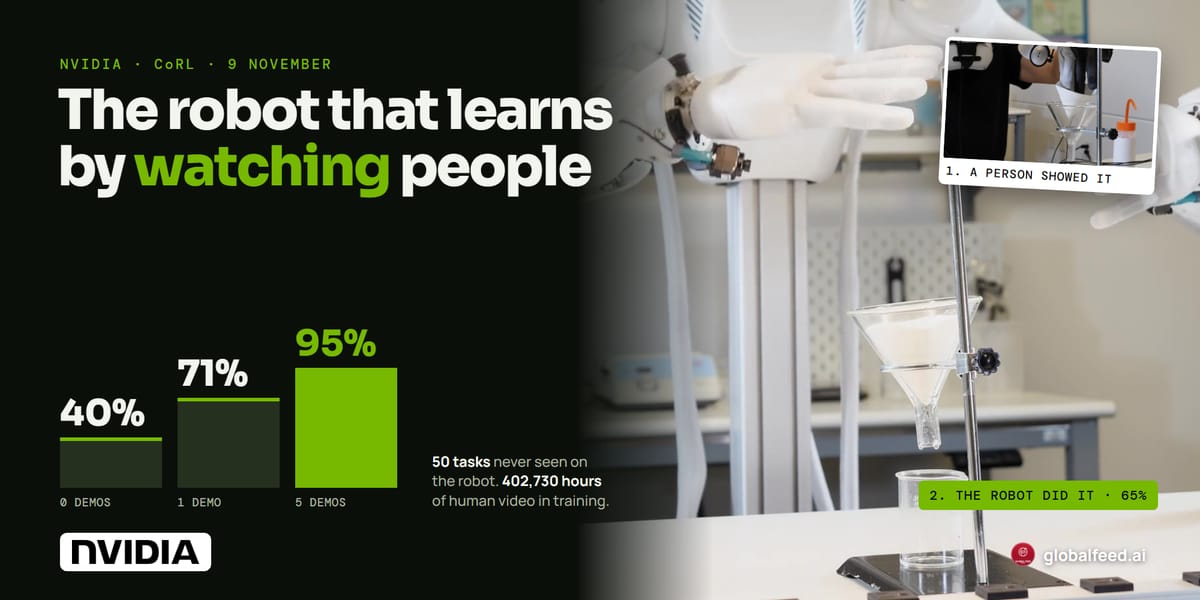
The classic way to teach a robot a new job is slow: an operator drives it by teleoperation and demonstrates the task dozens or hundreds of times. At the Conference on Robot Learning (CoRL) in Austin on 9 November, NVIDIA introduced a model that changes that equation. GR00T 2 learns from more than 400,000 hours of head-camera video of people at work. According to the project page, on 50 tasks never shown on the target robot it succeeds in 40% of trials with no extra data at all. Five demonstrations per task, under three minutes of robot data, and a 30-minute fine-tune on a single RTX 5090 lift that to 95%.
Robot data is expensive, human video is everywhere
Every hour of robot data needs a robot and an operator, while video of people working is abundant. The catch is that human video carries no robot actions. GR00T 2's answer is to learn to predict the world as well as to act. NVIDIA calls it a world-action model: alongside each action chunk, it generates video of how the scene will look. Because predicting future video is a shared goal for every clip, human video without any robot actions becomes direct training signal. Think of an apprentice watching a chef: before ever touching the dough, they learn what happens when an egg cracks.
How it works
At each step the model reads the last 0.8 seconds from up to four cameras, the robot's state and a language instruction, then outputs an action chunk together with predicted future frames for every camera. A single diffusion transformer denoises future video and actions together, and action tokens can attend to the future frames being generated, so the motion follows the future the model imagines. Small per-robot heads turn the plan into motor commands for grippers, five-fingered hands or a humanoid.
How it was trained
Data: 402,730 hours of egocentric human video, 10,184 hours of handheld UMI gripper demonstrations across 2,897 tasks, and 23,500 hours of robot teleoperation from YAM and Franka arms, Sharpa and Wuji hands and the Unitree G1. 100,000 hours of the human video are open on Hugging Face as Human-1M-100K under CC BY 4.0.
Architecture: GR00T 2 starts from Cosmos-Predict2.5-2B, a 2-billion-parameter video diffusion model. A frozen Wan 2.1 video VAE compresses each camera stream, a frozen Cosmos-Reason1 model encodes the instruction, and video and actions are trained together with flow matching.
Three stages: first, single-view human video adapts the video model to hands interacting with objects; second, robot-specific state and action modules are added and video and actions are trained jointly on multi-view data, with tracked hand poses standing in for human actions; third, robot data, especially YAM, gets more weight. Real-robot reinforcement learning follows, using a GRPO-style objective whose basis was found by AutoRL, a research agent that iterated in simulation for about 35 days. It lifts three contact-rich insertion tasks from 40-76% to 88-96%.
Does human video help? Four models trained on none, 1%, 10% and 100% of the human video improved real-robot task progress from 50% to 70% across 72 tasks, with no plateau at the largest scale. Pretraining ran on GB300 NVL72 systems, using 1,024 of a 2,016-GPU cluster.
What fell short: the lighter Turbo variant loses only 6.7 points on the YAM arm but drops from 68.6% to 34.3% on dexterous-hand tasks. The model sees just 0.8 seconds of history, treats force only as an output, and in three of eight long-assembly failures both the model and the agent judged half-driven screws as done.
What it can do
Taught chemistry-lab tasks only by people wearing gloves and cameras, a two-handed Dexter robot lines a funnel with filter paper and wets it in 65% of trials, where GR00T 1.7 scores zero. Shown only with a handheld gripper, the YAM arm assembles a toy dump truck in 60% of trials. Dexter's 22-DoF Sharpa hands seat GB300 memory modules at 85%. With a reasoning agent splitting tasks into steps, YAM completes at least 97 of 100 back-to-back assemblies for each of three toys. GR00T 2 Turbo runs on the Unitree G1's own Jetson Thor at 124 ms per prediction and served popcorn in all 48 trials.
Is it open?
NVIDIA describes GR00T 2 as an open world-action model built on Cosmos. As of 12 November the model files were not yet on Hugging Face, while the 100,000-hour human video dataset and the technical report are available. Nexuni, Foxconn and Siemens are testing it, according to NVIDIA. The headline lesson: much of what a robot learns need not come from robot data.
Sources: NVIDIA GR00T 2 project page, NVIDIA Blog: CoRL announcement, GR00T 2 technical report

