
AI agents spend most of their time waiting: how Agent Substrate fits millions of them
Open-source Agent Substrate snapshots idle agents and restores them onto free workers, aiming for 10x density on Kubernetes. We explain how it works and what NVIDIA contributed.

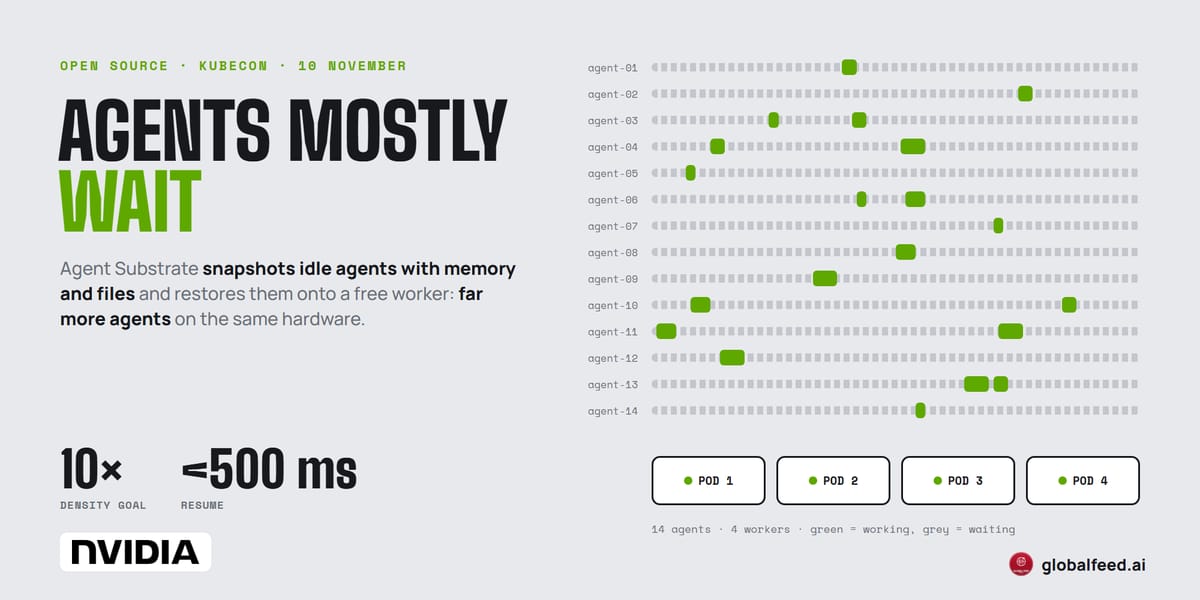
Watch an AI agent for a day and you will see what it does most: it waits. It takes a step, runs a command, then waits for a model reply, a tool result or a human approval, sometimes for milliseconds, sometimes for minutes. That simple observation describes the most expensive problem in running agents at scale. On 10 November NVIDIA published a technical post on its contributions to Agent Substrate, an open-source project built to solve it, and on how the project works with NVIDIA's inference stack. The goal is ambitious: run millions of agents securely at 10x the density of standard containers.
Kubernetes was not built for waiting
Kubernetes was designed for a small number of long-lived services, where a few seconds of startup do not matter. Agents wake, take one step and wait, and their filesystem, processes and working directory must persist between steps. According to NVIDIA, teams face two bad options: keep a warm Pod per agent and pay for idle compute, or create Pods on demand and pay a multi-second cold start every step. Think of a restaurant that reserves a table for every customer, even while they step outside for a call.
How Agent Substrate works
It uses Kubernetes for a small pool of ready worker Pods and adds a control plane that maps a large set of "actors", agents and their environments, onto that pool. Idle actors are snapshotted with memory and filesystem and their worker is freed; when called again, they are restored onto any free worker, with no new trip through the API server or scheduler. The project's docs cite resume times under 500 ms and more than 500 activations per second; its demo runs about 250 stateful actors across 8 Pods. Every actor runs in a gVisor or Cloud Hypervisor microVM sandbox, plain containers are not supported, and credentials are injected by an egress gateway outside the sandbox, so a compromised agent holds nothing to leak.
Who it is for
NVIDIA names coding assistants that need persistent, instant environments across thousands of sessions; reinforcement learning with verifiable rewards, where runs can grow from hundreds to hundreds of thousands of sandboxes and the slowest environment idles the GPUs; and short-lived GPU sandboxes for research.
What NVIDIA contributed
NVIDIA's post says Agent Substrate has been donated to the CNCF Sandbox. The repository opened in May, its top contributors come from the Kubernetes community, and NVIDIA is one of the contributing companies. Its work includes request parking when all workers are busy, GPUs in sandboxes through Kubernetes Dynamic Resource Allocation, per-container limits in microVMs, and a vendor-neutral design to save and restore GPU state when an agent pauses for review. NVIDIA Dynamo adds agent-aware inference routing, keeping related calls on GPUs that already hold the KV cache, and feeds signals such as projected time to first token back to Agent Substrate so it can suspend or wake agents.
Honest caveat and how to try it
NVIDIA notes that APIs are still changing, GPU support is being rebuilt on DRA and parts of the Dynamo integration are experimental. The code is Apache 2.0 on GitHub, with a quickstart and a demo you can reproduce in your own cluster. Infrastructure that accepts that agents mostly wait fits far more of them on the same hardware.
Sources: NVIDIA Technical Blog: Agent Substrate, Agent Substrate GitHub

