
A 16-megapixel image in under 10 seconds: how MiniMax's open model H3-Image works
MiniMax released H3-Image, an open model that generates 4096 x 4096 images in under 10 seconds without an upscaler. We explain its architecture, training, how to run it and its license.

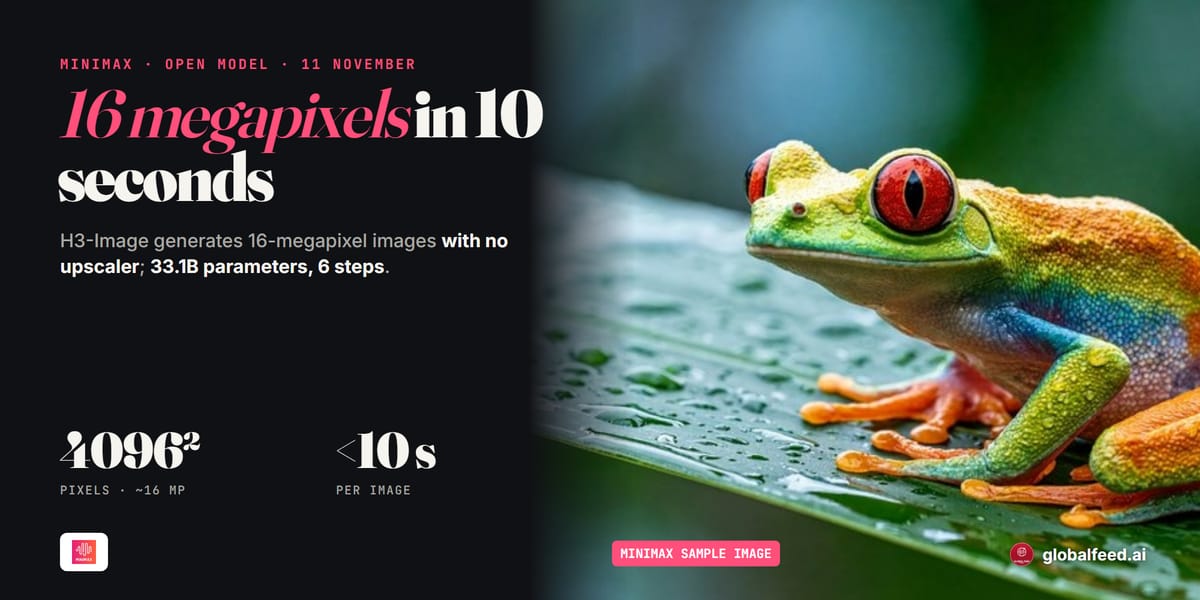
Most AI-generated images today land between 1 and 4 megapixels: fine on a phone, soft on a poster. On 11 November MiniMax released an open model that pushes past that. H3-Image generates a 4096 x 4096 image, about 16 megapixels, in under 10 seconds. One checkpoint handles text-to-image and editing, and it reads up to 16 reference images at once. The files are on Hugging Face.
Why 16 megapixels is hard
Doubling resolution quadruples the work, so most systems generate small and then upscale, and upscalers invent detail, giving the familiar smooth "AI look". According to the model card, H3-Image generates anything from about 4 to 20 megapixels directly with no upscaler, works best near 16 MP, and ships presets from 4096 x 4096 to 6272 x 2688 (21:9). It is the difference between photocopying a small print larger and painting on a big canvas from the start.
How it works
H3-Image comes from MiniMax's H3 family, a multimodal model that makes video with sound; H3-Image is that design with the audio branch removed. The Qwen3-VL-based H3 text encoder is used unchanged, and the generator reads its 50th-layer hidden states. A VAE with a CNN encoder and a 24-layer ViT decoder compresses images 16x per side into 24 latent channels; with 2x2 patches, each token covers 32 x 32 pixels, a key reason 16 MP is affordable. The diffusion transformer has 33.1 billion parameters in 50 dense, single-stream layers, with text, references and target image packed into one sequence.
How it was trained
MiniMax has not published a detailed training report. The blog says the model builds on H3's pre-training and that the work went into post-training: data, reinforcement learning, sampling-step reduction, the prompt expander and deployment optimization, with no single change making the difference. The clearest detail is speed: the released checkpoint is distilled to 6 sampling steps with no classifier-free guidance, using per-step output heads stored in a separate file, and the API rejects any other step count. Generation and editing were merged into one checkpoint. The model expects a detailed English description of the whole image; MiniMax's API expands short prompts in any language, and a 17.9 GB local prompt expander, MiniMax-H3-Image-PE, is also released. Reward signals, data size and sources, and approaches that were tried and dropped are not described.
What it can do
Showcases range from photorealism and surreal editorial shots to concept art, characters and painting styles. Two stand out: logic puzzles in Chinese and English written on a board with correct solutions, and ten references, an empty room plus nine pieces of furniture, composed into one living room. MiniMax says it leads open models in prompt adherence and runs up to 5x faster than mainstream alternatives; detailed comparison tables are not in the blog.
How to try it
Use the Hailuo app or the MiniMax API, or self-host with SGLang, vLLM-Omni, diffusers, LightX2V or ComfyUI. The BF16 transformer is about 66 GB and the text encoder another 67 GB from the H3 repo; vLLM-Omni lists hardware such as NVIDIA H200, RTX PRO 6000 Blackwell and AMD MI350X. Under MiniMax's community license, downloading, experimenting, fine-tuning and smaller-scale commercial use are open, while companies above 1 million dollars in annual revenue and hosted services need separate written permission. MiniMax hopes H3-Image narrows the gap between open and proprietary image models.
Sources: MiniMax: H3-Image announcement, Hugging Face: MiniMax-H3-Image model card

