
Rain, crowds, music: how does Inworld's open model pull a voice out of the noise?
Inworld open-sourced Voice Isolator v1 under Apache 2.0: 48 kHz, a 64M model for recordings and a 58M realtime model, trained on 10,000 hours of audio.

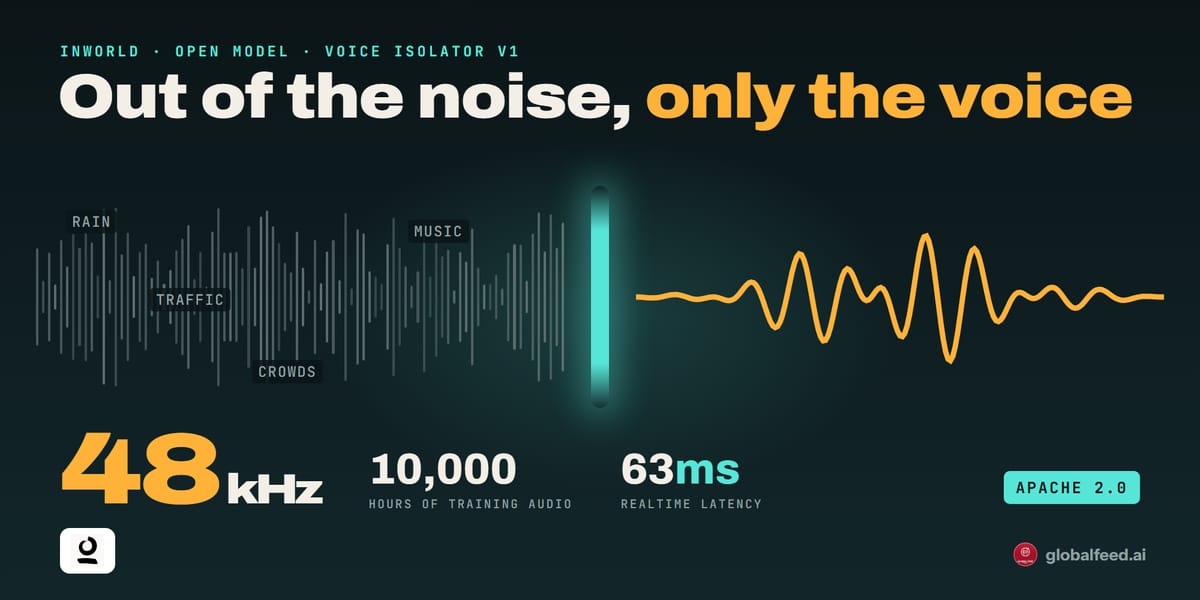
An interview recorded in a café, a video shot in the wind, a phone call with music playing behind it. All of these recordings share one question: how do you separate the speaker's voice from everything else without touching the voice itself? Inworld, known for its game and voice AI, has released Voice Isolator v1, the model it trained for this job, on Hugging Face and GitHub under the Apache 2.0 license. Both the code and the model files are free to use, modify and build into commercial products.
According to the model page, Voice Isolator works at 48 kHz, full band, music-grade quality. Many noise-removal tools work at 16 kHz, telephone quality, and cut off the bright upper frequencies of a voice from the start. Inworld's model aims to keep the voice across its whole band and clean the noise inside it. The model went up on Hugging Face on November 14 and its code on GitHub two days later.
One model, two modes
Voice Isolator comes as two checkpoints that share one architecture. The first, voice-isolator-v1, is for recorded audio at the best quality. Every frame sees the whole 8-second chunk it sits in, so when it cleans a word it also takes into account what comes before and after. Long recordings are processed in 8-second chunks overlapping by 2 seconds. It has 64 million parameters.
The second, voice-isolator-v1-realtime, is for live audio. It cannot see the future: it uses only the audio so far plus a look-ahead of 20 or 40 milliseconds. Per the model card, its algorithmic latency at 20 ms of look-ahead is 63 ms, short enough to go unnoticed in a live call or stream. It has 58.2 million parameters.
Both write two outputs: the clean voice and the removed background, which together rebuild the original mono input. That opens a side use: subtract the voice from the recording and you are left with the background alone, which Inworld suggests for extracting ambience or a backing track from a song.
How it was trained
The model card is unusually clear about the recipe. Voice Isolator v1 was trained on roughly 10,000 hours of unique audio, built as paired examples: clean recorded speech on one side, the same speech mixed with noise on the other. The model learns to take the noisy version and return the clean one.
The clean speech is broad: read and conversational speech in many languages, expressive character voices, whispers, singing, and the speaker's own non-verbal sounds such as laughs, breaths and sighs. That last part matters, because many denoisers treat a laugh or a breath as noise and delete it, leaving speech that sounds flat. Inworld trained the model to keep them.
The noise side includes household and environmental noise, traffic, rain and wind, music and crowds, sudden one-off sounds and competing talkers. The mixes were passed through measured and simulated room responses and through telephone and codec degradations, so the model meets bad real-world microphones as well as studio audio. Real recordings of the same speech, captured both clean and in rooms, complete the set.
The stated objective: return the voice as it was recorded, remove everything that is not the speaker (noise, music, other voices and the late room tail), keep the speaker's non-verbal sounds, level and timing, and invent nothing. The data combines Inworld's own recordings, data purchased from vendors and open sets credited in the NOTICE file: VocalSet, IndicVoices-R and VCTK.
What is inside
The network starts with an STFT that turns audio into a frequency picture in 10 ms frames. Each frame's spectrum is cut into 46 bands, narrow at low frequencies and wide at the top, much as the ear resolves small differences better in low sounds. Each band in each frame becomes a token, so the model processes sound the way a language model processes words.
Seven blocks refine those tokens. Four use attention along time, then across bands. Three run Mamba state-space layers along time and across bands; Mamba handles long sequences more cheaply than attention, which suits real-time use. Per-band heads then produce a bounded mask and a small residual applied to the input spectrum, a filter that decides, frequency by frequency, what is voice and what is noise. In the realtime model the blocks are causal and carry a look-ahead embedding.
The numbers
Alongside the model Inworld published VIBE, the Voice Isolation Benchmark and Evals. The benchmark page describes an eval set of 5,502 items across 77 conditions: 4,898 paired items in 13 languages, 96 noise-only beds and 508 real recordings in 128 languages, scored on ten axes covering what a system removes, what it keeps and how it sounds.
On the denoising board Voice Isolator leads with 0.768 and its realtime version follows with 0.718, ahead of ClearerVoice MossFormer2 (0.695), resemble-enhance (0.646), FastEnhancer-L (0.589) and DeepFilterNet3 (0.510). Inworld runs the benchmark itself and does not distribute the eval set, as the page states plainly, while the other systems run from their upstream releases. On the separate restoration board, recovering a dry voice from a reverberant room, NVIDIA's RE-USE models lead; Voice Isolator joins that task in version 2.
Its scope and what comes next
Inworld describes the scope clearly, which helps set the right expectations. Voice Isolator keeps the foreground voice: when two people talk at once it keeps the louder one and removes a voice a few dB quieter, and it usually keeps both when they are at similar levels. Picking one named speaker out of a group is a separate task. Version 1 cleans what surrounds the voice; bringing back what a recording lost, such as the high frequencies a phone line cut off, is the job of the planned version 2. The roadmap also lists testing on smaller GPUs, on-device support beyond Apple silicon and natural-language prompting.
How to try it
Install with pip install inworld-voice-isolation. Then voice-isolate noisy.wav clean.wav downloads the model on first use and writes two files, the clean voice and the removed background. For live audio, --mode streaming --lookahead 2 runs the realtime model, and the Python VoiceIsolator class offers a streaming session that takes audio in 20 ms pieces and returns clean audio as it goes. voice-isolate-doctor checks the machine, and the repository's AGENTS.md is written so a coding agent can do the whole setup for you.
The model is tested on NVIDIA A100, H100, B200 and B300 GPUs and on CPU, and runs on Apple-silicon Macs through Metal. Consumer GPUs are not officially tested yet, but at 64 million parameters it is a small model by today's standards and runs on a CPU as well. A browser demo cleans files in one tab and listens to the microphone live for up to 60 seconds in the other. If you produce podcasts, training videos or call recordings, it is a way to clean audio on your own machine without sending it to a paid cloud service.
Sources: Hugging Face model page, GitHub repository, VIBE benchmark

