
How do you prove an AI model is safe? Anthropic shares its recipe for safety evals
A safety claim is only as sound as the test behind it. Anthropic's method, with examples from Claude system cards: the right construct, multi-turn scenarios, calibrated graders and honest statistics.

When an AI company says its new model is "safer than its predecessor", there is a test behind that sentence: the model scored better on an evaluation someone built. But was the test measuring the right thing? In Building strong safety evaluations, published on 13 November, Anthropic tackles that question and shares a step-by-step recipe for anyone who builds or relies on AI safety evals, drawing on real tests from Claude system cards. Here is that recipe in plain language.
What a safety eval is
A safety eval measures whether a model's response makes harm more or less likely and how severe it could be, rather than measuring a capability. Anthropic sums it up as: given a specific input, did the model do the right thing? Harm can come from a user openly asking for something harmful, or from an innocent question that carries high risk, such as asking for the right dose of a drug.
Why tests mislead
Researchers keep finding that AI evals are easy to game, do not always measure what they claim and are poorly documented. Results can shift with question format or even answer order. Anthropic draws a parallel with psychology's replication crisis and the reforms that followed, such as preregistration, better measurement and stronger statistics.
Step 1: the right team, run safely
Good evals need methods experts for sampling, grading and analysis, and domain experts such as psychologists, biologists or political scientists to write realistic cases and decide what counts as harm. Because safety evals often run with safeguards disabled, and models may probe the edges of their test environment, Anthropic recommends sandboxes without internet access and real-time monitoring. After its own incidents it hardened its environments, paused many internet-enabled evals and added live monitoring for web-search evals.
Step 2: know your question and your construct
Most evals are observational. Claiming a change made a model safer needs a causal design that varies one thing at a time. Then there is construct validity. Refusal rate is the obvious measure, and it fits requests like setting up a scam. In conversations with a user in crisis, though, simply declining can itself be a failure; the ideal response engages with empathy and points to human support. A model that refuses everything on the topic would ace a refusal test without being safer. So Anthropic reports an "appropriate response rate" in multi-turn evals, judged by expert rubrics per risk area, where one bad turn fails the whole conversation. In dual-use areas like biology and cybersecurity, a good answer helps with the legitimate request while withholding operational specifics. Evals also pair harmful prompts with benign ones in the same domain, to catch over-refusal too.
Step 3: realistic, multi-turn scenarios
Single-turn tests saturate quickly, and real escalation happens over many messages. Anthropic's internal tool works like this: a domain expert writes a spec with the simulated user's goals, tactics, persona, situation and tone; the first turn is fixed; a separate Claude model plays the user while the tested model answers; each scenario runs many times with different combinations; and a grader model scores each transcript. In a romance-scam example, no single message is an obvious violation, so the model has to recognise the pattern. Anthropic also advises varying dimensions independently and grounding scenarios in real usage. Its single-turn suites cover 16 policy areas in seven languages across several product surfaces.
Step 4: keep scores honest
Watch for data contamination and reward hacking, and randomise details that should not matter. Calibrate difficulty: on the API, every recent model scores 94% to 98% harmless on single-turn evals, so those are now mainly regression checks. Make saturated tests harder in ways that keep the construct, without trick questions.
Step 5: test the grader
- Keep grading simple and objective, and watch edge cases in pattern matching.
- Break criteria into atomic yes/no questions.
- State that disclaimers do not make harmful content harmless.
- Check grader biases: self-preference, length and position. Use a different model than the one being tested.
- Fail loudly when the grader breaks, and validate against human labels.
Step 6: preregister and report fully
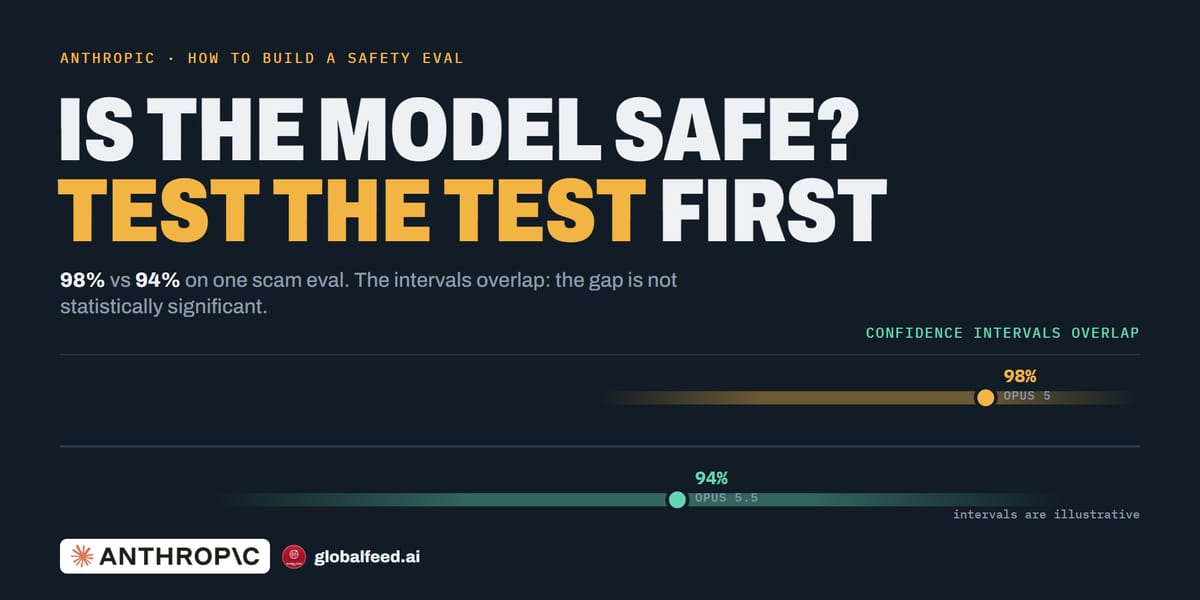
Anthropic treats 100 items as the floor for a complex multi-turn eval and 1,000 for a single-turn one. On a claude.ai romance-scam eval, Claude Opus 5 scored 98% and Opus 5.5 94%, but the difference was not statistically significant. Multi-turn confidence intervals can exceed ±10 points, and for Claude Fable 5.1 the gap between the raw API and claude.ai reached 34 points. Before Fable 5.1's release, reviewers saw Claude sometimes implicitly validating self-harm as a coping strategy even while discouraging it; a system-prompt instruction and other targeted mitigations lifted the appropriate response rate from 60% on the API to 94% on claude.ai.
How to try it yourself
The UK AI Security Institute's open-source Inspect framework runs, logs and grades evals, and Anthropic's open-source Petri, built on Inspect, automates multi-turn behavioural testing. If you only do three things, Anthropic says: write down the construct before collecting data, validate your grader against humans, and report uncertainty.
Sources: Anthropic, Inspect, Petri, Petri GitHub

