
The open model that makes a photo move like any video: how was Wan-Animate-2 trained?
Alibaba's 14B character animation model reads motion straight from video and moves the camera by text; data, training stages, what failed and results.

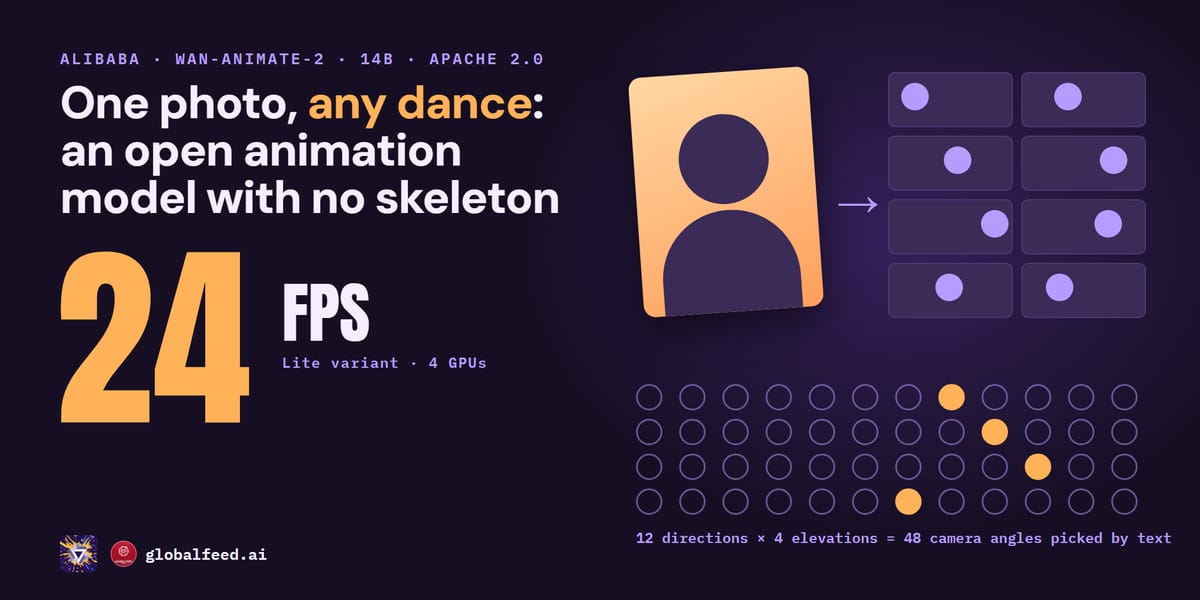
You have a photo of a character and a video of someone dancing. You want the character in the photo to perform the same dance, with the same facial expressions and the same finger movements, even if it is a cartoon cat, a robot or someone much bigger than the dancer. That task is called character animation, and so far the strongest results have mostly come from closed commercial platforms. Alibaba's Tongyi Lab has now released a new open model for it: Wan-Animate-2. The 14-billion-parameter model has been on Hugging Face since August 7, with code on GitHub under Apache 2.0, and the team's technical report walks through how it was built and trained.
Three ideas stand out. The model reads motion directly from the driving video, with no separate skeleton extractor in between. The camera angle can be changed with text such as "right 60-degree view" or "top angle". And a fast variant, Wan-Animate-2-Lite, reaches 24 frames per second for live streaming.
What Wan-Animate-2 does
Earlier systems took one of three routes. Skeleton-based methods extract a 2D pose or 3D body model first; according to the report, extraction errors carry into the output and identity drifts when body shapes differ. Implicit methods compress the video into a motion code, which loses fine detail such as small expressions, finger motion and cloth. In-context methods feed the whole video to the generator, which keeps detail but makes cost grow quadratically with length.
Wan-Animate-2 makes the third route cheaper. One branch processes the clean driving video, the other generates the new video from noise, and the reference branch is fixed at the clean timestep so noise does not leak into it. The key saving is sparse attention: frame 10 of the output only looks at frame 10 of the driver, so cross-branch cost grows linearly instead of with the product of both sequences. Giving both branches the same positional encoding destabilized training, so the team concatenates frames side by side and assigns the driver non-overlapping position indices, which keeps alignment even at different resolutions.
How Wan-Animate-2 was trained
Data. Training needs pairs of videos where different characters perform exactly the same motion, which barely exists in real footage. The team generated it with its previous model, the first Wan-Animate from September 2025. New character images were made either by editing the first frame of a reference video with Qwen-Image-Edit or by generating humans and cartoon animals with Qwen-Image and Z-Image, across full-body, half-body and close-up shots. These were paired with random videos and animated with Wan-Animate. Every sample was filtered on overall quality, motion (static or jittery clips removed) and identity consistency.
Camera angles. For viewpoint control the team rendered a synthetic dataset in Unreal Engine with 12 horizontal directions and 4 elevations, 48 views in total, labelled with plain phrases like "right 60-degree view" instead of numbers. The core transformer was frozen and only the shared attention projections were trained; the viewpoint skill is an optional LoRA on the text cross-attention layers.
Lite in three stages. First, the model learns to generate 8-frame chunks one after another, conditioned on earlier chunks. Second, an error buffer stores the model's typical prediction error and adds it to the clean history during training, so errors do not pile up at inference. Third, Self-Forcing distillation cuts dozens of steps to a few. At 14B this did not fit in memory, so the team first rolls out the whole video without gradients, scores it, then backpropagates chunk by chunk with the graph cut between chunks, making memory proportional to one chunk.
Results
The team reports a blind user study rather than a benchmark table. In overall quality, more than 70% of pairwise comparisons favored Wan-Animate-2 over the first Wan-Animate. Participants mostly preferred it over ByteDance's Dreamina, and against Kuaishou's Kling-MotionControl most rated the two as equal. Lite runs at 24 fps at 400x720 on a 4-GPU setup with 3 denoising steps.
The released files are Wan-Animate-2 Base and a 10-step distilled version; the 3-step real-time Lite model described in the report is not in the release list yet. Default settings target 8 A800 GPUs at 720p, and 480p was tested on 2 A800s.
How to try it
The easiest route is the team's ModelScope demo. Locally, clone the repo, install the Python 3.11 environment, download the files from Hugging Face or ModelScope, and provide a character photo, a driving video and a short appearance description. The model is also in Diffusers, DiffSynth-Studio and ComfyUI, and example videos are on the project page.
The user study is the team's own evaluation; independent comparisons and community tests in the coming weeks will make the picture clearer.

