
Hugging Face and Google bet on AI that decides without writing: how decision models work
Hugging Face introduced a shared interface for decision models and Google launched the Gemini Decisions API. We explain how a model scores options without generating text, the three question types and how to try one today.

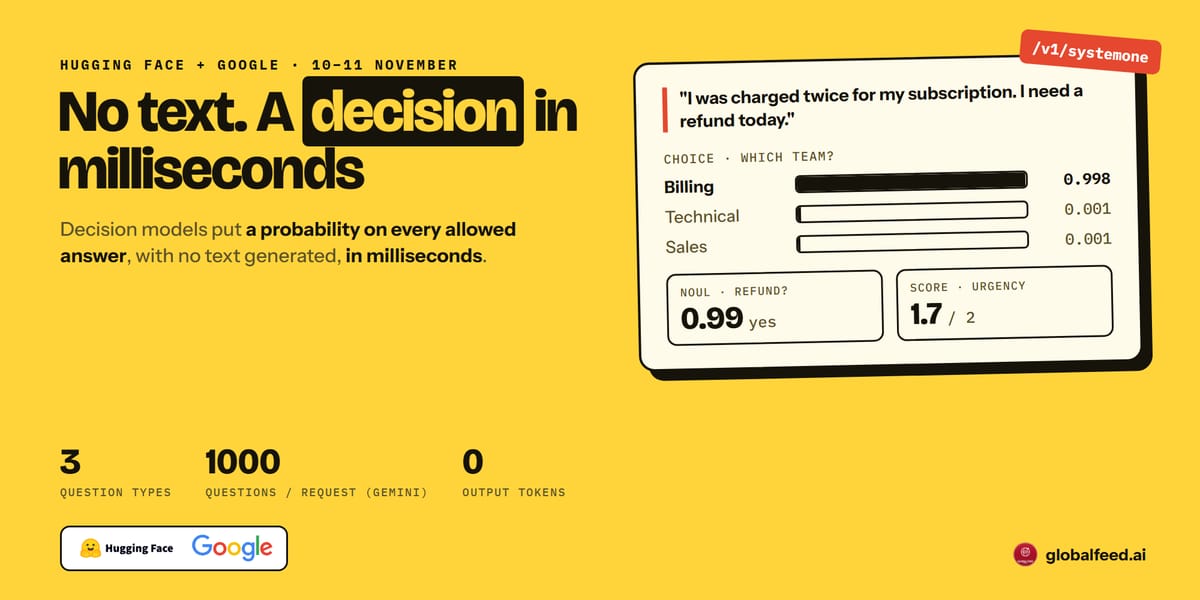
A message lands in a support queue: "I was charged twice for my subscription. I need a refund today." The system has to decide three things: which team handles it, how urgent it is, and whether the customer wants a refund. Most apps today hand that job to a large language model, ask it to write the answer as JSON, then parse the text. Two announcements on 10 and 11 November opened another path. Hugging Face introduced a shared interface for decision models, and a day later Google announced the Gemini Decisions API and its Gemini Decision 1 model, built on the same idea. The model puts a probability on each option directly, with no answer text to parse.
Here is how decision models work, how they differ from classifiers, how to try one on your own machine today, and what Google offers in the cloud.
Why generate text to pick an option?
Language models produce text token by token, which is great for open-ended questions. When an app only needs to choose between "billing, technical, sales", generating a whole response is extra work. Hugging Face lists three problems with the JSON approach: the model may break the schema or answer outside the allowed choices; constrained decoding libraries enforce structure but add overhead; and decoding token by token is unnecessary when the answers are known in advance. Think of a multiple-choice exam: you tick the right box instead of writing an essay, and a decision model also tells you how sure it is about each box.
How a decision model works
A decision model takes a state, a set of questions and the allowed answers, and returns a decision with probabilities for each question. The state can be plain text, structured JSON, or images and audio for multimodal models. Questions come in three primitives. Choice picks one of several options: the model scores each option and softmax turns the scores into probabilities that add up to 1. In the blog's example, "billing" gets 0.998. Score handles an ordered scale such as low, medium, high, and returns the expected value of the distribution: with 0.01, 0.26 and 0.72, the score is 1.7, meaning belief leans towards high. Noul, named after the Bernoulli distribution, answers yes or no by returning the probability of yes, here 0.99 that the customer wants a refund. A confidence value runs from 0 for an even spread to 1 when all probability sits on one option, so apps can send uncertain cases to a person or a bigger model.
Classifiers already produce probabilities, and zero-shot classifiers already accept labels at inference time. According to Hugging Face, the contribution of decision models is a consistent, typed interface: several named questions of different types about the same state, answered in one request. TypeSafe AI originally called its Jev model a "System One" model, after the famous split between fast, intuitive thinking and slow, deliberate thinking; the community settled on "decision model" instead.
What Hugging Face shipped
The goal is a common interface without a common implementation. Transformers now has DecisionPipeline, AutoModelForDecision and DecisionConfig, and transformers serve exposes a /v1/systemone endpoint. The same interface even works with compatible ordinary language models: Transformers builds the decision prompt, scores the answer labels in one batched forward pass and returns probabilities without generating text. llama.cpp supports the same endpoint for GGUF decision models. A new decision-model tag on the Hub lists compatible models; on 12 November it included models from Liquid AI, Perplexity, Cloudflare, Kakao and fastino, built on encoder architectures such as ModernBERT as well as larger generative backbones. Because decision models live inside Transformers, the Trainer API can fine-tune them; the blog fine-tunes JEV-9B to route support tickets with a plain cross-entropy loss. Native TRL support is in an open pull request, and Unsloth offers a recipe to turn models such as Qwen into decision models with LoRA.
How to try it
from transformers import pipeline

decide = pipeline("decision", model="autotrust/GEV-26B-Decide")
decide({
  "state": "I was charged twice for my subscription. I need a refund today.",
  "questions": {
    "team":   {"type": "choice", "instructions": "Which team should handle this?",
               "criteria": {"billing": "Payments and refunds", "technical": "Bugs and issues", "sales": "Pricing and plans"}},
    "urgency": {"type": "score", "instructions": "How urgent is the request?",
               "criteria": ["low", "medium", "high"]},
    "refund":   {"type": "noul", "instructions": "Is the customer requesting a refund?"}
  }
})
The reply carries the chosen answer, the probabilities and a confidence value for each question. To run locally, llama serve -hf ggml-org/Kev-4B-GGUF starts a small decision model on port 9931, and the same JSON goes to http://localhost:9931/v1/systemone.
Google's cloud version
The Gemini Decisions API uses the same three question types. Google says Gemini Decision 1 scores options in a single forward pass with 150 to 250 ms end-to-end latency, accepts text, images, audio, video and PDFs in one input, and handles up to 1,000 independent questions per request, with 2 to 255 options per choice. Its example checks a photo of a breakroom counter before a client meeting: is there a spill, which cleanup step fits, how severe is the mess. Inside Google, Gemini Notebook uses it to route queries to the right model tier, with up to 40% lower latency on everyday queries according to Google; CC from Google Labs picks an emoji reaction from more than 200 options; and Google Search uses it as a safety layer for MCP tools. Google's listed price on 11 November was $0.10 per million input tokens with no output tokens billed, and the shared input is billed once per request however many questions are asked. A free tier is available in Google AI Studio.
Where it helps
Decision models shine wherever the answer comes from a known set: routing tickets, choosing an agent's tool, sending a query to a small or large model, checking content against a policy, grading against a rubric. Because every decision comes with a probability, apps can set a threshold and pass uncertain cases to a person. If Hugging Face's shared interface sticks, an app built on one decision model could switch to another with a one-line change. Language models learned to talk; now they are learning to decide quickly and measurably.
Sources: Hugging Face: Decision Models, Google: Gemini Decisions API

