
Claude's agents on your own servers: how Managed Agents' four security principles work
Anthropic opened a private beta that lets Claude Managed Agents run entirely in an organization's own cloud or on-premise. We explain what changed and the four principles of agent security.

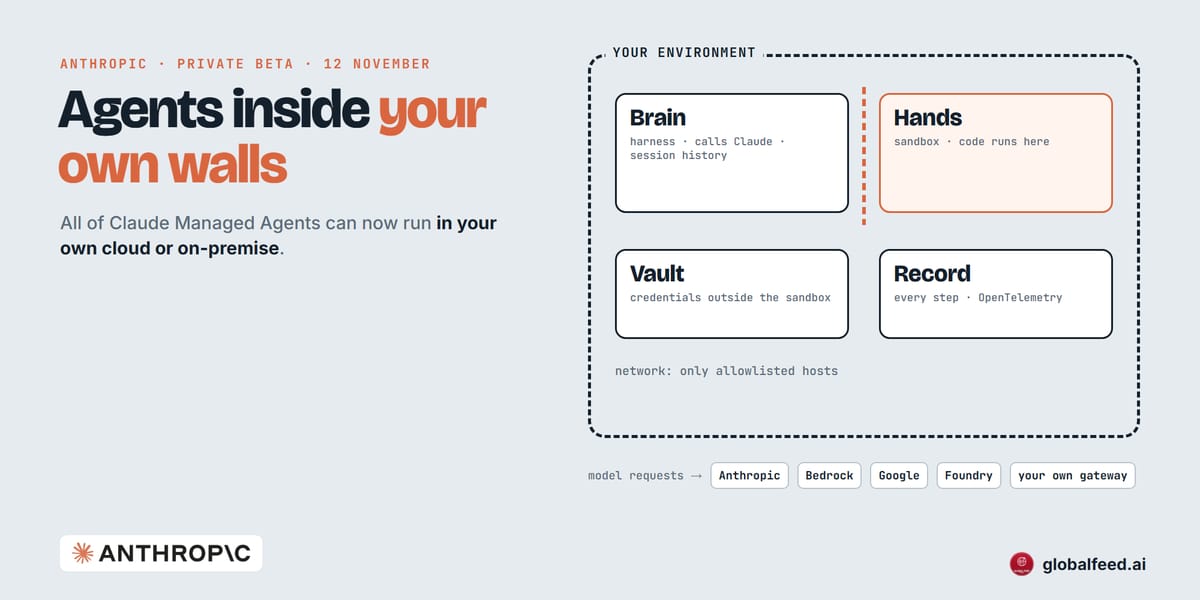
AI agents now fix broken builds, test releases, triage alerts and work through bug backlogs, unattended, inside a company's code and internal systems. Where such a powerful agent runs is therefore a real question. On 12 November Anthropic gave a new answer: Claude Managed Agents can now run entirely in a company's own cloud or on-premise. The agent's harness, sandboxes, credentials and session history stay in the organization's environment, and requests to Claude go wherever it chooses. The option is in private beta.
What Managed Agents is, and what changed
Managed Agents is a suite of composable APIs for building and deploying long-running autonomous agents, providing the harness, sandboxes, credential handling and session history. Anthropic first ran it as a hosted service, then added self-hosted sandboxes. Now the whole service can be self-hosted: the organization operates the Managed Agents server, its database and the workers where agents run shell and file tools. Model requests can go to Anthropic directly, to Amazon Bedrock, Google's Agent Platform or Microsoft Foundry, or to the organization's own gateway, and developers keep using the same core APIs. Session history lives in the organization's database, and an existing zero-data-retention agreement applies to Claude requests as with any Messages API call.
Four principles for agent security
Because no person can check every step of an unattended agent, Anthropic says the limits must be built into the system. The brain and the hands are split: the harness calls Claude, the sandbox runs code, and the loop, history and vault secrets stay outside the sandbox, which starts only when a tool needs it. Credentials stay out of the sandbox: a proxy outside adds credentials to MCP and supported API requests, and self-hosters can use their own secrets manager. Network access can be limited to an allowlist, such as just a git host and package registry for a build-fixing agent. Every session leaves a full record of steps, tool calls and results, exported over OpenTelemetry to existing monitoring tools.
Why it matters
This same week, Microsoft Research's Lazarus study stressed model provenance and limited agent permissions, and the open-source Agent Substrate project kept credentials away from agents. Anthropic's principles turn the same lesson into a product: balance the access that makes agents useful with limits built into the system. Self-hosted Managed Agents is in private beta; teams request access through their Anthropic account team, with details in the release notes.
Sources: Claude: Self-hosted Claude Managed Agents, Claude Platform release notes

