
The underground market reselling other companies' AI access: how LLMJacking works
Google Threat Intelligence Group and Mandiant walk through LLMJacking, where stolen cloud access is used to run and resell companies’ model accounts. How it works, the traces it leaves in logs and the settings teams can switch on today.

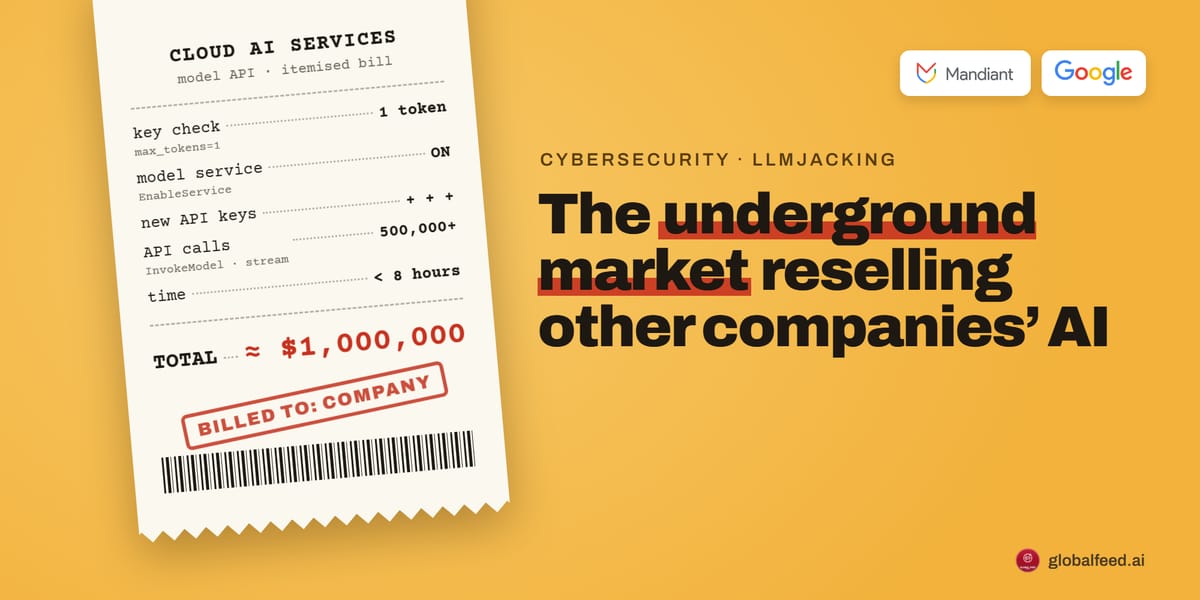
A company's AI bill passes $100,000 in a single day, and at some organisations the total reaches $1 million before access is cut. The company pays, while the models are used by underground customers who bought that company's access at a discount. A report published on November 3 by Google Threat Intelligence Group (GTIG) and Mandiant walks through this technique, known as "LLMJacking", step by step: attackers use stolen cloud access to take over companies' large language model accounts, then resell that access through relay services they run themselves.
According to the report, Mandiant responded to several such incidents in 2026 at organisations in financial services, retail, technology and transportation across North America, South America and Asia Pacific. The cases span several cloud and model providers. The useful part: every step of the attack leaves traces in cloud logs, and half of the report is about how to catch them. Below we explain how the technique works, what to look for in the logs and which settings teams can switch on today.
The idea: selling fuel on someone else's company card
Think of a fuel card a company hands out for its vehicle fleet. The card is stolen, and the person holding it fills up their own car and also sells fuel at half price to other drivers waiting at the station. At the end of the month the bill lands on the company's desk. In LLMJacking, the fuel card is a cloud access key and the fuel is the tokens processed by large language models. A token is each small piece of text a model reads or writes, and cloud providers charge for model use per token.
Secretly mining cryptocurrency on someone else's servers (cryptojacking) has been around for years. The report puts the difference this way: cryptojacking eats resources gradually, while LLMJacking can produce large billing spikes within hours. Sending high-volume requests to the most capable models costs far more than running mining software on a server. GTIG also describes a division of labour: one group breaks into the company, while another runs the infrastructure that turns the stolen access into money. The report calls these relay services "LLM Mixers".
The way in: exposed endpoints and leaked keys
Attackers skip front ends such as customer support chatbots and go straight for the model resources behind them. One route is model servers left open to the internet. The report shows an attacker probing exposed Ollama servers with an automated script and calling the /api/create endpoint to register their own models on them. Ollama is one of the most common ways to run models on your own machine; by default it only answers requests from the same computer, and exposing it to the internet takes a separate setting.
Across the incidents Mandiant investigated, the most common entry point was stolen or exposed cloud identity credentials: IAM credentials, service account keys, GitHub personal access tokens (PATs) and active session tokens. In mid-2026 the group tracked as UNC6993 got into a cloud instance through a misconfigured service account key and used that access to grant itself model API permissions. The same group set up a page posing as an application portal for joining a group of model users. It sent people to the real model service's website and asked them to paste back the raw JSON containing an active access token. Once that token reached the attackers' backend, the password and multi-factor authentication (MFA) steps were bypassed.
In other cases attackers combined a stolen PAT for private code repositories with a suspected web application flaw in a package running in a container environment. Another used corporate users' IAM credentials and cloud federation tokens to generate fresh access keys, getting around MFA that way. Model API keys accidentally pushed to public GitHub repositories are a target too. One detail stands out: a group tested whether such keys worked with tiny requests set to max_tokens=1, asking for a single token. That let it learn which keys were usable without tripping volume-based alerts.
Inside: hunting for keys and building back doors
Once in, the attacker maps the surroundings. The report describes mapping services and identity policies across several cloud regions, cloning code repositories to search for hardcoded passwords and developer keys, and scanning access logs for credentials to other environments. In one case the attacker queried a data warehouse's metadata tables for columns holding database passwords and administrator details. Through a service account with token-creation rights, temporary credentials were generated for high-privilege accounts, and infrastructure keys and third-party API keys were pulled out of cloud secret managers.
For persistence, attackers created unauthorised admin accounts and added SSH keys to virtual machines. One disguised back-door service accounts as harmless "billing optimisation" utilities. Routing software is a target as well: in LiteLLM, an open-source gateway that manages traffic to several models from a single point, a flaw in the /key/regenerate endpoint (CVE-2026-40217) was used to raise ordinary virtual keys to full PROXY_ADMIN administrator rights. In that case a second group stepped in after buying pre-validated keys from the group that had gained initial access.
The real business: selling tokens from someone else's account
The report sums up the goal in three ways: reselling tokens to others through proxy servers, running models in automated high-volume streams, and provisioning powerful GPU machines. UNC6993 created new API keys in the projects it controlled, switched on model services that had been off and quickly ran up a bill of more than $100,000. Another attacker moved a victim account to pay-as-you-go, picked the most expensive models and launched high-volume request streams. To get past rate limits it kept creating and deleting short-lived service accounts, while checking the provider's billing screen to see how much had been spent.
Some attackers set up their own service inside the hijacked account. One used Node.js proxy servers to expose several frontier models rebranded as "D1337-KAIROS". The same actor deployed a container built on the Manus agent framework: the agent consulted an outside model and ran the resulting instructions as commands on the machine, using SearXNG for search and agent-infra/sandbox for code execution. It then tried to start powerful GPU machines in several regions and asked the provider for quota increases.
The money flows through LLM Mixers. These services pool stolen keys, meter usage and hide where requests come from. GTIG assesses that UNC6993 used open-source tools such as new-api and gcli2api to combine keys and sold access through underground storefronts. The most striking example in the report is a service called Jet Night: an attacker feeding it made more than 500,000 API calls in under eight hours and passed nearly $1 million in token costs to the victim. According to the report, Jet Night sells unlimited access to frontier models for about $60 a month, where a comparable service would normally cost $100 to $250. GTIG believes such pricing only works with stolen keys and links the outages the service announces on its Telegram channel to victims revoking their keys. Another attacker built relay infrastructure called "ai-relay" on lookalike domains imitating the victim's internal host and drained the company's model quota into the newapi.pro resale network.
The traces it leaves in cloud logs
The most useful finding in the report: in many incidents Mandiant investigated, the company's model services were switched off at the time of the compromise. The attacker turned on services such as Bedrock or the Gemini API with the stolen key and grew the bill within minutes or hours. Any model service being enabled without the team's knowledge should therefore be treated as a critical security event.
For AWS, the report recommends watching CloudTrail for events from bedrock.amazonaws.com: unusual growth in InvokeModel, InvokeModelWithResponseStream and Converse calls; sudden spikes in ThrottlingException, ValidationException and ResourceNotFoundException errors; model discovery through ListFoundationModels; and new models being unlocked through PutUseCaseForModelAccess and CreateFoundationModelAgreement. Calls to PutModelInvocationLoggingConfiguration or DeleteModelInvocationLoggingConfiguration coming from outside infrastructure-as-code should be treated as high severity. Automated tools such as claude-cli, aws-sdk-rust or aws-sdk-go-v2 showing up in user-agent strings are another clue.
On Azure, the operations to watch sit under Microsoft.CognitiveServices. Model calls happen on the data plane, so diagnostic logs need to be on; on the management side, new deployments through deployments/write and reads or deletions of diagnosticSettings are worth watching. On Google Cloud, the report recommends an alert on the EnableService call that switches a service on. One detail matters here: the Data Access logs that record model calls are off by default because of volume and cost, so seeing GenerateContent and StreamGenerateContent calls requires turning them on manually in the IAM audit policy. The report also shares the domains of the relay services seen in these attacks, jet-night.com and newapi.pro, as indicators.
Settings teams can switch on today
The report's recommendations fall into a few groups, and most can be put in place in an afternoon. Spending comes first: set per-model quotas and spending caps on model services and add budget alerts, so a spike that starts at midnight shows up before the bill does. Key scope comes next: split API keys by model endpoint, environment (development and production) and usage limit. A key issued for a basic utility model should not be able to call the most expensive frontier models if it leaks.
On identity, the report recommends keeping keys in a central secrets manager with automatic rotation, running automated secret scanning on code repositories, giving users and service accounts only the permissions their tasks need, and keeping model services switched off on accounts that do not use them. Phishing-resistant MFA on cloud consoles and developer platforms, fast patching of model gateways such as LiteLLM, running AI applications that execute code in isolated sandboxes and pulling models only from trusted registries are also on the list. Watching model gateway logs for tiny repeated requests such as max_tokens=1 is how to catch the quiet key testing that comes before the large-scale abuse. For anyone running models on their own computer or server with tools like Ollama, the lesson is simple: do not leave the model server open to the internet unprotected.
GTIG expects attackers to shift further from cryptomining towards this technique because the underground LLM Mixer market pays quickly and at high margins, and to target flaws in model routing software more often. For any team building AI into its workflows, model services are now something to watch for security as closely as for billing. The good news is that nearly every trace described in the report can be caught with the logging and budget tools cloud providers already offer.
Sources: Google Threat Intelligence Group and Mandiant: The Rise of LLMJacking

