
What happens when a video model solves Sudoku: how was Sand AI's 480B MAGI-2 trained?
Sand AI's MAGI-2 makes 1080p video with native sound; its many-headed expert design, 4-trillion-token data, post-training and the surprising abilities fine-tuning dulled.

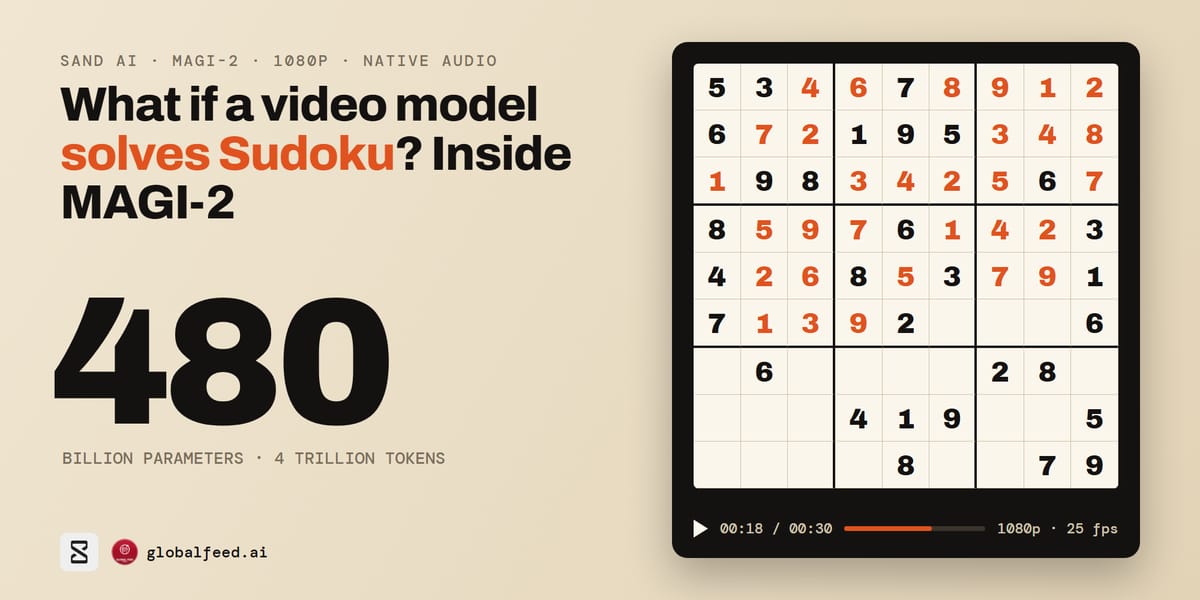
You give a video model a 9x9 Sudoku and ask it to solve it step by step. The model leaves the given digits alone and fills in the empty cells one by one until every row, column and 3x3 box holds 1 to 9. Nobody taught it Sudoku; it was trained only to make video and sound. Chinese video startup Sand AI says it saw this behaviour in the pre-trained checkpoint of MAGI-2, introduced on November 24. MAGI-2 is a video model with 480 billion total parameters, about 28 billion of them active per step, and it generates up to 30 seconds of 1080p video at 25 frames per second, with native audio.
It is a scaled-up version of MAGI-2 Preview, which Sand AI open-sourced in August; the Preview files are on Hugging Face under Apache 2.0. The company says it will also open-source the 480B MAGI-2 and publish a detailed technical report, with no date given yet. The launch post already walks through how the model was built, how the data was gathered and which training stages it went through, including what did not work.
What MAGI-2 does
MAGI-2 generates picture and sound in one model at the same time. A speaking character's lips move with the words, and footsteps, ambient sound and music come out together with the image. Six aspect ratios are supported. Its "omni-reference" feature accepts up to 20 examples in a single request: up to 10 images, 5 videos and 5 audio clips. Users can set what happens at which second on a timeline and where shots cut, and edit just part of an existing video. In one of the company's examples, the model draws on five famous paintings, including The Starry Night and Water Lilies, and flows from one painter's style to the next in a single uninterrupted 30-second take.
By Sand AI's figures, MAGI-2 gained 151.8 Elo points over the Preview on the four-task average of Artificial Analysis Video Arena v2.1, from 998.5 to 1150.3. On that blind head-to-head ranking, MAGI-2 sat in first place on the image-to-video board as of November 26.
How MAGI-2 was trained
One stream, many-headed experts
MAGI-2's backbone is a single-stream transformer. Text, video and audio tokens enter the same model as one long sequence, so motion, lip-sync and sound develop together. The design comes from daVinci-MagiHuman, a paper Sand AI co-published in March 2026. The model does not run every input through all of its parameters. In a mixture-of-experts (MoE) design, each layer holds many small "expert" networks and only a few are used for each token. About 28 billion of the 480 billion parameters work at each step, what the company calls 5.8% sparsity.
The real novelty is how tokens reach the experts. In a standard MoE, each token passes a router and is then shipped whole to the GPU holding its chosen expert. More chosen experts means more traffic between GPUs, and nobody knows in advance how many tokens land on each card, so some cards idle while others jam. Sequences that mix video, audio and references make that imbalance worse. The Multi-Head Latent MoE in MAGI-2 first splits each token into independent "heads", each with its own router and expert pool. Heads are spread across GPUs in a fixed pattern, and expert selection happens locally on each card. Think of sorting letters into fixed boxes first, with each city collecting its own box and handling delivery inside it: the size of the traffic between GPUs is known up front. The company says plainly it chose this design "less by pure modeling gains than by hardware and systems scalability".
Training infrastructure
Running this architecture efficiently at 480B meant rebuilding the whole training stack. Head Parallel and MagiFSDP separate the fixed slice exchange between GPUs from the sharding of expert parameters, gradients and optimizer states. MagiMoE runs thousands of narrow experts per layer quickly on each card and overlaps computation with communication. MagiMuon scales the Muon optimizer to sharded expert matrices. By the company's measurement, at the same total compute budget Multi-Head Latent MoE trains about 22% faster than single-head LatentMoE.
What was tested and compared
The team checked the architecture with controlled experiments. With total and active parameters matched, an 8-head Multi-Head Latent MoE gives consistently lower validation loss than a standard MoE and slightly beats single-head LatentMoE over longer runs. Plotted against training compute, it reaches the same loss with about 23% less compute. The stability recipe from a June blog post underpins the run: clipping runaway activations, keeping routing in high precision, tuning timestep sampling and using Muon. The company says the recipe gave loss curves with almost no spikes.
Data: 4 trillion tokens without the filtering trap
Pre-training data grew about threefold over the Preview to 4 trillion tokens. That is roughly 1 billion samples averaging 4,000 tokens each, and the company says it annotated all of it in three weeks. Just as important is what was kept. The common path for video models is to strip out complex, "ugly" footage and train on a tidy, aesthetic set. Sand AI calls that the "filtering trap" and keeps multi-character scenes, rapid cuts, on-screen text and dense real-world soundscapes in the data, while still removing unsafe, private, badly corrupted and duplicate material. Its observation: when model and unfiltered data grow together, defects such as extra fingers or collapsing motion, which smaller models needed heavy post-training to fix, largely recede during pre-training itself.
Post-training and 1080p
With the basic structure settled in pre-training, reinforcement learning went into visual richness rather than fixing anatomy: lighting depth, fine surface texture, fur and material realism. In the last step, a separate upscaler lifts the output to 1080p at 25 frames per second, and the user's reference images are fed in again at this stage. Since the model already knows where faces and text move in each frame, the upscaler can take fine detail straight from the original images; the company says this clearly improves small-face identity and text legibility across 30-second scenes.
Unexpected abilities, and what did not work
The most striking part of the post is what the team noticed while probing the 480B pre-trained checkpoint. Even with "prompt enhancement", the feature that has a large language model rewrite prompts, turned off, the model showed early problem-solving on visual puzzles such as shape marking, symmetry completion, mazes and Sudoku; the company notes failure cases too. Given only character and scene references and a three-beat story, as in a boat dialogue between Lu Su and Zhuge Liang, the model planned camera angles, perspective switches and close-ups by itself. Asked to have a character speak another language, it translated without a separate language model.
Post-training weakened these behaviours. Fine-tuning on several thousand curated clips clearly raised visual polish, but reasoning, spontaneous storytelling and cross-lingual behaviour became much harder to draw out. The team's explanation is that a small, aesthetics-focused dataset narrows the model's outputs toward a cinematic look and pushes broader abilities aside, which it compares to the "alignment tax" known from language models. Sand AI takes a lesson from this: video models should be measured on more than visual beauty, with rule-following, cause-and-effect sequencing and combining different kinds of input evaluated separately.
The model that is open today: MAGI-2 Preview
While the 480B release is pending, the model you can download is MAGI-2 Preview from August 5. It has about 114 billion total and about 6 billion active parameters across 40 layers, with the middle 36 using the multi-head expert design: 12 heads per layer, 256 experts per head, each head choosing 6. It uses Qwen3.5-27B to read text, the Wan2.2 video autoencoder to compress images and Stable Audio Open for sound. Generation runs in two stages: the model drafts at 512x896 in 100 steps, then a separate refiner takes it to 1088x1920 in 5 steps. The Preview makes 10-second 1080p clips with sound. Sand AI's first open model, MAGI-1 from April 2025, generated video chunk by chunk in sequence; the company says it moved to the simpler single-stream design for MAGI-2 to keep system complexity down while modelling sound and picture together.
Limitations
Sand AI lists its own limits: very fast motion can occasionally produce trajectory or continuity errors, medium and wide shots of 2D animation can look too smooth in fine motion, and complex soundscapes have room for richer layering and physical realism. Keeping pre-trained general abilities through post-training remains an open research question for the team.
How to try it
MAGI-2 currently runs on Sand AI's own platform, reachable from sand.ai. To run the open Preview on your own servers, the GitHub repository is ready: download the files with hf download sand-ai/MAGI-2-preview --local-dir ckpt and start generation on 8 GPUs with torchrun --nproc_per_node=8. The repo recommends 8 NVIDIA Hopper GPUs and ships a Docker image; the files total about 307 GB. A step-distilled fast version is marked "coming soon".
Sand AI announced a new $200 million funding round on November 5 and introduced MAGI-2 three weeks later. What makes MAGI-2 interesting is evidence that a large video model can start reaching into tasks it was never taught, and the team's candour about how post-training dulls those abilities. Once the open 480B release and technical report arrive, anyone will be able to test these observations themselves.
Sources: Sand AI MAGI-2, MAGI-2 Preview, GitHub, Hugging Face, Artificial Analysis

