
One token, 80+ providers: Hugging Face now routes open models through OpenRouter
Every language-model request on Hugging Face Inference Providers now goes through OpenRouter, which picks a provider by live price, speed and reliability. How the router works and how to try it.

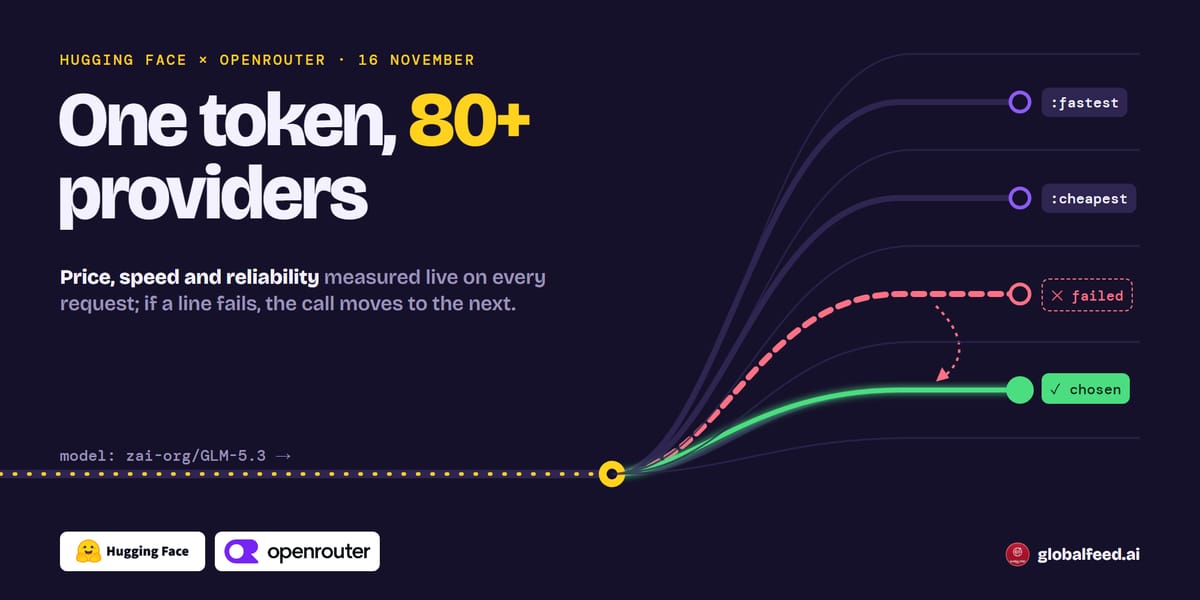
Anyone who wanted to try an open model has always faced the same questions: who serves it, who is cheapest, who is fast right now, and what happens if a provider goes down? Hugging Face now answers those questions for you. On 16 November the company announced a partnership with OpenRouter: every request to a language model on Hugging Face Inference Providers now goes through OpenRouter's router. With one Hugging Face token and the same API, you can call any open model on the Hub that a provider serves, and live measurements pick the provider for each request.
Below we explain what a model router is, how OpenRouter makes its choice, how to try it with a single command and where open models stand today.
What is a model router?
An open model such as GLM-5.3 or DeepSeek V4.1 does not live on one company's servers. Dozens of cloud providers run the same model on their own hardware, each with its own price, speed and current load. A router sits in front of them like a switchboard: it takes your request, connects it to the best line at that moment and moves you to another line if the first one drops. You only write the model name.
OpenRouter does this at scale. According to Hugging Face, it serves more than 800 trillion tokens a month to over 10 million users, across 600+ models from 80+ providers. Hugging Face previously ran its own router, which picked one provider per request and returned the error if that provider failed. Now a failed try is retried on the next best provider inside the same call.
How it was built: how the choice is made
On 28 October OpenRouter described how it rebuilt its provider routing. The old system split traffic almost entirely by input price, so the cheapest provider got the most requests, even when it was slow or failing. The new algorithm tracks each provider's realized price, time to first token, throughput and error rate, and picks the best mix for every request. When a provider slows down, traffic moves away until it recovers.
In OpenRouter's own measurements, the new routing cut capacity errors by 46% and improved time to first token by 16.9% and throughput by 16.3%, with cost rising about 6%. Routing is also cache-aware: a conversation stays on the provider that holds its prompt cache.
How to try it
Your code stays the same. The router accepts OpenAI's Chat Completions and Responses formats and Anthropic's Messages format for every chat model. You state a preference with a short suffix on the model id:
zai-org/GLM-5.3            # default: best mix of price, speed and reliability
zai-org/GLM-5.3:fastest    # highest throughput
zai-org/GLM-5.3:cheapest   # lowest price
zai-org/GLM-5.3:novita     # only Novita
Agents resend the same long system prompt, tool list and history on every turn, and providers cache that repeated prefix, which makes those tokens faster and usually cheaper. Per Hugging Face's docs, sending a stable UUID per conversation in the X-HF-Session-Id header keeps the conversation on one provider. The docs also advise putting what does not change first and avoiding timestamps or random ids at the top of the system prompt.
Setup guides are out for Claude Code, Codex, OpenCode, Pi and Hermes Agent. The Claude Code guide shows that pointing ANTHROPIC_BASE_URL at the Hugging Face router and passing your HF token is enough; the hf-claude extension for the hf CLI adds an interactive model and provider picker behind a single hf claude command.
Where open models stand
According to OpenRouter's October 2026 data, open models went from 26.8% of tokens served on OpenRouter in October 2025 to 71.7% at the end of September 2026, after peaking at 77.5% in July. Weekly open-model volume grew more than 60-fold over the period, against almost tenfold for closed models. This week the most used model on OpenRouter is an open one, DeepSeek V4.1 Flash 1017, with 59.2 trillion tokens.
Open models cost about four times less on average: $0.28 per million input tokens and $1.62 per million output tokens, against $1.27 and $6.36 for closed models. The best closed models still lead on the hardest benchmarks: on the Artificial Analysis Intelligence Index, Kimi K3.1 Pro, the best open model, scores 46 against 65 for Claude Fable 5.2, at about $3.68 per task against $26.54. Hugging Face's view is that for many workloads the trade-off is worth it, and being able to compare both paths with one token is what this partnership makes easy.
Pricing, visibility and one changed setting
Pricing does not change: you pay the provider's price on your Hugging Face bill with no markup. PRO users get $2 of credits a month, Team and Enterprise organizations $2 per seat. Model pages gain a Providers tab, listing each provider's price, speed and uptime over the last 24 hours, and a Metrics tab. Your usage overview breaks spend down by provider, and you can turn off any provider in your settings. Image, video and audio generation keep working directly through Inference Providers.
One setting changes: because language-model requests now go through OpenRouter and are billed to your Hugging Face account, you can no longer use your own API key for a provider with these models. Picking a provider with a suffix and turning providers off still work, and custom keys for image and video providers continue. Hugging Face calls this the first step; next come connecting an OpenRouter account to Hugging Face and routing more tasks through OpenRouter.
Sources: Hugging Face Blog, OpenRouter Blog, HF docs: Claude Code, HF docs: Prompt Caching

