
Empero's PiVo fits a talking AI into 1.4 million parameters
A 5.8 MB text-to-speech model, vocoder included, runs on a plain CPU with no PyTorch or GPU. The report covers what failed, too.

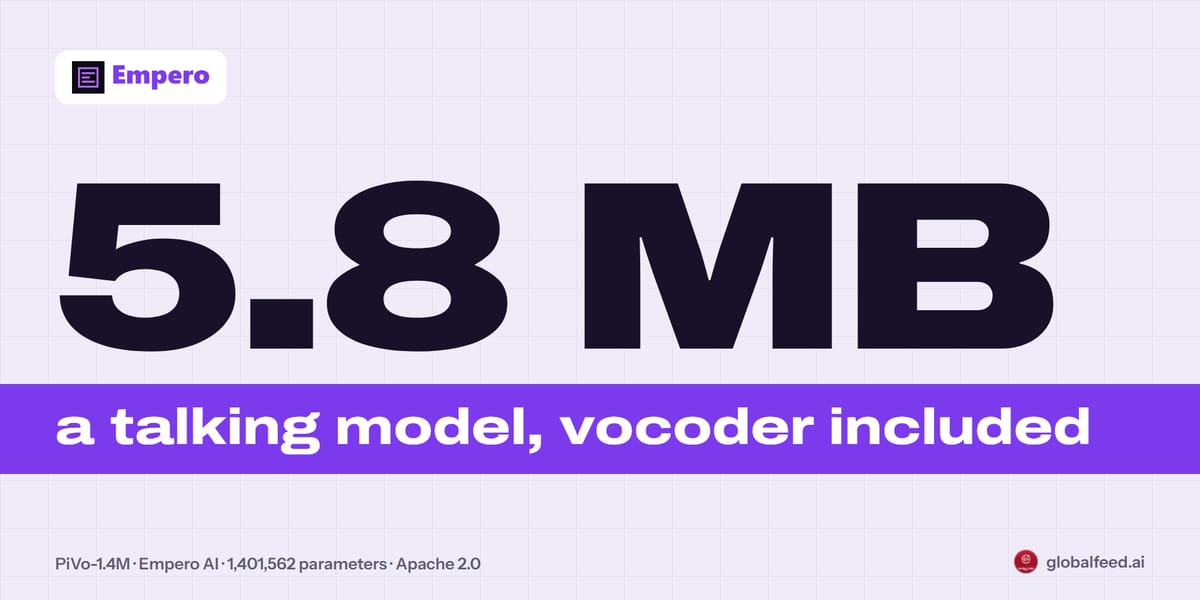
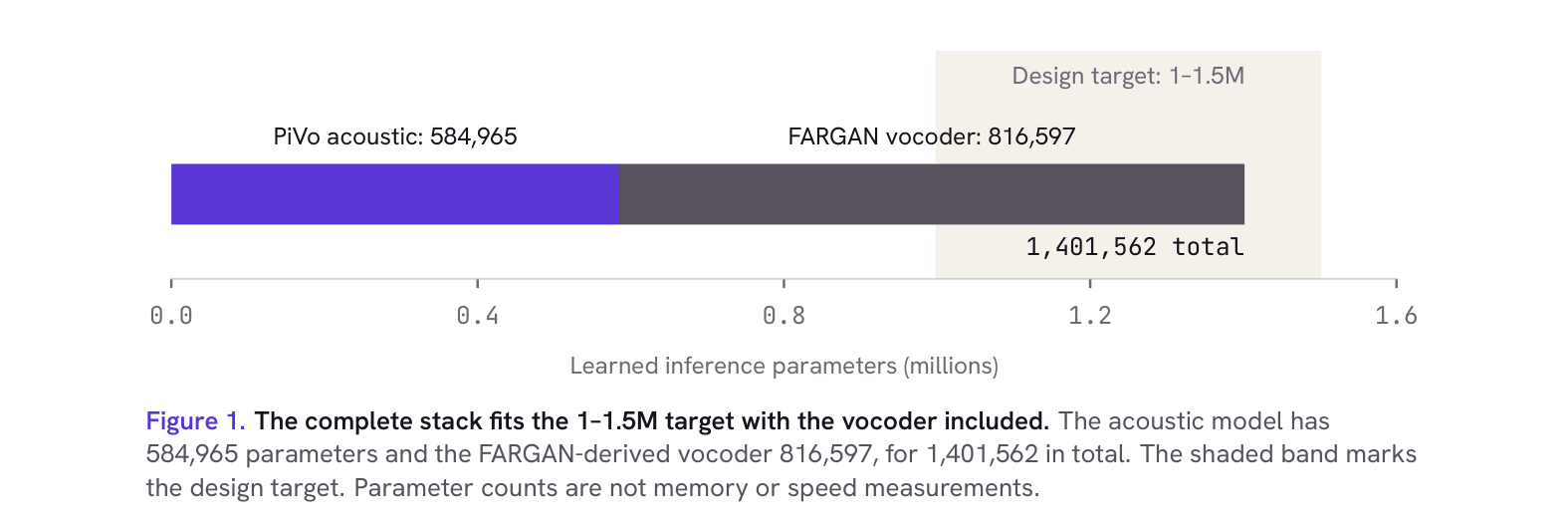
How many parameters does a voice need? Empero AI, an independent research lab in Germany, asked itself that question, and its answer is PiVo-1.4M: the whole system, from text to waveform with the vocoder included, is 1,401,562 parameters. The model files come to about 5.8 MB. For comparison, the teacher model PiVo learned from, Qwen3-TTS, has 1.7 billion parameters; PiVo is roughly 1,200 times smaller. And it runs on an ordinary CPU, with no PyTorch and no GPU. It was released on 2 November under Apache 2.0, with an unusually candid seven-page technical report.
What this is about
Today’s good text-to-speech models run on hundreds of millions or billions of parameters, and most want a GPU. For anyone building an app that talks on a phone, a watch or offline, that is a heavy load. So Empero’s question matters: how much model does a voice really need to stay intelligible? The team set a 1 to 1.5 million parameter target with a hard ceiling of five million, and counted the vocoder, which many papers leave off the books. The long-term goal is offline, real-time speech on phone-class ARM CPUs.
PiVo speaks English in two fixed synthetic voices, Pi (feminine) and Vo (masculine), at 16 kHz mono. No real person was recorded, and there is no voice cloning.
How it works
From text to acoustic features. A rule-based frontend expands numbers, currencies, ordinals and dates, then looks up stressed phones in the CMU pronouncing dictionary. When a word is missing it refuses instead of guessing, and the caller can supply a pronunciation. The acoustic model is just 96 units wide. Its six-block text encoder alternates grouped-query attention with dilated convolution, and a two-entry embedding picks the voice. A duration predictor estimates how long each phone lasts. Two causal attention blocks then predict 20 values every 10 ms: 18 cepstral coefficients, a pitch value and a pitch correlation. Attention looks back at most 64 frames, keeping memory bounded. There is no mel spectrogram step; the model predicts exactly what the vocoder expects.
From features to waveform. The vocoder is derived from FARGAN, known from the Opus codec. The team chose it because explicit pitch control and frame-by-frame generation fit a tiny budget. It looks at the previous, current and next frame and produces four subframes for each 160-sample frame. The system ships as four ONNX graphs and runs on NumPy plus ONNX Runtime, streaming audio in 10 ms chunks. The acoustic design is inspired by Mariusz Kurman’s Neuroblast, but the report says the code is original and uses no Neuroblast weights.
How it was trained
Recordings from a teacher. Qwen3-TTS VoiceDesign designed the two voices and Qwen3-TTS Base generated the recordings. The teacher produced 9,656 recordings (about 13.93 hours); after quality filtering, 8,628 remained: 4,314 scripts read by both voices, about 12.29 hours. Scripts mix the team’s own writing with excerpts from Austen, Conan Doyle, Dickens, Carroll, Grahame and Montgomery. The split is 8,362 training, 114 validation and 152 test utterances, with both readings of a script always kept together.
Alignment and trimming. Montreal Forced Aligner produced phone timings. While auditing durations, the team caught a real bug: leading silence was being counted as part of the first phone. They built an edge-corrected corpus that keeps the spoken region plus three frames of margin, leaving about 10.77 hours. The report is clear that fixing timing was worth it on its own but did not make the voices sound better by itself.
Training. The parent model minimises a smooth-L1 loss on acoustic features plus 0.1 times the squared error on log duration, with batch size 8 and learning rate 3×10⁻⁴. The best validation checkpoint came at epoch 82, after 85,772 updates and about 90 minutes of training. Then came 1,200 refinement updates, with a 110,018-parameter critic network looking at the cepstral channels to push the output toward more realistic sound, while the encoder and duration predictor stayed frozen. The critic is used only in training and adds nothing at inference. The released model comes from a single run with seed 42.
How good it is
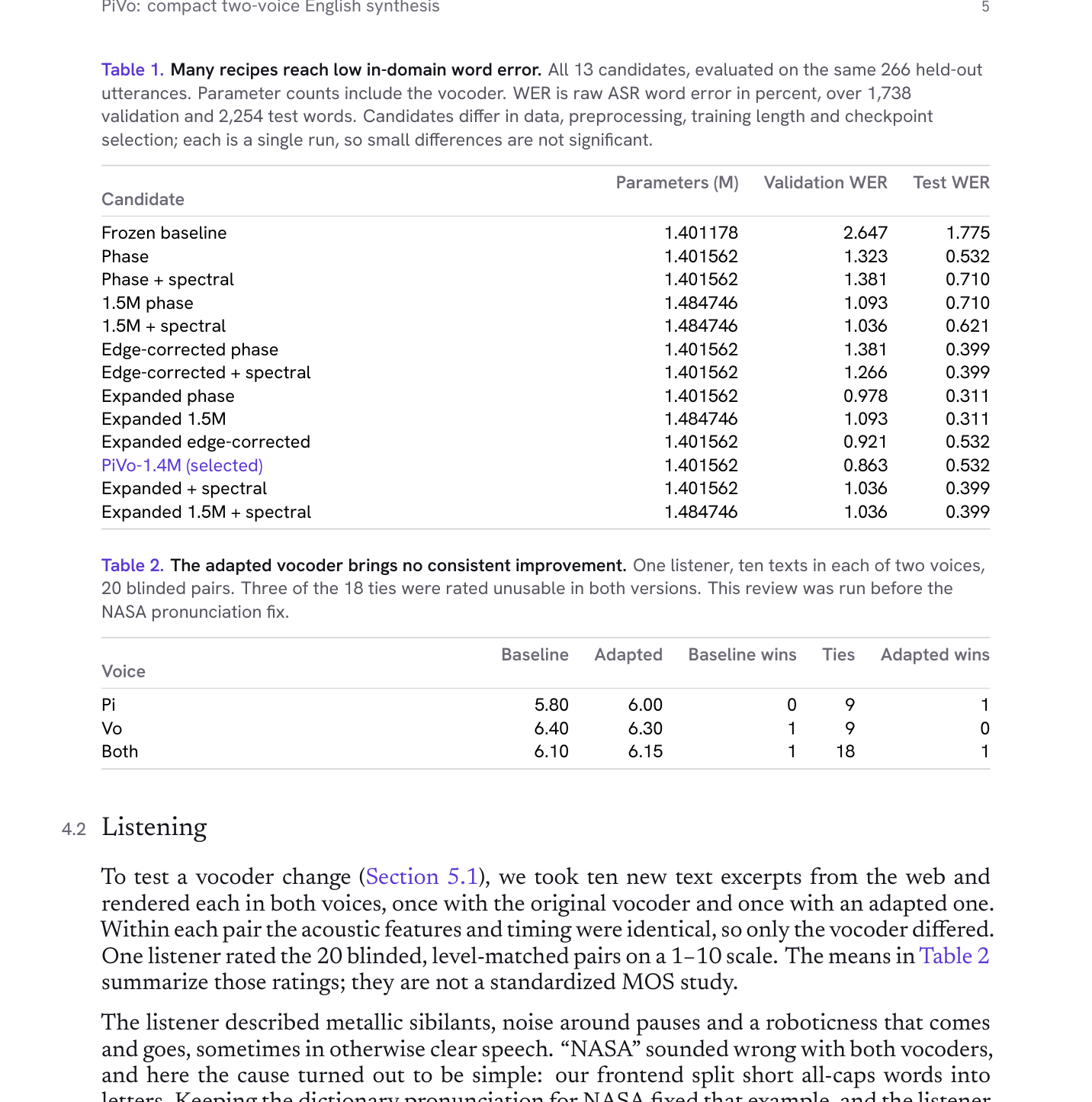
On intelligibility it does very well. Whisper small.en transcribes PiVo on 266 held-out utterances with word error rates of 0.863% on validation (15 errors in 1,738 words) and 0.532% on test (12 in 2,254). The team compared 13 candidates on the same data; one scored 0.311% on test, but the release was chosen on validation before test scores were seen. That is picking the right method over the prettier number. The ONNX graphs match the PyTorch model to within about 7×10⁻⁶.
Naturalness is another matter, and the report says so on page one: “Intelligible is not the same as natural.” Some sentences keep a metallic or robotic texture, especially on sibilants and around pauses. The pitch feature is off by 1.65 and 2.82 semitones on average.
What didn’t work
This is the most instructive part of the report. The team looked for the source of the robotic texture in the vocoder and adapted it. The adapted vocoder cleaned up a familiar example, but 20 fresh blind comparisons gave 18 ties and one win each way, with mean ratings of 6.10 and 6.15, so the original was shipped. They also found the artifact is audible even when the vocoder gets features from the clean teacher recording, so the acoustic model is not the only culprit. Porting the vocoder to C made it sound worse, and a post-filter for sibilants and pauses made no useful difference. They tried the UTMOSv2 quality model as a reward; it agreed with the listener 6 times, disagreed 7 times and abstained 5 times, so it was dropped. RL was not tried, because the model does not produce the probabilities those methods need.
How to try it
The model runs fully offline on Python 3.11+ with NumPy and ONNX Runtime and downloads nothing during synthesis. One utterance is at most 2,000 characters and 30 seconds, and speed can be set from 0.5 to 2.0. There is a demo page on Hugging Face if you don’t want to install anything. Next on the team’s list are latency, real-time factor and memory on phone CPUs; these are not measured yet, and the report explicitly refuses to assume them from the parameter count.
For developers who want offline speech in their own language, the method is open: generate synthetic data from a teacher model and train a few-megabyte voice, vocoder included. In the report’s own words, PiVo is “an honest record of what 1.4 million parameters can and cannot do.” All measurements are the team’s own and the listening review had one listener; there is no independent evaluation yet.
Sources: PiVo model card, Technical report, Evaluation data, Demo page, FARGAN paper, Empero AI

