
The fast model that outscores Google's deep thinker: how Gemini 4 Hydrogen works
Google's Gemini 4 Hydrogen beats Argon on a key index while running 2.5x faster, and it now powers Search and the Gemini app. We explain its role, training and what it changes.

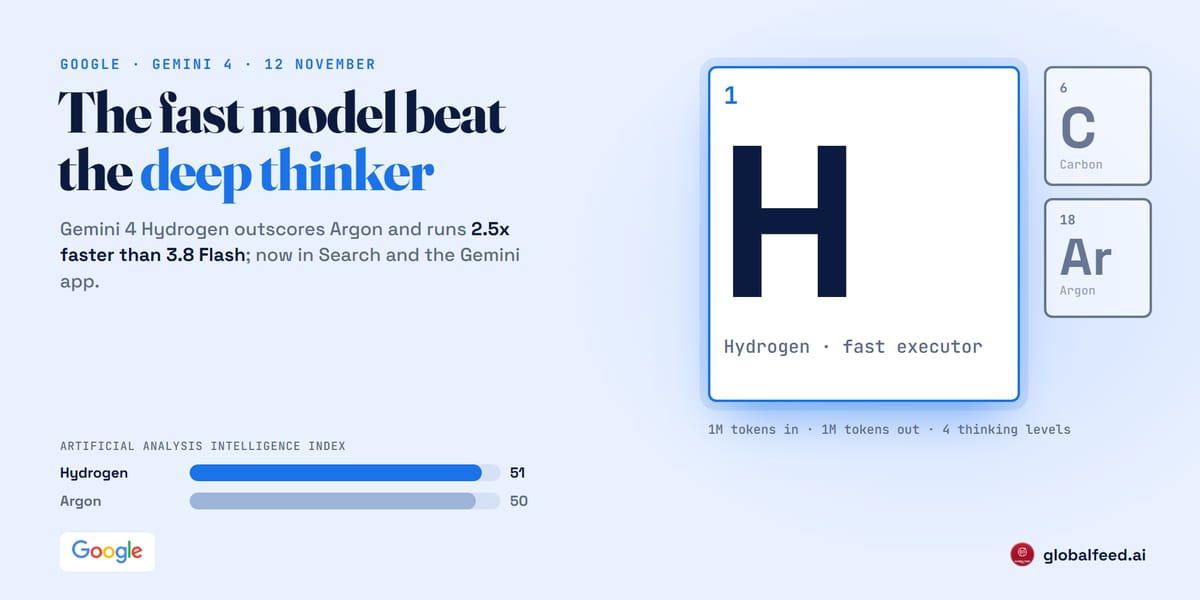
Big AI models usually force a choice: very smart but slow and costly, or fast but limited. Gemini 4 Hydrogen, which Google introduced on 12 November, aims to change that balance. According to Google, at its default high thinking level it scores 51 on the independent Artificial Analysis Intelligence Index, above the family's deep-reasoning model Gemini 4 Argon (50), and 54 at its highest setting, while finishing tasks 2.5 times faster than Gemini 3.8 Flash. It reached the Gemini app, Google Search, the Gemini API and business tools the same day, putting Gemini 4 in everyone's hands for the first time.
A thinker and a doer
Software work needs deep thinking to design systems and fast, disciplined execution to write code, run tests and verify changes. Google positions Carbon and Argon for the first and Hydrogen for the second: the architects and the craftsman. A new Orchestrator in Google Antigravity switches between Carbon and Hydrogen within one session; on Terminal-Bench 4.0 it reached near-Carbon success while using 24% less quota and finishing 19% faster, according to Google. In parallel setups Carbon coordinates and Hydrogen powers worker and verifier agents.
What it can do
Versus 3.8 Flash, Google reports 2.5x faster tasks, Terminal-Bench 4.1 up from 18.2% to 57%, and more than 5x fewer fabricated claims. It batches file reads and searches in parallel; partners saw 2x to 2.8x speedups and 12% to 23% fewer tokens. It ranks #5 on Agent Arena, scores 58.8% on HLE-Diamond, ranks #1 on Vals Tax Agent Bench (52.3%) and ties for #1 on Vals Legal Research Bench (55.8%). It takes 1 million input tokens and can produce up to 1 million output tokens, scoring 53.4% on the Multimodal Knowledge Agent benchmark and 71.6% on Agents' Last Exam v1.1. Four thinking levels run from low to a new xhigh.
How it was trained
The model card chains its training details up the family: Hydrogen is adapted from Gemini 4 Carbon, which is based on Gemini 4 Argon. The exact adaptation method is not described. Per the Argon model card, the family is a large sparse mixture-of-experts transformer with native text, vision and audio input. Pre-training data spans web documents, text, code, images, audio and video, from public datasets, crawled data, licensed data, user data under Google's terms and user controls, and synthetic data. Post-training used instruction tuning, reinforcement learning and human preference data, including multi-step reasoning, problem-solving and theorem-proving data. Processing included deduplication, honoring robots.txt, and safety and quality filtering. Training ran on Google TPUs with JAX and ML Pathways.
For Hydrogen itself, Google shares safety results: up to 81% less overreach and 79% less under-service in agentic tasks, 12x fewer misaligned actions and shortcuts, up to 2x less likely to bypass permission boundaries, a 94% score on an internal agent honesty evaluation, 99.9% chain-of-thought legibility across more than 200,000 audited turns, 2.3x more resilience on the Gray Swan prompt-injection benchmark, and false refusals under 0.4% on HealthBench Pro. Parameter count, data size and Hydrogen-specific distillation steps were not disclosed.
Search, the app and pricing
Hydrogen also powers Google Search for all users, handling messy multi-part questions, giving more visual answers and widening the range of links through an upgraded query fan-out. In the Gemini app it follows tone and format rules more closely and calls the right tools more often. Google's API price on 12 November is flat across the 1M context: $1.50 per million input tokens and $7.50 per million output tokens. The model is closed and available only through Google's services and API.
Sources: Google: Introducing Gemini 4 Hydrogen, Gemini 4 Hydrogen model card, Gemini 4 Argon model card

