
How did RadixArk train its first open model, DaisyRose-27B, on 1,200 tasks with RL only?
RadixArk, founded by core SGLang maintainers, trained its first model on top of Qwen3.8-27B with RL only, without showing it a single example answer. We walk through the recipe, from task design to sandboxes.

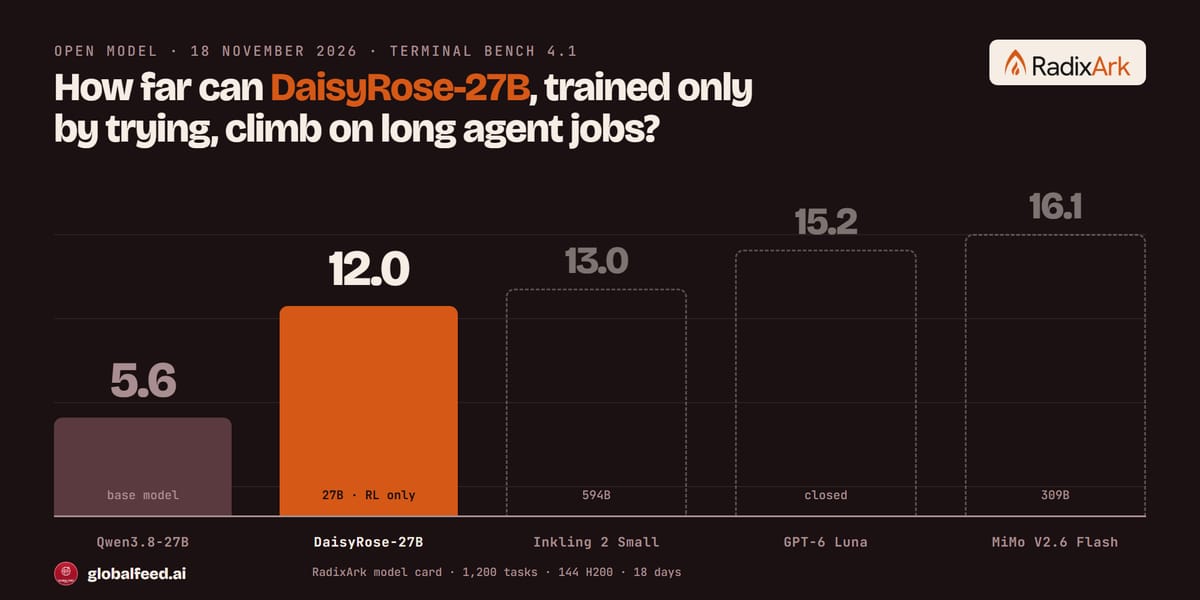
Give an AI model a long job: open a code repository, find the bug, fix it, run the tests, and back up and try again when something breaks. Such a job can take an hour and a half and more than a hundred commands, and most small models lose their way halfway through. RadixArk, founded by core maintainers of the popular SGLang inference engine, released its first model, DaisyRose-27B, on 18 November, and it is built around exactly that problem: how far can a mid-sized open model get on long jobs by learning only from trying?
The headline number is striking. According to the model card, DaisyRose-27B lifts Qwen3.8-27B's score on Terminal Bench 4.1, one of the hardest long-horizon tests, from 5.6 to 12.0. It took about 1,200 carefully chosen tasks and 18 days on 144 H200 GPUs. The model is on Hugging Face under Apache 2.0 in BF16, FP8 and NVFP4, and runs on a single GPU.
What reinforcement learning means here
There are two common ways to teach a model a new skill. One is to show it thousands of correct solutions and let it imitate them; this is supervised fine-tuning, and distillation is a version of it that uses a larger model's answers as the examples. The other is reinforcement learning (RL): the model gets no solutions, tries the job itself, and receives a score depending on whether it succeeded. Behaviour that earns high scores becomes more likely. It is like teaching someone to drive by putting them on a closed track and telling them after each lap whether they finished it. RadixArk says DaisyRose-27B was trained from Qwen3.8-27B with RL only, with no supervised fine-tuning and no distillation.
What the model is made of
DaisyRose-27B keeps Qwen3.8-27B's architecture, tokenizer and chat template. It has 27.8B parameters in total, including a 0.46B vision encoder and a 0.42B multi-token-prediction head, both left unchanged. The 64 decoder layers follow a 3:1 pattern of Gated DeltaNet linear-attention and full-attention layers, which helps carry the 262,144-token context. It keeps image understanding and works as a drop-in replacement for the base model.
How it was trained
Tasks. RadixArk built the tasks with Eigent AI from a large pool in machine learning, software engineering and science. Out of thousands of candidates, about 1,200 made the final set. Each task targets a mistake the base model makes and was tuned until its solve rate was neither too easy nor too hard to learn from. Each is a chain of interdependent problems, and an attempt gets up to 1.5 hours in a sandbox with more than 100 tool calls and more than 256K output tokens. To avoid reward hacking, the team reviewed every task alongside the model's attempts and fixed or removed any that could be passed without really solving it.
Infrastructure. Training ran fully asynchronously with Miles, RadixArk's open-source RL framework. 128 H200s ran the agent through SGLang while 16 trained on finished trajectories, with the updated model sent back after every step. Some sessions reached 1M tokens and were folded into several trajectories by harness summarization. RadixArk reports 37% model FLOPs utilization against 16% for a Megatron-based open-source trainer, which it says means 57% less GPU time, and about 16,800 tokens per second end to end against 8,300. The run used about 63,000 GPU-hours and stayed stable throughout.
Sandboxes. Every attempt ran in a fresh sandbox on RadixArk's service built on the open-source AgentENV project: about 944,000 sandboxes between mid-September and mid-November, up to 1,566 at once. The service grew from one machine to 12 and took ten upgrades during training. Sandbox creation succeeded 99% of the time over nine weeks and above 99.95% since late October, after fixes such as stopping machines from freezing when memory ran out. The company puts the cost about 80% below popular hosted sandbox providers, partly by letting each sandbox's memory grow and shrink with use.
Results
The model card shows gains over the base model on every listed benchmark: Terminal Bench 4.1 from 5.6 to 12.0, Terminal Bench 2.1 from 73.0 to 75.5, DeepSWE v1.1 from 42.2 to 46.2, SWE Bench Pro v2 from 91.3 to 94.7, IFBench from 79.5 to 82.4, GPQA Diamond from 89.2 to 90.7 and HLE from 33.9 to 34.3. On Terminal Bench 4.1, much larger models such as MiMo V2.6 Flash (16.1), GPT-6 Luna (15.2) and Inkling 2 Small (13.0) remain ahead, though the gap is far smaller than the parameter counts suggest. DaisyRose-27B's scores average eight runs per task on RadixArk's own harness, while other models' numbers come from their developers or public leaderboards, so the comparison is best read as a rough guide.
How to try it
RadixArk recommends serving the model with SGLang and DSpark speculative decoding, and the SGLang cookbook generates launch commands per GPU. The files take about 52 GB in BF16, 29 GB in FP8 and 23 GB in NVFP4, and the model runs on a single GPU from H200 down to RTX 5090 and DGX Spark; NVFP4 needs Blackwell. Because Miles is open source, teams can apply the same recipe to their own tasks. RadixArk asks users to share where the model falls short on the model's Community tab, and for a fuller picture it is worth following evaluations from independent researchers as well.
Sources: DaisyRose-27B model card, Hugging Face blog post, RadixArk announcement, Miles on GitHub, SGLang cookbook

