
Kolibri 1.1 does the same work with 3.4x less GPU time: how did Aleph Alpha train it?
The new version of the German and English open model speeds up with sparse attention; the branched training, Merlin-Arthur, results and setup.

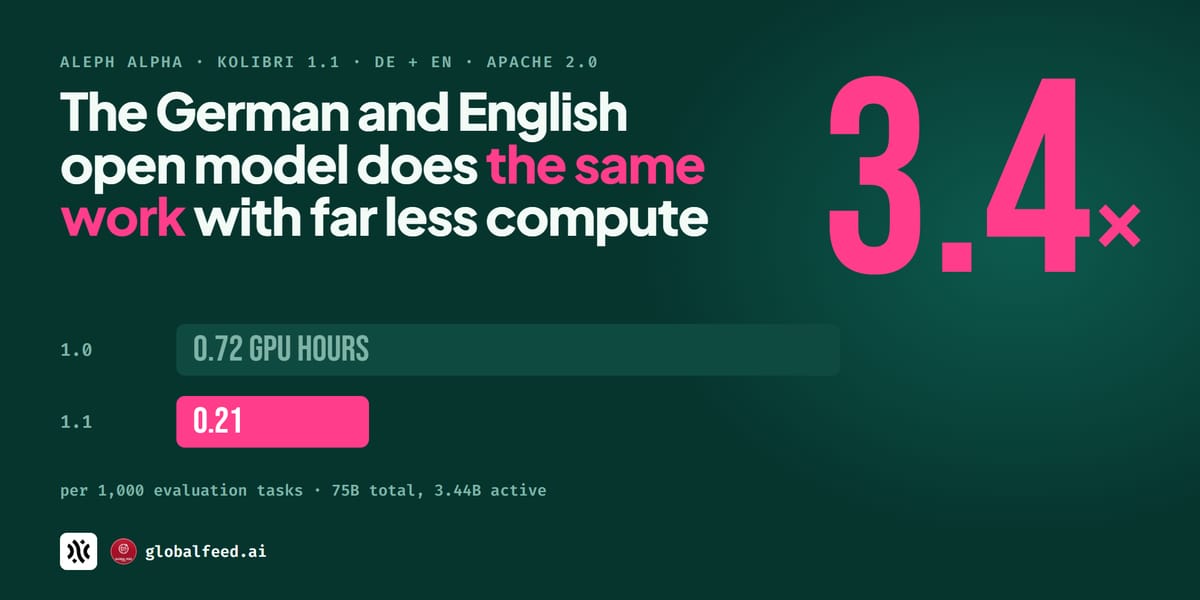
We covered Aleph Alpha's Kolibri, an open model built for German and English, in early October. Seven weeks later, Kolibri 1.1 does the same work with far less compute. Per the announcement, it produces 41% fewer output tokens per task and uses 3.4 times less GPU time per task. The model card puts it at 73.2 points for 0.21 GPU-hours per 1,000 evaluation tasks, against 66.6 at 0.72 GPU-hours for Kolibri 1.0. It was released on November 23 under Apache 2.0 on Hugging Face, with 75 billion total and 3.44 billion active parameters. Our earlier story covers version 1.0.
What changed
Full-attention layers became sparse: each query attends to 2,048 selected keys, and several layers share the keys and values of an earlier one, in a 4:1 mix with 512-token sliding-window layers. The blog reports up to 14 times higher decode throughput at 1M context on four B300s. The first layers were densified, which is why total parameters fell from 78 billion to 75 billion. The model also learned to write code that renders visual output, such as SVG, TikZ, CAD, Blender scenes and slides, and to abstain when evidence is insufficient.
How it was trained
Training branched from a Kolibri 1 mid-training checkpoint after 20 trillion pre-training and 3.42 trillion mid-training tokens. A second mid-training phase ran 805 billion tokens over 8,000 steps at 196,608-token sequences, then a long-context phase ran 201 billion tokens over 1,000 steps at 262,144 tokens. The final model is a uniform average of all 40 checkpoints, trained on 512 and 384 GPUs for 5.52×10²² FLOPs. The German web and document share in the second phase rose from 2.1% to 14.5%, and RL added a language-consistency reward for German reasoning. Erroneous tool calls and terminal actions in agentic data were masked out of the loss so the model learns to recover without learning the mistakes.
Against hallucination, the team used its Merlin-Arthur protocol: Merlin hides context in ways that make the right answer easier and the model learns to answer; Morgana hides context that makes it harder and the model learns to abstain. SFT trained three models for 5,000 steps (about 336 billion tokens each), with mix weights found by merging 29 per-cluster specialists in 88 combinations and Bayesian optimization, then souped into one checkpoint. RL ran 650 steps at batch size 4,096, mostly with verifiable rewards.
Results
Overall scores rose from 64.0 to 72.2 in English and from 69.2 to 74.2 in German; SWE-bench Verified from 64.0 to 70.4, Terminal-Bench 2.1 from 25.8 to 35.6 and safety from 58.9 to 91.0. Some numbers slipped: the agentic average went from 61.8 to 61.0 and English industry RAG from 84.8 to 81.8. Larger-active models such as Qwen3.8 27B (75.3) and GLM-5.3 Flash (78.6) score higher overall; Kolibri 1.1 is the top model in the card's 3 to 4B-active group.
How to run it
It needs about 77.6 GB, so at least two H100s or one B200, and serves with vLLM via "pip install 'aleph-alpha-inference>=2'". GGUF builds range from 16.6 GB to 80 GB; Q4_K_M is 45.5 GB at about 0.7 points of quality loss, pending a llama.cpp merge.
Sources: Hugging Face model card, Aleph Alpha announcement, GGUF builds, Merlin-Arthur paper

