
How did Ant Group's open medical model LingSante learn to think like a clinician?
inclusionAI's MIT-licensed LingSante-3.1-flash, with 560B parameters, is trained for medical reasoning, multi-step health record work and evidence-based research.

Picture a clinician's day: an incomplete patient history, two lab results that disagree, a guideline that changed last month, and very little time. The hard part of medicine is often less about knowing facts and more about finding the right evidence, weighing it and carrying a task through to the end. LingSante-3.1-flash, uploaded to Hugging Face on November 19 by inclusionAI, the AI unit of Ant Group, is an open model trained for exactly that kind of work. It is released under the MIT licence, so anyone can download it, inspect it and build on it.
According to the model card, LingSante is the medical edition of the company's general Ling-3.1-flash model. It has 560 billion parameters in total, activates 25 billion per token and supports a 1-million-token context, enough to read a thick patient record or dozens of papers in one go. inclusionAI says it is built around four abilities: complex medical reasoning, professional healthcare communication, evidence-based deep research and long-horizon medical tasks.
Where it shines
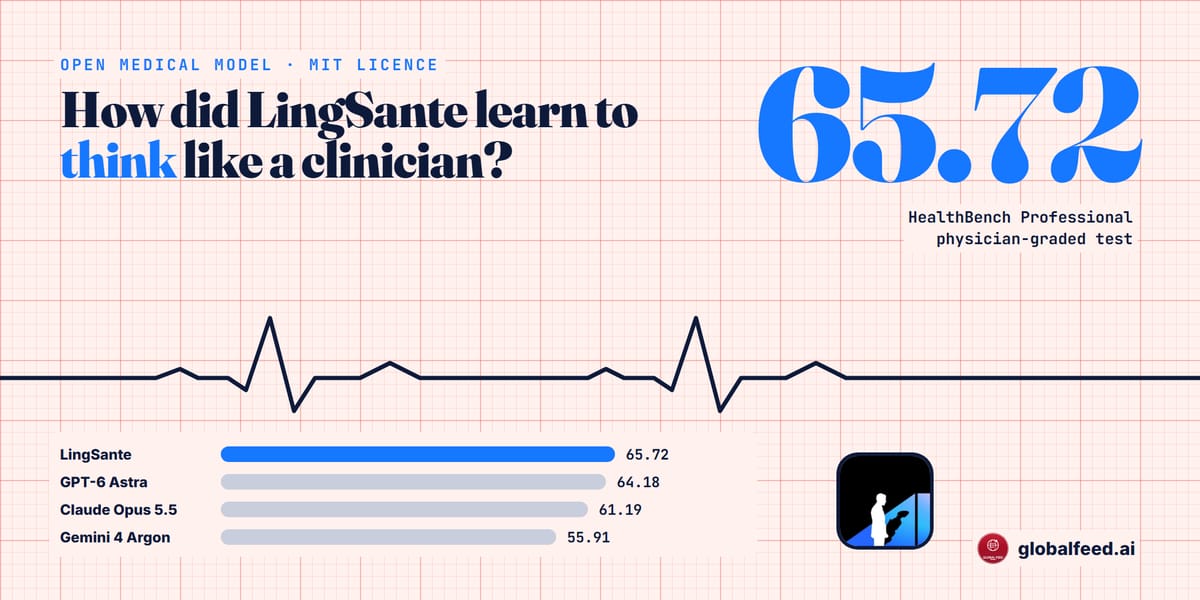
The standout number in the company's results is on HealthBench Professional, a physician-graded test, where LingSante scores 65.72; in the same table GPT-6 Astra scores 64.18, Claude Opus 5.5 61.19 and Gemini 4 Argon 55.91. On DiagnosisArena it scores 83.9, just behind GPT-6 Astra (84.7) and ahead of Claude Opus 5.5 (82.6). On MentalHealthBench it is second with 54.64, behind GPT-6 Astra.
The bigger claim is about agentic work. On EHR-Complex, which runs multi-step tasks over electronic health records, it tops the table with 74.40. On PhysicianBench, 100 clinical tasks carried out over many rounds, it scores 57, with Gemini 4 Argon at 58 and GPT-6 Astra at 45. It is also strong at research: 94.10 on BrowseComp with context and 72.22 on HLE with tools, ahead of every model it is compared with. On professional-behaviour benchmarks, the card says it ranks second overall, behind only GPT-6 Astra.
Cost matters too. On inclusionAI's InclusionMed medical AI benchmark it scores 45.064 overall, fifth among 23 model configurations, and the card places it on the performance-cost Pareto frontier, meaning it gets close to pricier closed models at a lower running cost.
The other side of the table is visible as well. On general medical knowledge (MedQA) it scores 94.50, below the closed models at around 97, and on expert-level MedXpertQA it scores 57.27 against Gemini 4 Argon's 71.35. It also trails on coding and terminal work, with 26.5 on Terminal-Bench 4.0. Some tests, such as AFUMED and TeleMedAgentBench, are the company's internal benchmarks.
How it was trained
Architecture. LingSante keeps the architecture of Ling-3.1-flash. It is a mixture-of-experts model with 512 small expert networks; for each token a router picks 8 of them, plus one shared expert that is always on, so only 25 billion of the 560 billion parameters are computed at each step. The attention design is the second key choice. Of 72 layers, 63 use KDA, a linear attention whose cost grows in a straight line as text gets longer, and every seven of them are paired with one gated MLA layer that carries full attention. That 7:1 mix is what makes a 1-million-token context affordable.
Data. For the base model, the company's training-content summary under the EU AI Act lists more than 10 trillion tokens of text: Common Crawl and other public web data, academic papers, code and Q&A sites, partnership data and synthetic data, collected up to about July 2026. What is different in LingSante is that medical data is not bolted on at the end. General and medical data are used together through pretraining, mid-training and supervised fine-tuning, so medical data brings domain knowledge and clinical examples while general data keeps reasoning, coding, search and tool use intact.
Three frameworks. inclusionAI describes an evidence-reasoning alignment framework that teaches the model, through high-quality synthetic data, to find the key factors behind a clinical decision, verify the supporting evidence and resolve conflicts between sources; a long-horizon task framework with realistic interactive environments, varied tool settings and structured verification; and a professional behaviour framework that aligns answers with real clinical scenarios and medical standards.
Training steps. After pretraining, mid-training and fine-tuning comes reinforcement learning for medical reasoning, tool use, search and professional behaviour, tuned for reliable and efficient execution as well as correct answers. The last step is multi-teacher on-policy distillation: several teacher models, each strong in a different area, correct the student on answers the student itself produces, merging their strengths into one model. The previous medical release, Ling-3.0-flash-Sante, had 124 billion total and 5.1 billion active parameters. The card does not describe approaches that failed, and no technical report has been published yet.
Who can try it
The card suggests medical research, literature analysis and evidence synthesis, clinical document analysis with qualified human review, structured extraction and building medical agents. It needs serious hardware: the recommended setup is 8 H200 or 4 GB300 GPUs, and the FP8 files take about 574 GB. Recipes for SGLang and vLLM are on the card, along with an API option through Computrix. inclusionAI states that the model is for research and evaluation and must not be the sole basis for diagnosis, prescriptions or treatment. Within that frame, it shows an open medical model sitting in the same table as closed frontier models, and gives researchers a starting point they can study and improve.
Sources: LingSante-3.1-flash model card, Ling-3.1-flash model card, Ling-3.1 training-content summary

