
Is the AI answering you really the one you picked? How FlashProve's mathematical receipt works
Anthropic's FlashProve tries to prove which model wrote a reply without revealing the model's weights. What provable inference is, how it works step by step and how to try it.

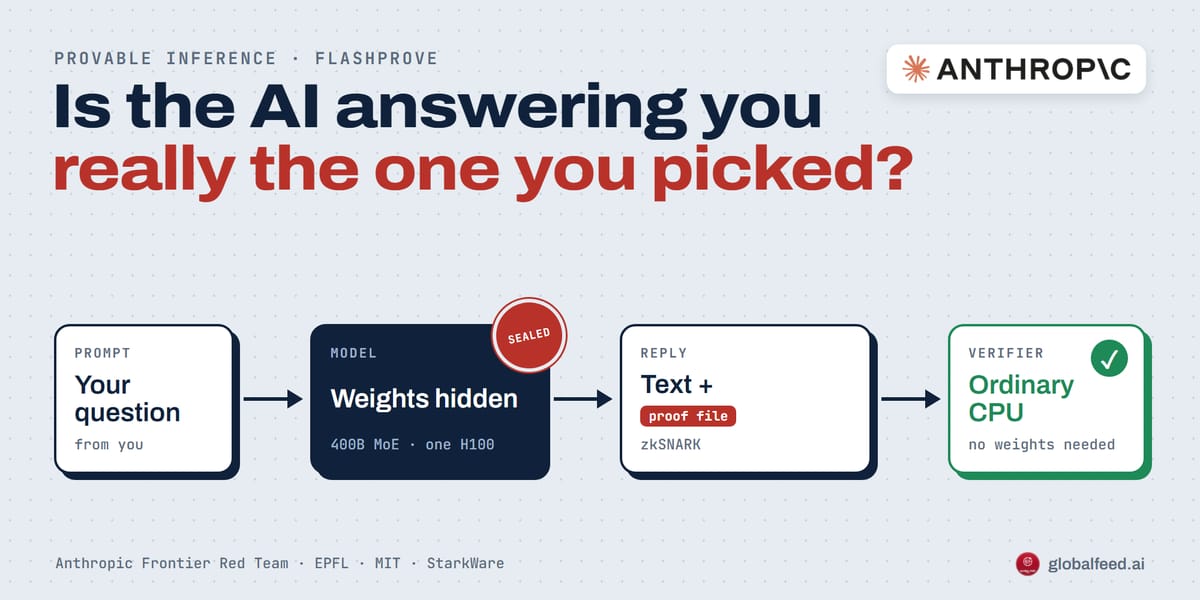
You pick the strongest model in a chat app and a fluent answer appears on screen. Did the model you chose actually write it? Today there is no way to know. A routing service in the middle could quietly send your request to a cheaper model to save money, and someone who breaks into an inference server could slip their own text into the reply; the answer would still read well. On November 2, Anthropic's Frontier Red Team, working with researchers from EPFL, MIT and StarkWare, released FlashProve, a system that answers this question with mathematics. Every reply comes with a small proof file. Anyone can check it on an ordinary computer in seconds and see that the reply came from the promised model, without ever seeing inside that model.
The code, the proofs and the protocol document are on GitHub under the Apache 2.0 license. According to Anthropic's post, Claude played a large part in the work: it produced the cryptographic speed-ups, and it wrote the protocol specification. This piece explains what "provable inference" means, how FlashProve works step by step, where it could be useful and how you can try it on your own machine.
The problem: seeing the model behind the screen
When you talk to a friend in person, you know it is them from their face and voice. With an AI model you have none of those signals. Judging by the quality of the answer is not enough either, because a cheaper model can also write something that looks good. Running the model yourself to compare runs into two walls: frontier model weights are kept private, and even if they were open, running a 400-billion-parameter model is beyond the hardware of an ordinary user and of most independent evaluators.
Think of a famous chef who keeps a recipe secret but leaves a sealed fingerprint of it with a notary in advance. Every plate that leaves the kitchen comes with a receipt showing it was made from exactly that sealed recipe. You can check the receipt quickly and you learn nothing about the recipe. If the chef cooks from a different recipe, the receipt fails. FlashProve does something very close to this: the recipe is the model weights, the notary's seal is a "commitment", and the receipt is the proof file attached to each reply.
The idea is called provable inference. Inference is a trained model producing an answer to a prompt. The mathematical tool behind it is the zkSNARK, a zero-knowledge succinct argument. One side (the prover) shows with a short certificate that a computation was done correctly, and the other side (the verifier) checks that certificate far faster than redoing the computation. Zero-knowledge means the certificate reveals nothing beyond the fact that the computation was correct. The same family of techniques has been used for years in blockchain networks such as Starknet on Ethereum.
How FlashProve works, step by step
There are two parties: the provider serving the model and the user checking the reply. The work happens in two phases.
Phase one: sealing. The provider publishes a commitment, a short fingerprint of the model weights. It pins down exactly which weights will be used without revealing them. Anthropic measured this as a one-off job per model taking about 39 minutes on a single GPU. One commitment is good for about 16 million requests, after which the provider has to commit again.
Phase two: proving. When a user sends a prompt and gets a reply, the provider produces a proof of the statement "the committed model produces exactly these output tokens for this prompt". Anyone holding the commitment, the prompt and the reply can check it without the weights and without serious compute. If the reply did not come from the committed model, the check fails.
The team measured the system on Meta's Llama 4 Maverick, a 400-billion-parameter mixture-of-experts (MoE) model in which only about 17 billion parameters, a handful of "expert" sub-networks, run for each token. They used a public 4-bit conversion of about 232 GB. The prover runs on a server with one NVIDIA H100 and 24 CPU cores. A batch of 24 requests is proved in about 223 seconds, roughly 110 tokens per second, and each proof for a 1,024-token request is about 18.78 MB.
The checking side is far lighter. The user downloads the commitment files once, about 6.5 MB in all, and then one proof per request. No GPU is needed; checking a proof takes 17 seconds on 24 threads and 21 seconds on a single thread. The price is paid by the prover: Anthropic says proving takes roughly 70 to 95 times the GPU time that vLLM, a widely used open-source inference engine, needs to process the same requests.
Where the speed comes from
First, the prover's work scales with the experts that actually ran: it proves the roughly 17 billion parameters used for a token instead of all 400 billion, and the proof still hides which experts were picked. Second, requests are proved after the fact and in batches; the prover reads finished text in one parallel pass and opens the commitment once per batch rather than once per request. Third, the system was designed to fit on one GPU. Layers are split into segments and proved one segment at a time, with weights kept in host memory and streamed in, so a single 80 GB card with about 290 GB of host memory beside it is enough.
The proof system itself follows a well-established recipe: an information-theoretic object called an interactive oracle proof (IOP) is compiled into a cryptographic proof using hash functions, which also gives it post-quantum security. Anthropic explains why it chose proving after the fact: in-line proving has to be extremely fast and may trade security for speed, while post-hoc proving can afford to be slower.
Prior work shows how fast the field is moving. By Anthropic's survey, the only earlier proof of the same Llama 4 Maverick model, VerInf, reported 14.3 hours for 1,000 tokens, with a 93.6 GB proof that took almost a day to verify. In 2024 zkLLM proved a 13-billion-parameter model at about 2.5 tokens per second on one A100. On the commercial side, Attestable reports 53 to 77 tokens per second for the 31-billion-parameter Gemma 4 on one H100, and has not yet released an open-source library for it.
A second layer of trust: Lean proofs
Cryptographic code is famously brittle. Anthropic therefore turned to formal verification: the protocol and its security properties were written in the Lean proof assistant and proved in machine-checkable form. Three properties were targeted. Completeness means an honest proof is accepted. Soundness means a fake proof is rejected except with negligible probability. Zero knowledge means the proof reveals nothing about the weights beyond what the reply itself implies.
The release ships two verifiers. The Lean verifier is slow, but it is proved to accept only what the soundness theorem covers, so it serves as the reference. The C++ verifier is the one for daily use; it carries no formal guarantee, but it agreed with the Lean verifier on every proof in the team's tests. An interactive visualizer of the Lean theorems is included to help with auditing. The authors are Roy Rinberg and Alex Allain of Anthropic, Alessandro Chiesa (EPFL, StarkWare), Miranda Christ (MIT), Giacomo Fenzi and Guy Weissenberg (EPFL), and Rahul Dalal and Ben Mayer from Anthropic's fellowship programs.
Where it could be useful
Anthropic lists four uses. Independent evaluators who test a model before and after release could confirm that the model they tested is the one being served. Providers could detect tampering by demanding a valid proof from their servers for every reply; an attacker who takes over a server cannot produce valid proofs for the expected weights. Anthropic's Frontier Safety Roadmap set a goal of a prototype for verifying inference traffic by September 30, 2026; the company says it met that goal with a separate project that signs traffic and recomputes inference on a trusted server, and FlashProve pursues the same aim by a different route.
The third use is text provenance. A software company could prove its library was scanned by a particular security model. Anthropic gives a striking example, a "proof of failure": a provider could prove that a specific model spent at least 1 million tokens on a patch and found no bugs. The fourth is regulation: if rules require that only approved models are served, a regulator could check compliance without re-running each request, and the same idea can show that data-center hardware is really being used to serve inference.
For users, the most concrete benefit is simple: a company using a model through a third-party router can see that it is getting the model it pays for. The team sees this software approach as a complement to trusted execution environments. Those rely on the manufacturer building tamper-resistant hardware, while FlashProve rests on mathematical problems believed infeasible to solve, so a fake proof cannot be produced even if the operating system or hardware is compromised.
Try it on your own machine
Interestingly, the repository was written with AI agents in mind, and the README includes a ready-made instruction to hand to a coding agent. The easiest manual test is to check a stored example proof. You need Linux, bash, g++ 13 or newer and under 2 GB of RAM; the build takes 1 to 2 minutes and the check under 2 seconds:
git clone https://github.com/anthropics/FlashProve
cd FlashProve
verifier/build.sh
bin/cp_verify examples/accepted-proof/config examples/accepted-proof/ivk \
  examples/accepted-proof/example.req examples/accepted-proof/example.y \
  examples/accepted-proof/example.proof -id "$(cat examples/accepted-proof/ID.txt)"
Look for YES on the last line and exit code 0. The example is a small model with synthetic weights, so it shows that the verifier works. A second route runs toy proofs on the CPU in about a minute (blocks/first_look.sh). Producing real proofs needs a single NVIDIA H100 80 GB: a full cycle with a small 8-layer model finishes in about half a minute after a build of roughly 29 minutes, and the real Llama 4 Maverick weights need 330 GB of RAM and 245 GB of disk. The repository is shared as a research artifact, and its Apache 2.0 license lets anyone take the code and adapt it to their own models, which the team says is exactly the point.
The current version has clear limits. Proofs cover an integer version of the model under greedy decoding, so a reply from a floating-point engine or from sampling may not match exactly, which is why the repository also offers a looser acceptance policy. Context is capped at 1,024 tokens for now, only mixture-of-experts models are supported and the architecture is not hidden. Side-channel attacks, such as reading information from proving time, are out of scope for this release. The repository's documents also remind users that a proof does not say which model the provider committed to, so the commitment ID should come from a party you trust, never from the server being checked. Anthropic notes that it does not guarantee the technical report, the Lean protocol and the running code all match. For a fuller picture, follow evaluations from independent researchers as well.
Sources: Anthropic research post, Technical report, GitHub repository

