
They moved the robot's eyes inside the language model: how NEO-VLA was trained
NEO-VLA, a 2B open robot model from NTU S-Lab, SenseTime Research and Ropedia, has no separate image encoder. From the data and three training stages to the experiments that failed and real-robot results, here is how it was built.

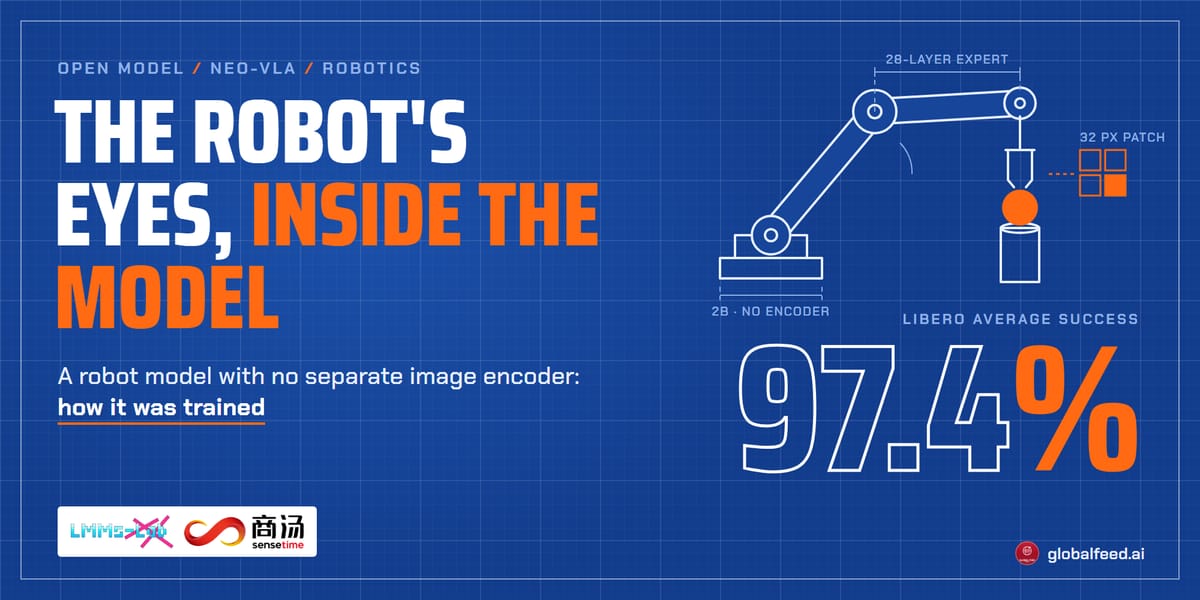
Imagine telling a robot arm to "put the tennis ball on top of the can." The top of the can is smaller than the ball, so the robot has to release it gently and dead center. Knowing where the ball is will not do; it needs to see edges, depth and the angle of its gripper relative to the ball. Most of today's robot models look at that scene through a separate "eye": another model reads the image first, writes a summary, and only that summary reaches the part of the robot that decides what to do.
Researchers from S-Lab at Nanyang Technological University in Singapore, SenseTime Research and Ropedia released NEO-VLA on November 3. This 2-billion-parameter robot model has no separate eye. Pixels from the cameras pass through one small layer and go straight into the language model, where they are processed together with the words of the instruction in every layer. The part that produces movement does not look only at the last layer either; it reads from different depths of the model. The team has published the code, the open model and the dataset it trained on. Here is how a robot model works, how NEO-VLA was trained, which experiments worked and which did not, and how you can try it.
Image, instruction, action: what a VLA is
VLA stands for vision-language-action. Such a model takes three things at once: images from the cameras, the instruction a person typed, and the robot's current state (joint angles, whether the gripper is open or closed). Its output is the movement the robot will make over the next short stretch of time. NEO-VLA produces a 30-step action chunk each time; the robot executes it, then asks for a new chunk with a new image.
Most of these models are built as an extension of chat AI. You start from a vision-language model that understands images and text, then teach it to produce movement with robot data. Recognizing objects, telling "the red bowl" from "the blue bowl", comes from that pretraining. The question is how the image reaches the language model.
What the separate eye does, and why it was removed
In the classic setup the image first passes through a separately trained image encoder such as CLIP, SigLIP or DINOv2. The encoder compresses the picture into a meaningful summary: "a ball on the table, a can next to it." Think of the minutes an assistant writes for a manager who missed a meeting. The minutes tell you what was discussed, but who said it in what tone, and the small details on the table, are gone. According to the NEO-VLA team, what a robot loses this way is edges, local geometry and depth cues. The fine detail needed for movement is abstracted away before it reaches the policy.
NEO-VLA removes the minutes. A small two-stage convolutional layer cuts the pixels into 32-pixel patches, and each patch enters the language model's token space directly. Each camera view fits into at most 88 tokens; the model can look at up to three cameras and at both the current and the previous frame. The cameras' intrinsics and rotation are fed in as well. Text is read in order, while image patches can attend to each other in every direction, and positions are kept on three axes: time, height and width. Image and language are processed together from the first layer to the last.
How it was trained: backbone first, then robot data, then the action expert
Backbone. At the center sits NEO-2B, a 40-layer vision-language model without a separate image encoder that the same group released earlier and presented at ICLR 2026. It was trained in three stages: large-scale image-text pretraining to give it sight, mid-training on captioning, conversation, OCR and detection data, then instruction tuning. The visual path has no vision transformer, autoencoder or quantized codebook.
Robot data. For action training the team combined nine public dataset families: AgiBot-World, Bimanual YAM, RoboCOIN, Open X-Embodiment, Galaxea Open-World, RoboMIND, RH20T, DROID and the simulated InternData-A1. That is 2,231,583 episodes and 9,927 hours of robot recordings. Data from so many sources is messy, so every recording was filtered. Implausible joint readings, channels that never change, action outliers and corrupt episodes were masked or dropped. Camera calibration was checked too: the arm's recorded 3D positions were projected into the image and compared with the motion actually visible, and poses that did not match were marked unknown. The team removed only the faulty part and kept the rest of each recording.
Action expert. The part that produces movement is a narrow 28-layer network initialized from scratch. Each of its layers reads the cached keys and values of one chosen backbone layer. It generates movement with flow matching: starting from random noise and moving toward the right action in 10 steps. The output is two 26-value arm chunks and one 8-value body chunk. An arm has 7 joint targets, 3 translation, 3 rotation, 1 gripper and 12 hand-joint values; the body covers base motion, torso and head. That lets one model describe very different machines, from a single-arm tabletop robot to a two-armed robot with hands and a wheeled base.
Three stages. In stage 1 the backbone was frozen and only the action expert and the small modules that handle camera and state inputs were trained: 113,400 steps with 8,192 samples per step. In stage 2 the whole model was unfrozen and trained for another 75,000 steps on the same robot data, with image and text understanding examples added on every other step so the model kept its vision-language skills while learning to act. Stage 3 continued for 75,000 steps on the team's own in-house action data.
What was tried and what did not work
The most instructive part of the paper is how the team measures each design choice one by one. In all of these experiments the models were trained under the same settings, for 75k steps on Open X-Embodiment, and scored on LIBERO over 2,000 rollouts.
Which layers should the expert read? The team kept the expert at 28 layers and changed only which backbone layers it reads. With a frozen backbone, early layers won: reading the first 28 layers scored 94.9%, spreading reads evenly across all 40 layers scored 90.9%, and skipping the first 12 layers scored 86.7%. Losing access to the early layers cost 4.2 points. With the whole backbone fine-tuned, the readout spread across every depth was best at 95.3%. An intervention test points the same way: swapping one layer's information with that of a different scene raised the movement error most at layers 0 to 10. Hiding the wrist camera hurt most around layers 6 to 10, and deleting the instruction hurt most at layer 0. Language, appearance and geometry each have their strongest influence at a different depth.
Same expert, three backbones. The team paired the same action expert and the same robot data with Qwen3-VL-2B, Gemma-3-4B and NEO-2B:
| Backbone | Size | Frozen backbone | Full fine-tuning |
|---|---|---|---|
| Qwen3-VL | 2B | 79.5 | 90.8 |
| Gemma-3 | 4B | 84.5 | 91.0 |
| NEO-VLA | 2B | 90.9 | 95.3 |
With the backbone frozen, NEO is 11.4 points ahead of Qwen3-VL and nearly as good as the other two after full fine-tuning. The team adds an honest caveat: the three backbones were pretrained on different data with different capacity, so this comparison does not isolate the effect of removing the encoder alone.
An idea that did not work: giving access inside the encoder. The obvious objection is that NEO wins only because it can reach early visual features. The team tested this directly by routing 13 expert layers in Qwen3-VL to the encoder's intermediate features. It went the other way: frozen-backbone success fell from 79.5% to 64.9%, and after full fine-tuning the two interfaces were level at 90.8% and 90.9%. The team's conclusion is that early visual features help only when they are learned together with language and presented in the space the rest of the model uses.
A second idea that did not work: training on action data alone. The team compared post-training on robot actions only with post-training that also mixes in image and text understanding data. The mixed model stayed within 1.5 points of its starting point on understanding tests and reached 69.4% on RoboTwin 2.0's hard split. The action-only model stopped producing valid text and fell to 10.7% on the same test. Good robot movement turned out to depend on the backbone keeping its understanding.
On benchmarks and on a real robot
LIBERO is a widely used simulated test of tabletop tasks: putting objects in specific places, opening drawers, finishing long sequences of steps. NEO-VLA averages 97.4% here. In the same table, open models π0.5 score 96.8%, EO-1 98.4% and OpenVLA 76.5%. The team writes that LIBERO is close to saturated and reports it mainly to show the model keeps its basic skills.
LIBERO-Plus runs the same tasks under seven kinds of disturbance: camera angle, the robot's starting state, instruction wording, lighting, background, image noise and object layout. NEO-VLA's total of 89.7 is the highest in the table. It is especially strong when the camera moves, at 94.5%, and weaker when the robot's starting state or the layout changes. RoboTwin 2.0 measures two-armed tasks and checks whether a model trained on clean scenes holds up on randomized ones. NEO-VLA scores 69.4% there; according to the team, the best result among methods with both code and model public.
The team states plainly that when object positions or the task goal change, NEO-VLA, like the other models in the table, mostly fails. They see that as the next step: robust perception is coming along well, and the next job is turning it into flexible movement under changing geometry.
Real robot. The team built a small three-task benchmark. Each model was trained on only 50 demonstrations per task and tested 20 times, 10 in layouts like the training data and 10 in different ones.
| Model | Size | Ball on can | Tape and ball | Can upright in tape |
|---|---|---|---|---|
| StarVLA | 3B | 1/20 | 2/20 | 0/20 |
| π0.5 | 3B | 10/20 | 14/20 | 13/20 |
| NEO-VLA | 2B | 12/20 | 17/20 | 13/20 |
Task two has two stages: the tape roll goes into the bowl, then the ball goes into the roll. In task three the robot grasps a lying can by its side, rotates it 90 degrees and stands it upright in the roll. The team notes that 20 trials is a small sample and a difference of one or two successes is within noise. The project page also shows the robot pouring water from a paper cup into a glass and picking four gunkan pieces, one by one, from a table of mixed sushi onto a plate.
On speed, the model runs on a single RTX 3090. From requesting a 30-step action chunk to having a plan the robot can execute takes 286.2 milliseconds, most of it spent in the action expert's 10 steps.
How to try it
The open model files are on Hugging Face in five folders: stage 1, stage 2, the vision-language backbone taken from stage 2, and two ready policies tuned for LIBERO and RoboTwin 2.0. Download the folders you need like this:
from huggingface_hub import snapshot_download

snapshot_download(
    repo_id="weepiess2383/NEO-VLA",
    allow_patterns=["stage2/*", "stage_libero/*"],
    local_dir="NEO-VLA",
)
To adapt it to your own robot, follow the training guide in the VLAKit folder; the stage 2 files are the suggested starting point. The action data used in pretraining is shared as a separate dataset. The model card reminds users that the checkpoints need task-specific adaptation and evaluation before going on a physical robot. The code is released under Apache 2.0, free to use, modify and distribute; the backbone files and source datasets keep their own original terms.
NEO-VLA's real contribution is not a single score. It removes a part robot models have taken for granted for years and measures, carefully, what replaces it and what each layer carries, while keeping code, data and files open so others can repeat the experiments. Because the other models' numbers come from earlier papers with different test setups, the team does not present these tables as a definitive ranking, and it is worth following what independent researchers find on their own robots.
Sources: NEO-VLA announcement, arXiv paper, Hugging Face model card, NEO GitHub repository, Pretraining dataset

