
ERNIE 5.5 Flash Preview opens up: how was it trained across 300,000 workspaces?
Baidu's 280B agent model with 1M context is Apache 2.0 on Hugging Face; compressed attention, training environments, what did not work and the results.

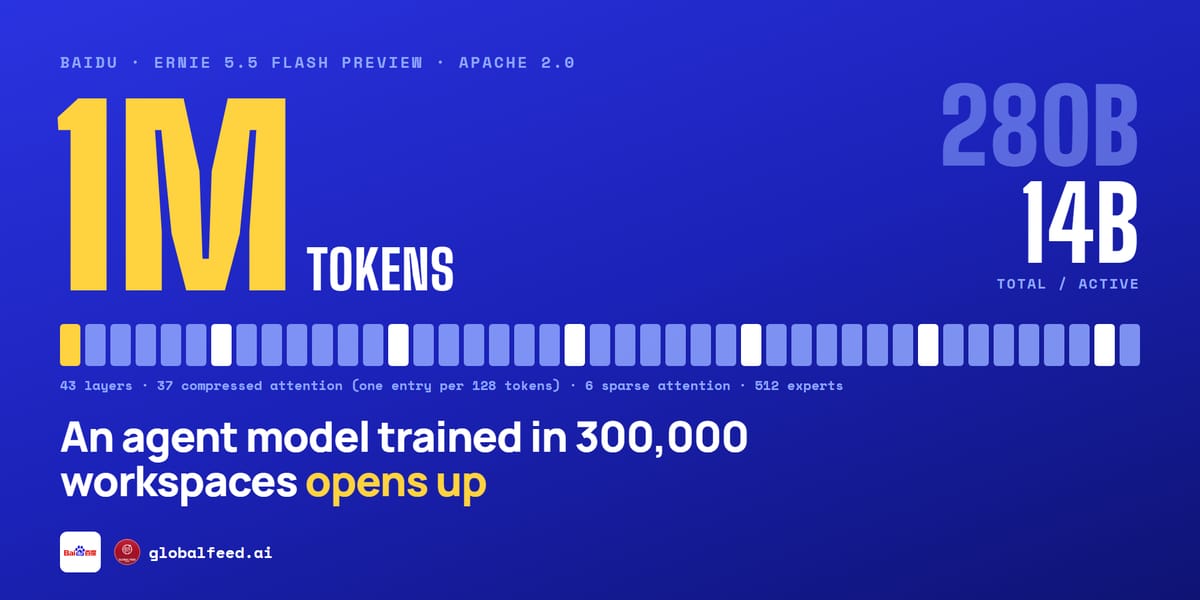
A few weeks ago Baidu opened the raw base version of ERNIE 5.5 Flash, which we covered as a model you cannot chat with but can build on. Now the chat and agent version built on that base is here. ERNIE 5.5 Flash Preview was uploaded to Hugging Face on November 23 under Apache 2.0: 280 billion parameters with 14 billion active per token and a 1-million-token context window. The card calls it an intermediate post-training checkpoint, with training still ongoing. Our earlier story explains how the base was trained.
Architecture
It has 43 layers, one dense and 42 mixture-of-experts layers with 512 routed experts plus one shared expert and top-10 routing in a 2,048-dimensional latent space. Thirty-seven layers use Heavily Compressed Attention, caching one entry per 128 tokens plus a 128-token sliding window; six use sparse attention that picks the 2,048 most relevant positions through a small indexer. Most parameters are FP8, with routed experts in quantization-aware-trained MXFP4, bringing the smallest checkpoint to about 155 GB. A DSpark draft head ships for speculative decoding.
How it was trained
The base was pre-trained from scratch on 33.5 trillion tokens with up to 128K context, per the vLLM-ERNIE repo, and mid-training extended context to 1M. Per Baidu's blog, post-training used 300,000 knowledge-work workspaces in fields such as finance and law with 10 million reference files across more than 40 file types, over 150,000 video-creation environments supporting more than 1,000 skills, plus game-development data covering Unreal, Unity and Godot and training in Blender and CAD tools. SFT data, RL algorithms and step counts are not disclosed.
Three papers describe components, tested on small research models rather than the 280B model. ECHO has the final layer predict future tokens with randomly sampled depth, raising a 14-task average from 35.22 to 35.73 on a 10B model, though a deeper ECHO-2 setup did worse. VHA cuts KV cache from 4 KB to 1 KB per layer per token, but each half of the method alone fell below the baseline and it trails MLA on coding. Multi-View Latent MoE lifts a nine-task mean from 33.07 to 34.25, with a third routing head adding nothing reliable.
Results
On the card's self-reported table, Preview leads AutomationBench at 61.9 (Claude Opus 5.5: 58.0), SpreadsheetBench V2 at 36.4 and edges MCP-Atlas at 84.6 against 84.2. On harder agentic and reasoning tests, Claude Opus 5.5 and GPT-6.1 Sol stay clearly ahead: Terminal-Bench 4.0 is 46.5 for Preview against 66.4 for Claude Opus 5.5, and text-only HLE is 46.4 against 61.4. Among open models it trades places with DeepSeek-V4.1-Flash and Hy4.
How to run it
Weights are about 155 GB (FP4), 280 GB (FP8) or 560 GB (BF16), which means four 80 GB GPUs for the smallest build. It runs on vLLM 0.32.0 with the vLLM-ERNIE plugin or on SGLang; thinking is on by default with low, medium or high effort. An API is available on Baidu's Qianfan platform. The model is text-only.
Sources: Hugging Face model card, ERNIE blog, ECHO paper, VHA paper, Multi-View MoE paper, vLLM-ERNIE

