
Forty-four hours, 10 cloud accounts: what one forgotten key opened at Barracuda
Barracuda's CISO has published an hour-by-hour account of an intrusion into the company's cloud. The attacker used a key given to a vendor and never retired; the traces match the open-source AI pentest framework ARTEX. The company's lesson is short-lived credentials.

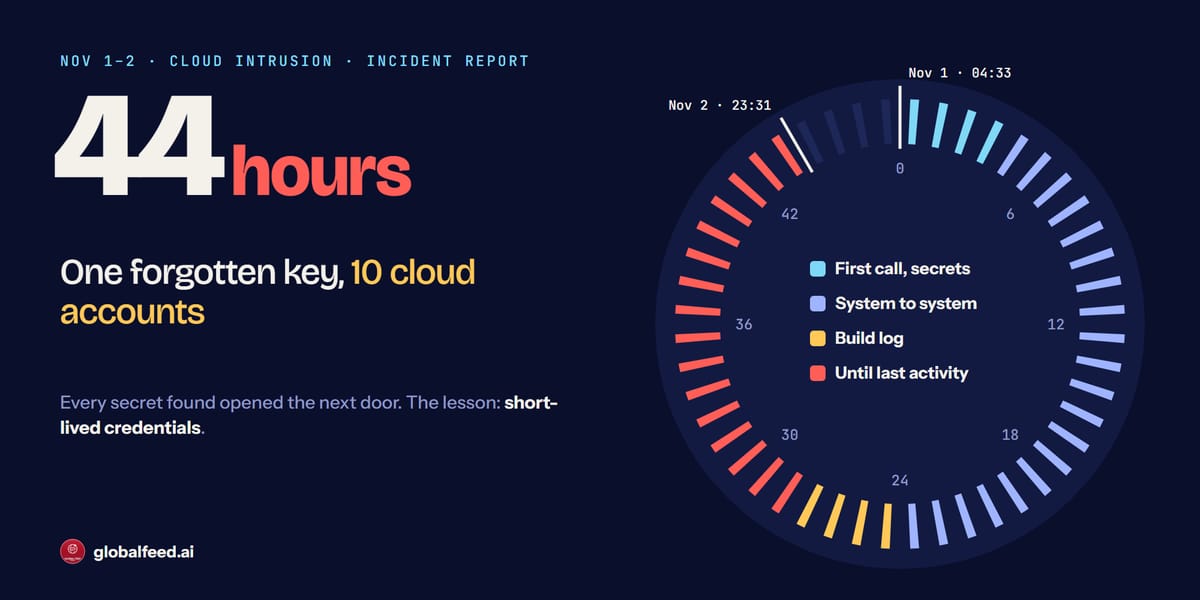
When a company's security chief publishes an hour-by-hour account of an attack on their own company, it is worth reading. Arve Kjoelen, chief information security officer at security firm Barracuda, did exactly that on November 11. The post, "Forty-four hours: Anatomy of a machine-speed intrusion", lays out how the attacker got in, what it did over two days, what it was looking for and what the company has learned. Its most striking finding: the attack's fingerprints match an open-source, AI-driven penetration-testing tool released in July.
The door was not broken, it was unlocked with a key
According to Barracuda, the attacker came in with a valid cloud access key. The company had given the key to a vendor working in AI for an earlier project and did not retire it when the work ended. Kjoelen owns it in one sentence: "That is on us." In October, the vendor's own development environment was compromised. Barracuda's advisory, updated November 13, says the key was stored in a configuration file in the vendor's GitHub repository and was exposed in that compromise. Other Barracuda credentials in the same file had already expired or have since been revoked.
What happened, step by step, over two days?
The attacker made its first call with the key on November 1 at 04:33 UTC. Within minutes it was mapping what the key could reach and reading stored secrets such as AWS access keys and Azure service principal secrets. Over the next 24 hours it used each secret it found to reach the next system: from cloud accounts to a data analytics system, from there to a source-code access token, and from there to Kubernetes clusters.
In the early hours of November 2, in just under four hours, it pushed short-lived branches to a handful of repositories to trigger a build workflow that printed the build system's secrets into the job log. The secrets were encoded, so the log's usual masking did not hide them. The last recorded activity was at 23:31 UTC on November 2. In Barracuda's summary, the attacker touched about 10 cloud accounts in roughly 44 hours.
The attacker also tried to leave a way back in. On one Kubernetes cluster it deployed a container that mounted the server's file system read-only and harvested that server's credentials. An attempt to create a new administrative cloud identity was blocked. Barracuda removed the container on the evening of November 4 and rotated credentials across every system involved.
Why do the traces point to ARTEX?
The attacker gave its resources no human-readable names: all began with the letter "i" followed by digits (for example i31911 or i28324probe). According to Barracuda, this naming, the order of the attack and built-in routines that hunt for credentials and crypto wallets match ARTEX, an open-source penetration-testing framework released in July 2026. In its design, a "planner" AI agent decides the next step while "worker" agents run common tools and add what they find to a shared map of the target. It was built for authorized security testing. Barracuda notes that researchers at Wiz, Microsoft, Google and CrowdStrike have reported malicious groups using it as well, and stresses one point: because many groups use the tool, the match shows how the attack was carried out, not who carried it out.
The post is also clear about what the attacker wanted. First, credentials and secrets everywhere: secret stores, infrastructure state files, server metadata services and Kubernetes service accounts. Second, cryptocurrency; its commands searched for environment variables such as WALLET, MNEMONIC and SEED and for wallet files. Barracuda says no wallet material exists on those systems. It also notes a third possibility: some of the secrets in reach were credentials for AI services. The incident report from cloud platform Railway, hit in October, describes a similar chain and an ARTEX-like harness.
What should Barracuda customers do?
One of the systems the attacker reached stores the credentials Barracuda XDR uses to collect data from customers' connected systems. The company says it found no direct evidence that these were accessed, but its logs were not detailed enough to rule it out. So it assumed the worst and contacted potentially affected Managed XDR Cloud and Monitored Endpoint customers directly, asking them to revoke and recreate their integration credentials and to review activity in connected systems from November 1. Customers who have not heard from Barracuda do not need to do anything.
How can your own team cut this chain at the start?
Kjoelen's own lesson is direct: short-lived, narrowly scoped credentials would have stopped this intrusion at its first step. A few established practices help cut such a chain early:
- Scan repositories for forgotten keys. Open-source scanners such as Gitleaks and TruffleHog check a repository's full commit history, not only its current state. Running them in a pre-commit hook and in CI keeps keys from entering the repository at all. GitHub's secret scanning and push protection do the same job on the server side.
- Keep an inventory of keys given to third parties. Every key handed to a vendor should have an owner and an end date, and should close when the project closes.
- Prefer short-lived identities over standing keys. Role assumption in AWS, workload identity in Azure and OIDC-based cloud login in GitHub Actions issue credentials that expire on their own within hours.
- Check who can trigger build workflows. Here, secrets were dumped into a log by a workflow triggered from freshly pushed branches. Exposing secrets only to protected branches and approved environments is sturdier than relying on log masking.
- Shrink what a single key can open. In Barracuda's words, no single credential should open the next door, and the one after that.
The last part of the post is about information sharing. The most useful outside signal Barracuda received came from the vendor, which did not think Barracuda was affected but shared what it knew without waiting to be sure. Detection itself started when an engineer noticed unusual activity on their own account and reported it. Kjoelen argues that companies should share indicators early, even when unsure, and that automated threat feeds will speed this up. Barracuda's detailed, candid account of its own mistake is part of that sharing.
Sources: Barracuda blog, Barracuda Trust Center advisory, Railway incident report

