
A voice that talks with the internet off, in 65 MB: how Gradium built Phonon
Gradium's open voice model Phonon speaks offline on phones, in the browser and on a Raspberry Pi, and sits next to models 100 times larger on Hugging Face's new leaderboard. Here is how it represents sound, how it was trained and how to try it.

An Apple Watch with Wi-Fi switched off talks you through brewing coffee, step by step, from your wrist. In a gym with no signal, a phone counts your reps out loud and keeps you going. In an offline dino runner game in the browser, a character named Rex hosts a live radio show. Every one of these demos speaks with the same small model, and none of them touches the internet. The model is Phonon, from voice AI company Gradium, and its smallest version takes about 65 MB.
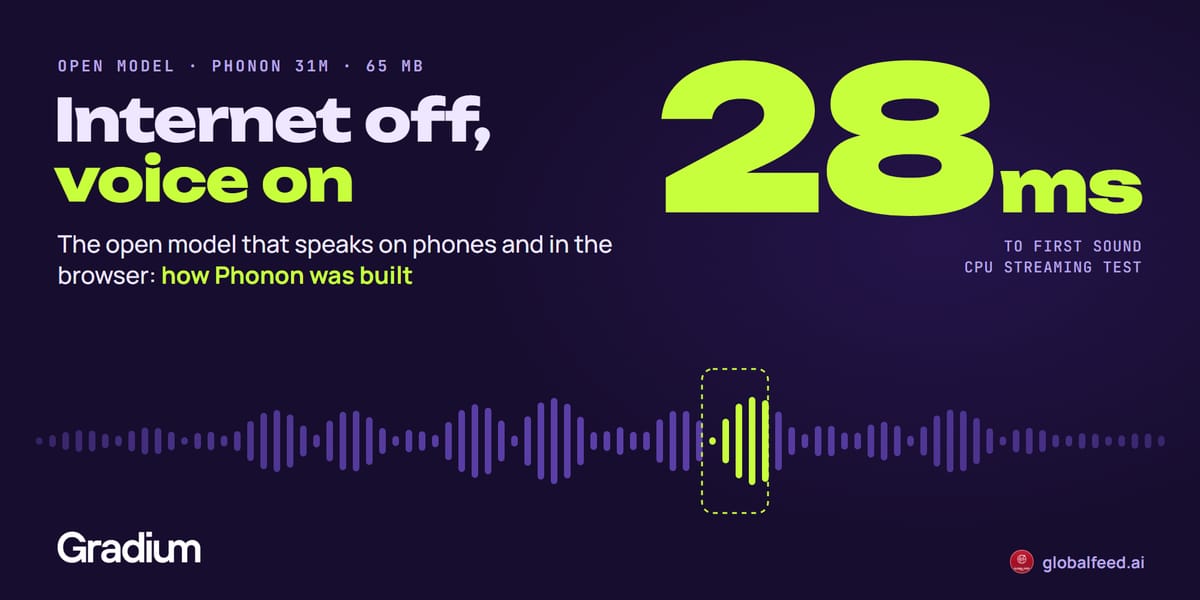
Gradium released Phonon as an open model on October 20. On November 5 it shared the first two weeks in a joint post with the Hugging Face team. According to the company, the model was downloaded more than 200,000 times in two weeks. On Hugging Face's new open text-to-speech leaderboard, Phonon ranks first in German and Spanish on intelligibility and in the top three in every language measured, next to models up to 100 times its size. In the CPU streaming test it starts speaking in 28 milliseconds. Below we explain what text-to-speech models do, how Phonon stays this small and still sounds good, how it was trained, and how you can try it today.
What a text-to-speech model does
Text-to-speech (TTS) models turn written text into a human voice. Screen readers, navigation apps, voice assistants, game characters and audiobooks all speak through them. Most of the voices we hear today live in the cloud: the app sends each sentence to a server, the server generates the audio and sends it back. That round trip needs a network connection and costs money on every request.
A model that runs on the device changes all three. Your text stays on your device, the voice keeps working in a tunnel or in airplane mode, and the app maker does not pay per request. As Gradium puts it, the problem was always the same: make the model small and it stopped sounding good, make it sound good and it no longer fit. Phonon is one of a new generation of small models trying to solve that. The company says both sizes run without any server on phones, laptops, single-board computers such as the Raspberry Pi and inside a browser tab.
What the leaderboard measured
The Open TTS Leaderboard is a new Hugging Face project for comparing open voice models in one place. The Hub hosts more than 9,000 TTS models, and the leaderboard measures them in 23 languages on three axes: how many words come out wrong when the speech is transcribed back to text (intelligibility), how fast audio is generated and when the first sound arrives (speed), and how natural it sounds (naturalness). There is also a Listen tab where you can hear models read the same sentence side by side and vote for the one you like.
Phonon ranks first on intelligibility in German and Spanish. On speed, the leaderboard looks at time to first audio in CPU streaming, and the two fastest models are both Phonon: the 31M English model at 28 ms and the 40M model at 38 ms. Pocket TTS, third on the same chart, starts at 165 ms. The figures are 95th percentile, so 95% of measured runs were at least this fast. For scale, 28 ms is under a third of a blink.
Gradium's own measurements point the same way. On a MacBook Air M5 CPU, the company says Phonon starts speaking in about 7 ms, while Kokoro, which does not stream and so waits for the whole sentence, takes 517 ms. On a Raspberry Pi 5 the 31M model starts in 38 ms and speaks 3.7 times faster than real time. Arm measured 28 ms on its CPUs, and on Qualcomm's Snapdragon 8 Elite Gen 5 the figure is 7.5 ms at 24 times real time.
For voice quality, Gradium had independent listeners compare two voices blind and pick the better one. In English, with 468 raters and 8,290 votes, the model card reports these scores (a higher Elo means listeners preferred it more; a lower hard-set error means more accurate reading):
| Model | Elo (listener preference) | Word error on hard sentences |
|---|---|---|
| phonon-31m-en | 2098 | %1,5 |
| phonon-40m-en | 2117 | %2,3 |
| phonon-40m-multilingual | 2097 | %2,0 |
| Kokoro | 2043 | %3,5 |
| NeuTTS | 2034 | %8,7 |
| Magpie | 1939 | %28 |
The hard set is a telling detail. Phone numbers, dates, time windows, version numbers and units are where voice models trip most often. Gradium built a 500-sentence test set per language from cases developers' current models get wrong, and made it public. In the company's examples another model turns "minus three degrees Celsius" into a meaningless name and reads version "3.10" as "3.1", while Phonon runs a normalization step that writes numbers and symbols out in the right language before speaking.
How it was trained: continuous sound instead of chunks
Phonon's small size comes down to how it represents sound. Most audio language models first cut audio into small codes with a lossy compressor, then predict those codes one by one, the way a language model predicts words. It is like painting by numbers with a limited set of pencils: with few pencils you lose detail, and a better picture needs more pencils and more work. The CALM (Continuous Audio Language Models) research the Gradium team did earlier at the Kyutai lab took another route. The model generates sound directly as continuous values instead of numbered codes, and the paper reports higher quality at lower compute cost. The same work produced the 100M-parameter Pocket TTS in January 2026, which showed real-time speech on a laptop CPU.
Phonon builds on that line. According to Gradium's launch post, a causal transformer backbone first takes the text and speaker features as a prefix. Text is split with a 4,000-token SentencePiece vocabulary, so the model reads raw text with no language-specific phoneme converter. That makes new languages easier to add, and the company credits part of its lead in French, German and Spanish to this choice. The backbone then produces one vector for every 80 ms of audio. A small head using flow matching combines that vector with random noise and turns it into continuous audio features in a single step. A smaller version of Kyutai's Mimi decoder turns those features into 24 kHz sound, and a separate head decides when speech should end.
The two sizes differ only in backbone depth: 6 transformer layers in the 31M model, 9 in the 40M, both 512 wide with 8 attention heads. The audio head and decoder are shared by all Phonon models. The model card puts the 31M model at exactly 30,788,354 parameters, and the decoder that makes the audio audible adds about 10.3M more. Every Phonon model was distilled from a larger Phonon teacher: the large model learned first, and the small ones learned to imitate it, packing that knowledge into fewer parameters. Training ran on an NVIDIA H100 cluster, and the team says it used CUDA Graphs to speed up experiments on such tiny models.
It was not a straight road. In the Hugging Face post the team writes that flow matching brought this quality to this size but created new training problems: training was numerically unstable at first and needed several tricks to produce good results in all five languages. The post does not say what those tricks were. The contents of the training data and the number of hours used are not disclosed either. For a sense of scale, Kyutai's open training code for Pocket TTS, from the same lineage, suggests 200 hours of English for an intelligible model and 2,000 hours or more to match the official one.
Phonon's history also shows what was tried. Gradium first announced it in April 2026 as a private beta of about 100M parameters. At the time each partner got a separate model fine-tuned for one voice, one language and one use case. Voice cloning had been trained only on 10-second samples; when shorter references came in, the team looped them instead of retraining. The March version scored 1.48% word error on the Seed-TTS English test, and the May update brought it to 1.00%. For these evaluations the team used OpenAI's Whisper instead of its own speech recognition model, so that techniques shared between its two models would not tilt the result. Partner feedback made the model smaller and added languages, and the October release opened it to everyone with more than 100 built-in voices. The same day, Kyutai published work shrinking Pocket TTS from 18.2M down to 1.9M parameters, and Gradium says it draws on those miniaturization techniques.
How to try it
The easiest way is the browser demo, with nothing to install: type a sentence and the voice is generated inside your tab. To try it on your computer one line is enough; uv runs the package without installing it:
uvx ptts --lang en --quant q8 --voice Easton "Hello from Phonon." -o speech.wavFrom Python:
pip install ptts

import ptts
tts = ptts.TTS("hf://gradium/phonon-31m-en", lang="en", quant="q8")
tts.save("speech.wav", "Hello from Phonon.", voice="Easton")
Gradium's open source runtime, ptts, supports more than 10 hardware backends: Intel and Arm CPUs, WebAssembly and WebGPU for the browser, NVIDIA CUDA, Vulkan, Apple Metal and Core ML, and the Snapdragon NPU. The repo includes guides for iPhone and Android apps, an engine that works as Android's system voice with the TalkBack screen reader, a Home Assistant setup and an OpenAI-compatible local server. Phonon is also in Hugging Face Transformers 5.21 and later, MLX-Audio for Apple Silicon, Ollama, and the read-aloud feature in LM Studio's Bionic app. It ships with more than 100 voices; in Gradium Studio you can clone a voice from a short recording with the speaker's consent or describe a new one in plain text. The downloaded voice file loads into Phonon and runs fully on the device. Supported languages today are English, French, German, Spanish and Portuguese, and Gradium says it trains custom models for other languages with partners.
License
The 31M English model, the built-in voices and the decoder are Apache 2.0: free to use, including inside a commercial product. The runtime is MIT or Apache 2.0, your choice. The 40M language models and the multilingual model are free for non-commercial projects, and commercial pricing is based on the app's number of users.
Speed and listener scores are Gradium's own measurements; the rankings come from Hugging Face's new open leaderboard. The best check is your own ears in the leaderboard's Listen tab, along with tests from independent developers.
Sources: Hugging Face blog: Phonon TTS, phonon-31m-en model card, Gradium's launch post, ptts repository, Open TTS Leaderboard, CALM paper

