
Wave Forcing generates a 100-second AI video in 12 seconds
An open model from Shanghai Jiao Tong University lines GPUs up like an assembly line and streams video eight times faster than real time. The paper shows what failed, too.

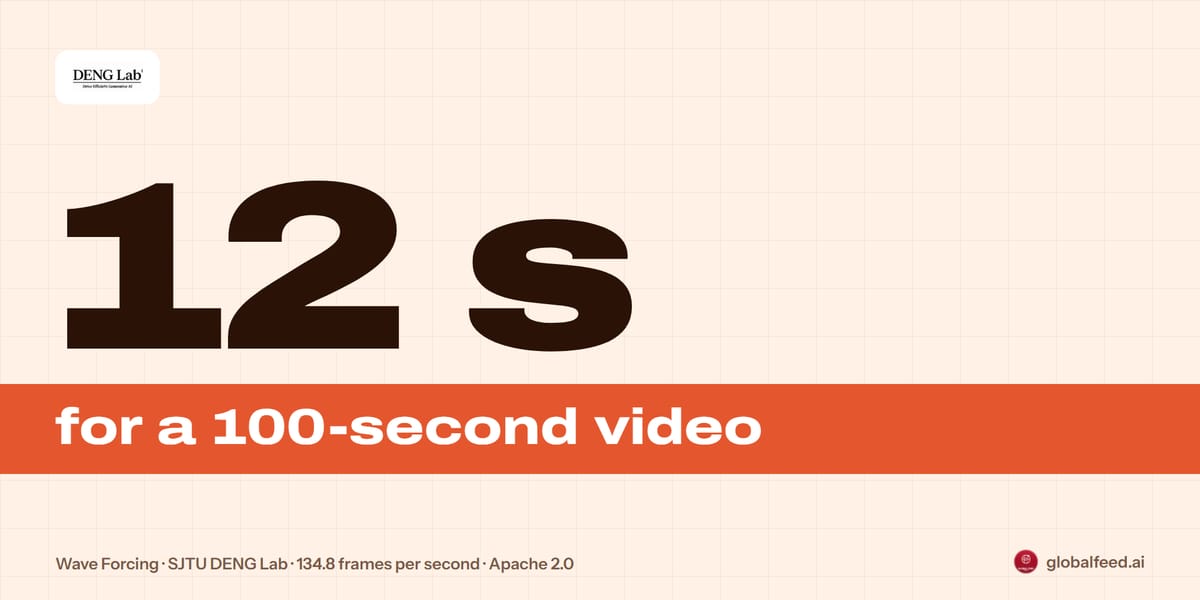
Making video with AI usually means waiting: minutes of progress bar for a clip a few seconds long. Wave Forcing, released on 31 October by DENG Lab at Shanghai Jiao Tong University, flips that around. According to the paper's measurements, the 1.3-billion-parameter model generates a 100-second video (1,593 frames) in about 11.8 seconds on a single eight-GPU server, or 134.8 frames per second. Put differently, the video streams out more than eight times faster than you can watch it. The model is built on Alibaba's open Wan2.1 video model and is on Hugging Face under Apache 2.0. The team did not name it modestly: the paper's title is "Towards Speed-of-Light Streaming Video Generation".
What this is about
Streaming video models do not produce a video in one go; they add it chunk by chunk, each chunk looking at the ones before. That lets a video run as long as you like, and the first frames can be watched before the last ones exist. But each chunk goes through several denoising steps. In Wave Forcing's four-step version these run at noise levels 1000, 750, 500 and 250, followed by one more pass that writes the finished chunk into memory for the chunks that follow. Done one after another, every chunk waits for five passes. Known methods such as Self Forcing and Causal Forcing need two passes per chunk even with a single denoising step.
An everyday comparison: the old way is one craftsman building every product from start to finish. Wave Forcing sets up an assembly line. Each GPU specialises in one stage, and chunks move down the line one step apart, like a wave. Once the line is full, one finished chunk comes off every round. The team calls this "wave parallelism", which is where the name comes from.
How it works
The line needs one rule to run smoothly: a noisier, newer chunk can look at the cleaner chunks before it, but never at chunks after it. So each GPU can keep working without waiting for the next chunk. Each chunk is 3 latent frames and decodes to 12 real frames. Every stage has its own full copy of the model on its own GPU: in the four-step version, four denoising GPUs, one memory GPU and three GPUs that decode the image to pixels, eight in all.
What makes it fast is WaveRT, the runtime the team wrote. The attention memory passed between GPUs leaves as soon as it is computed and travels while computation continues, and the receiving GPU writes it straight into the right slot, with no stitching afterwards. This cuts a step from 91.96 ms to 78.88 ms. The team also verified that the different transfer modes give bit-identical results, so the speed comes with no change in output.
How it was trained
Three models take part. The student is Wan2.1's 1.3-billion-parameter text-to-video model, adapted to generate chunk by chunk. The teacher is the same family's 14-billion-parameter model, frozen throughout. And a critic, initialised from the 1.3-billion model, judges the student's output. The method is distribution matching distillation (DMD): the small student is pushed to produce videos from the same distribution as the big teacher, so it can work in 4 or 5 steps instead of 50. No real video dataset was used; prompts come from a filtered version of the open VidProM prompt list.
Stage one, mixed-noise initialisation. The student trains on videos it generates itself. Each round runs either a Rolling Forcing or a Self Forcing style attempt, with even odds; the paper says the Self Forcing attempts stabilise motion. It lasts 3,000 rounds: 3,000 critic updates and 600 student updates.
Stage two, distillation with teacher data. The 14-billion teacher generated 2,176 video samples at 50 steps, 2,048 for training and 128 for validation. In this stage consecutive teacher chunks are re-noised at staggered levels, with earlier clean chunks supplied as memory. An image similarity term (LPIPS, weighted 0.25) is added to the loss. It lasts 1,000 rounds. The five-step version skips stage one and starts straight from Rolling Forcing's released checkpoint.
Stage three, adapting to streaming. Each round picks a Rolling Forcing, Self Forcing or Wave Forcing style attempt with one-in-three odds; the Wave Forcing attempt uses memory built from its own output. It lasts 2,000 rounds. All stages use the Adam optimiser, learning rates of 1.5×10⁻⁶ for the student and 4×10⁻⁷ for the critic, and batches of eight. Evaluation uses the model's moving-average (EMA) copy.
What didn't work
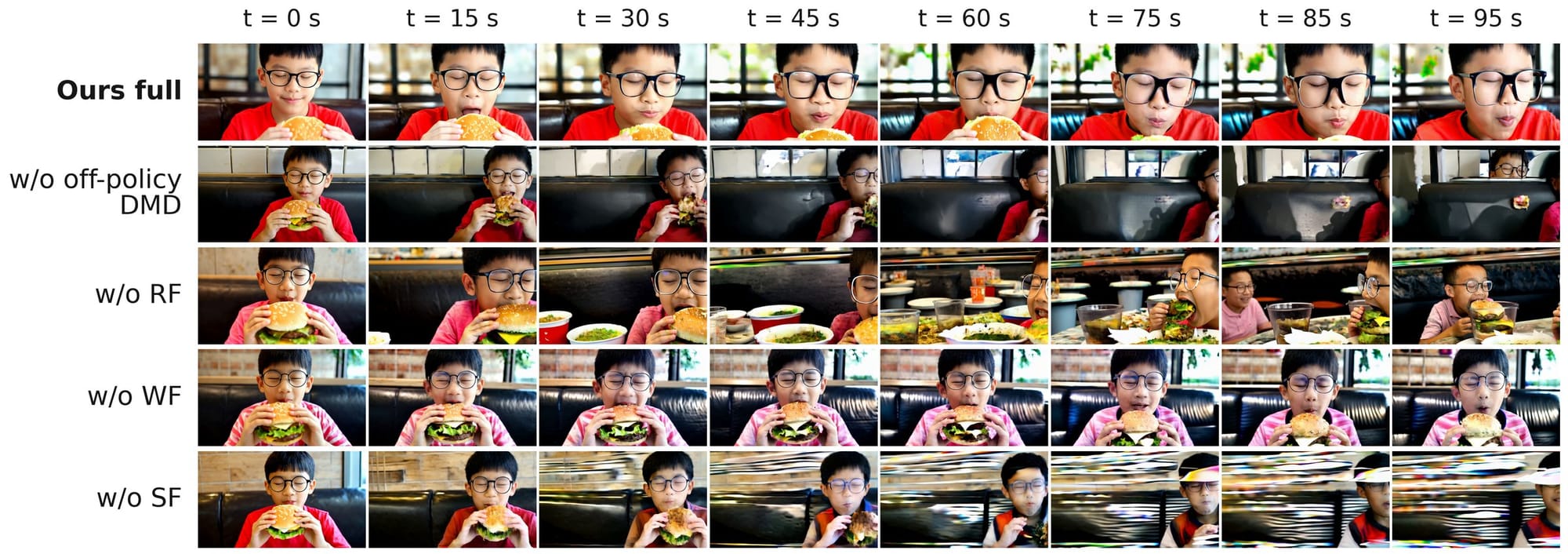
The most instructive part of the paper is where it removes training pieces one at a time. Without the teacher-data distillation stage, the long-video motion score falls from 74.97 to 15.73 and subject preservation from 91.88 to 76.53; in the image above the boy simply wanders out of frame. Without the Rolling Forcing attempts, motion goes up but camera drift jumps from 0.36 to 6.24. Without the Wave Forcing attempts, the subject is preserved best but the video nearly freezes, with motion down to 48.12. Without the Self Forcing attempts, both image quality and motion drop. The team's lesson: the three kinds of attempt pull motion and stability in different directions, and only all three together strike the balance. The team also did not train the 14-billion model because, according to the paper, the compute needed exceeded their resources.
How good it is
On speed the picture is clear. The same 1.3-billion model produces 19.06 frames per second on one GPU with Causal Forcing; Wave Forcing reaches 134.81 on eight, 7.07 times faster. Counting only the generation part it is 147.6, and steady streaming peaks at 157.8 frames per second with the fastest settings. The five-step version is slower but better looking, at 96.46 frames per second.
On quality the five-step version scores 81.64 on the VBench video benchmark, ahead of Rolling Forcing's 81.15. The real difference is in motion and consistency: dynamic degree rises from 51.39 to 94.44 on short videos and from 36.63 to 91.45 on 100-second ones, and the score for the subject staying the same throughout rises from 92.75 to 97.10. On camera drift Rolling Forcing leads at 0.17 against Wave Forcing's 0.37. The team sums up overall quality as "comparable" to Rolling Forcing, at a much higher speed.
The team also measured the method at 14 billion parameters, for speed only: the model was randomly initialised for this test and never trained. Speed goes from 5.51 frames per second on one GPU to 33.50. That shows the method scales to large models; it says nothing about image quality at that size.
How to try it
The model is on Hugging Face in 4-step and 5-step versions. Running it needs Python 3.12, PyTorch 2.11 and SGLang; the text encoder and image decoder come from the Wan2.1 repository. The runtime starts with python -m wave_rt, and --num-frames 399 reproduces the 100-second benchmark. By design it needs several GPUs: the reported layouts are five or six model GPUs plus two or three decoder GPUs. All measurements used eight NVIDIA H200s, and the code is so far validated only on Hopper-generation GPUs. The model and the WaveRT runtime are Apache 2.0; the training code in the GitHub repository is also shared for academic work under a separate licence.
Streaming video faster than real time opens a door for live broadcasts, game worlds and interactive video that users steer as it plays. The team points that way too, while being honest: changing the prompt mid-stream, camera control and serving several streams at once have not been tested yet. All measurements in the paper are the team's own; there is no independent evaluation yet.
Sources: Wave Forcing project page, Paper, GitHub repository, Hugging Face model page, Wan2.1 base model

