
Training one model across distant data centers: how does Google's Streaming DiLoCo work?
Google's MaxText team explained Streaming DiLoCo, which trains one model across data centers in different cities. Over a 10 Gbit/s link, Qwen3-32B's step time fell from 55.11 to 5.76 seconds. We explain the method, the numbers and how to try it.

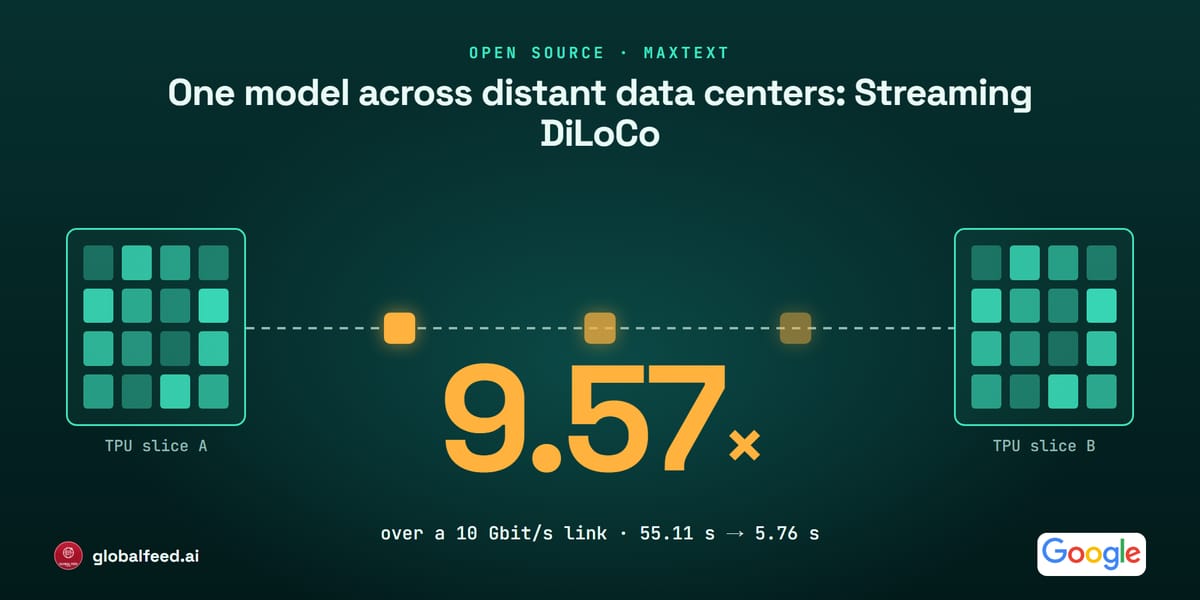
Training a large language model usually means wiring thousands of chips together inside one building with very fast links. What happens when those chips sit in data centers in two different cities? In a post published on November 19, Google's MaxText team described a method built for exactly that case: Streaming DiLoCo. In their measurements, training the 32-billion-parameter Qwen3-32B across two TPU groups over a 10 gigabit per second link brought the step time down from 55.11 seconds to 5.76 seconds, a 9.57x speedup over the usual method. Traffic between the two groups over the same span fell from 4,258.8 GB to 67 GB.
The method ships inside MaxText, Google's open-source JAX training framework, and you turn it on with a few lines in a config file. Here is what DiLoCo is, what the "Streaming" part changes, where Google's numbers come from and how to try it.
The problem: calling the whole team after every sentence
Most large models are trained with data parallelism. Each group of chips holds a copy of the model, processes a different slice of data, and at the end of every step all groups exchange and average their gradients in an operation called all-reduce. Inside one building, with links carrying hundreds of gigabits per second, that is fine.
Across cities it is not. In Google's example, Qwen3-32B in bfloat16 exchanges about 65.5 GB per step. With a step taking about 6.2 seconds, keeping up needs roughly 85 Gbps of sustained bandwidth. On a 10 Gbps line the same transfer takes over 50 seconds while the chips wait. Think of a group of writers who phone every colleague after each sentence: the line is busy and the text does not move.
What DiLoCo is: write a page, then meet
DiLoCo stands for Distributed Low-Communication training and comes from a 2023 Google DeepMind paper. Each group of chips, an "island", takes H steps on its own with the usual AdamW optimizer. Then the islands meet, measure how far each one's parameters moved (the "pseudo-gradient"), average those moves and apply them to the shared model with a second, Nesterov-momentum optimizer. Everyone then goes back to working alone from the updated model.
Communication drops by a factor of H. In the original paper, eight workers on C4 matched fully synchronous training while communicating 500 times less. A 2025 scaling study covering 35 million to 2.4 billion parameters found the method scales predictably with model size; at 2.4B, DiLoCo's loss was 2.317 against 2.326 for data parallel. In MaxText only parameters are shared; each island keeps its own AdamW state.
What Streaming adds: one box a day instead of one big truck
Plain DiLoCo has a weak spot: at each meeting the whole model is sent at once. For Qwen3-32B with H = 65, that is a 65.5 GB burst every 65 steps, and training stalls while it moves. The Streaming DiLoCo paper splits the model into fragments and syncs one fragment per step, like sending one box a day instead of moving house in a single truck trip.
In MaxText there is one fragment per layer plus one. Qwen3-32B has 64 layers, so 65 fragments, synced in turn. Fragment zero (embeddings, final norm and output head) is large, so it is split evenly across the others to avoid traffic spikes. By Google's math this brings traffic to about 1 GB per step and the needed bandwidth to about 1.3 Gbps. The post says weight deltas go to syncer workers on the learner hosts' CPUs, which run the all-reduce in the background while the TPUs keep training.
How it was done: the test setup and numbers
Google ran the test with Qwen3-32B on two TPU v5p-32 slices, throttling the link between them with Linux's tc tool; the post names no real cities or distances. Unthrottled, all three methods ran at 5.6 to 5.9 seconds per step. At 30 Gbps, data parallel rose to 19.41 seconds while plain DiLoCo took 6.39 and Streaming DiLoCo 5.76. At 10 Gbps, data parallel took 55.11 seconds, plain DiLoCo 7.55 and Streaming DiLoCo still 5.76. As the link narrowed, Streaming DiLoCo's step time did not move.
On quality, Google says Streaming DiLoCo matched the synchronous baseline loss on Qwen3-32B with no degradation. In 4,000-step runs with the mixture-of-experts models Qwen3-30B-A3B and Gemma4-26B-A4B, validation loss held and slightly improved, after brief sync adjustments in roughly the first 800 steps. The outer optimizer used momentum 0.9 and learning rates between 0.3 and 0.7.
How to try it
The feature is in MaxText v0.2.5 and later, on PyPI, in the Docker images and on GitHub main. Install with pip install maxtext==0.2.5 (Python 3.12 or newer). The MaxText DiLoCo tutorial adds these config lines: enable_diloco: true, enable_streaming_diloco: true, num_diloco_fragments and diloco_sync_period (both set to layers plus one), diloco_outer_lr: 0.7, diloco_outer_momentum: 0.9, and dcn_diloco_parallelism for the number of islands. The tutorial's examples use two TPU v5p-128 slices on Google Kubernetes Engine.
No second data center? You can emulate a slow link: dcn_bandwidth_limit: "10gbit" caps traffic at 10 Gbps. The docs list a few rules: the layer count must divide by the fragment count minus one, the global batch size must divide by the number of islands, and the sync period should equal the fragment count. On fast links DiLoCo brings no speedup and only adds memory for the outer optimizer on each island; it pays off where the link is narrow. If loss spikes at sync points, lower the outer learning rate; if islands drift apart, shorten the sync period.
The real promise of Streaming DiLoCo is loosening the need to fit training into one giant building. Pooling spare capacity from data centers in different cities for one model becomes workable over an ordinary metro link. The code is open and the tutorial is out, so you can throttle your own cluster with a tc rule and measure the difference.
Sources: Google Developers post, MaxText DiLoCo tutorial, DiLoCo paper (2023), Streaming DiLoCo paper (2025)

