
Tracing every number in a 3,000-page file: how Amazon Textract Insights works
Amazon Textract Insights extracts the fields you describe and attaches a confidence score, source page and position to every value. Blueprints, inference types and thresholds explained.

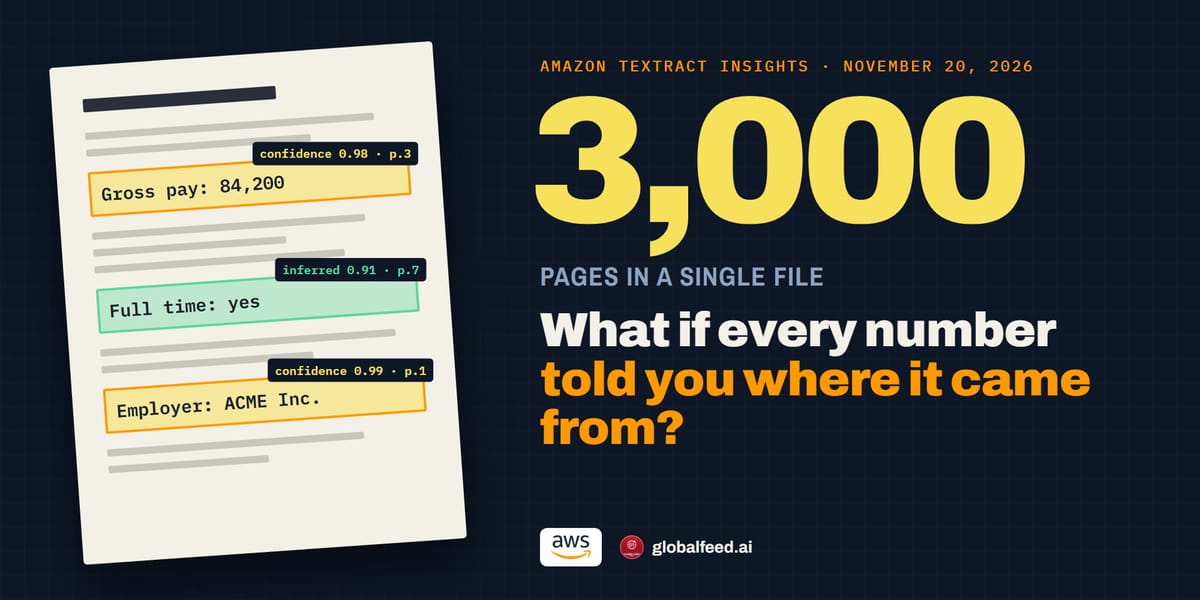
Picture a mortgage file: a single scan holding payslips, bank statements, a tax form and a loan officer's handwritten notes. The pages arrive in no fixed order and every document has its own layout. Ask a language model "what is the applicant's annual income?" and you will get a fluent answer. The real question comes next: which page did that number come from, and how sure is the model? Amazon Textract Insights, which Amazon made generally available on November 20, is built to answer exactly that.
According to the announcement on the AWS Machine Learning Blog, the new feature arrives as a separate API inside Amazon Textract. You describe the information you want in plain language and submit a single document or a mixed packet of many documents. The structured result attaches a confidence score to every value, along with the page and the position on that page it was drawn from. No model training is required. This article walks through how verifiable document extraction works.
The problem: a fluent answer is not enough
Document processing is daily work for banks, insurers, healthcare providers and public agencies, who turn scanned files and paper forms into data their systems can act on. The AWS post describes two common approaches. The first is a custom pipeline: optical character recognition, document splitting, classification, a prompt to a foundation model and a human review step, all integrated, scaled and operated by the team.
The second is using a general-purpose large language model by default. The post says this gives fluent answers but does not reliably cite the source page or provide a confidence score. Without a traceable source and a calibrated score, it is hard to know which values to accept automatically, so automation tends to stall. Textract Insights aims to fold the whole workflow into a single asynchronous request.
Blueprints: describing what you want
At the centre is a blueprint, which is a JSON Schema where every field has a name and a natural-language description of what to look for. Each field also has an inference type that decides whether the value is read verbatim from the page or inferred from the document's content. Gross pay on a payslip is printed and gets read; whether someone works full time is often not in any single box and has to be inferred. Keeping the two apart makes it clear in the output what was read and what was interpreted.
AWS provides public blueprints for common documents such as the W-2, Form 1040, Form 1098, passports and birth certificates, and teams can write their own for business-specific documents.
Splitting a mixed packet
You add a blueprint for every document type you expect to the same project, submit one file of up to 3,000 pages from your Amazon S3 bucket, and turn on splitting. The service breaks the packet into logical sub-documents, matches each to the right blueprint, extracts the fields and returns a confidence score and grounding for every value.
The example in the post is a 26-page mortgage PDF containing a W-2, payslips, bank statements and handwritten notes. The project uses the public W-2, payslip and bank statement blueprints plus a custom one for the notes. One StartDocumentInsights call sends the file; results land in your S3 bucket with a confidence score, page and bounding box for each value.
Confidence and grounding
Both explicit and inferred fields come back with a confidence score and page coordinates, so a reviewer or auditor can check any result against the original. AWS recommends accepting values above a confidence threshold and routing the rest to review, tuning that threshold on a representative sample of your own documents. Vijay Agrawal of Symbeo, a CorVel company, is quoted saying extraction rules built for one source of medical bills rarely transfer to another, and confidence scores let his team review only the low-confidence fields. The post does not explain how the confidence score is calculated.
A refreshed engine underneath
AWS also updated Textract's reading engine, Amazon Textract Core, with better handling of dense tables and handwriting and support for 40 languages in the DetectDocumentText and AnalyzeDocument APIs, with no changes needed from existing customers. Textract Core is now in Tokyo and Zurich, for 18 AWS Regions in total, although Insights is not yet available in those two. Projects and blueprints are encrypted at rest, customers can bring their own KMS key, and intermediate job data is deleted when a job completes.
How to try it
Getting started takes four steps: define the fields with a public blueprint or your own description, add blueprints to a project, submit a document or packet from S3 with one API call, and sort the results by your confidence threshold. Inputs can be PDF, PNG, JPEG or TIFF, and documents in English, French, German, Italian, Portuguese and Spanish are supported. Pricing is per page with no minimum commitment; current rates are on the Textract pricing page.
Sources: AWS Machine Learning Blog

