
The voice on the line may be Gemini: how Duplex evolved over a decade
Google Research traced Duplex's three generations, from narrow recurrent models to Gemini. It now calls businesses for users from Tasks in the Gemini app.

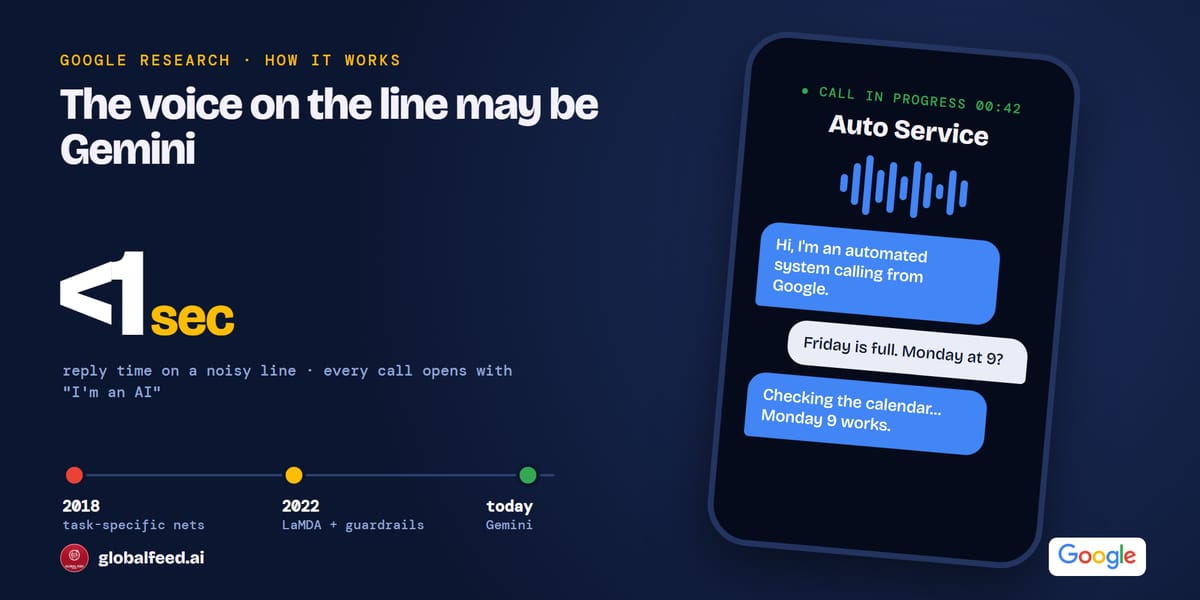
Picture calling a restaurant. The person on the other end answers over kitchen noise, changes their mind halfway through a sentence, says "one second" and puts the phone down. For a person that is an ordinary call. For an AI, even a half-second pause is something it has to get right. Google Research's post of November 20 tells the story of the nearly decade-long effort to pass that test: Google Duplex, introduced in 2018, now lives in Tasks in the Gemini app, where it can call businesses and book appointments on a user's behalf.
The post is signed by Yossi Matias of Google Research, Google Fellow Yaniv Leviathan and Janet Zhou of Google Maps. This article explains how an AI agent that makes phone calls works, the three architectural eras Duplex went through, and what was designed for the business on the other end of the line.
The problem: phone calls do not follow a script
Booking dinner or a hair appointment takes time because so much of it still happens by phone. According to Google, live calls move fast and rarely follow a script. The other person can say almost anything and revise their thoughts mid-sentence, and whose turn it is to speak is often signalled by subtle changes in tone. Pause half a second too long and it sounds like the call dropped; speak too soon and you talk over each other.
So an agent that handles calls needs three things working together with no lag: understanding speech, deciding what to say in context, and answering in a natural voice. Google writes that it set out to combine all three in a single low-latency system.
Three generations of architecture
Era one, before language models. Work on Duplex began before modern large language models and even before the transformer was invented. The system was kept to narrow domains, and Google trained custom recurrent neural networks on anonymised, task-specific phone conversations. With no pre-trained world knowledge, each task type had to be taught separately: the rigid flow of a restaurant booking needed different training data from checking holiday hours.
Era two, early generative models and hybrid stacks. As open-domain foundation models arrived, Duplex put them into production. In 2022, the post says, Duplex used LaMDA on live calls. Pre-trained models made comprehension and common-sense reasoning easier and let the system handle unexpected tangents. But they were less predictable and sometimes slower, so Google built hybrid stacks: a generative model for flexible phrasing, deterministic state tracking to follow where the conversation stood, and strict policy guardrails.
Era three, open-ended tasks and Gemini. As foundation models improved, the fixed verticals were dropped entirely and the system is now prompted with free-text task descriptions. That lets it generalise to new task types, to details like a window seat or extra space for a stroller, and to new business categories without building a dialogue model from scratch each time. Today's calling stack uses Gemini to unify multimodal understanding, planning and dialogue generation, so it can handle requests with several constraints, such as scheduling car maintenance around calendar conflicts, and adapt when a receptionist suggests a different slot.
Two hard parts of live telephony
Google lists two hurdles that pre-training on web data does not solve, even with frontier models.
The first is context and intent. The web does not record how calls with busy merchants unfold. Google says nearly ten years of goal-directed calls taught the system those unwritten norms, and that this helps before the call even starts: a free-text task is matched to a business using the history of past conversations. If a venue is known not to take large-group reservations at weekends, for example, the system can predict whether the task will work. During the call, the same experience helps the model judge what to ask at a given moment, read polite indirect refusals and keep calls short.
The second is noise and latency. Calls run over compressed phone lines, against clattering kitchens, espresso machines, street noise and side chatter. Google says the stack is tuned for low-latency streaming inference so replies land at a natural pace, while custom acoustic and conversation-cadence models help the core system handle background noise and pauses and stop talking when it should.
The other end of the line: the business
Duplex has to work as well for the business answering the phone as for the user. Google highlights four design choices:
- Clear disclosure: every call opens by saying the caller is an AI agent, an automated system calling from Google.
- Businesses stay in control: merchants can opt out of automated calls in their Google Business Profile settings, or simply say "Please stop calling my business" during a call.
- No setup: Duplex works through the phone a business already answers. No software to install, no booking system to maintain, no staff to train.
- One conversation, many answers: details from one call can answer many later questions, so a business is not asked the same thing over and over. Google Maps can show details Duplex gathers, such as happy hour specials, patio seating, pet-friendliness or a weekly trivia night.
Duplex data has been showing up in Google products for years. As Google shared in 2023, business information from Duplex calls had been shown in Search and Maps more than one trillion times. During the pandemic, when opening hours shifted quickly, Duplex focused on verifying business information automatically. Since 2019, Pixel features such as Call Screen and Hold for Me have run on on-device versions of the same conversational models.
What it looks like in Tasks in Gemini
In Google's Gemini announcement of November 17, Josh Woodward describes his own example: when his minivan's check-engine light came on, he asked Gemini to call the two nearest dealerships and find an early Friday slot over the coming weeks. According to the announcement, Gemini called both at once, sat through the hold music, booked at the dealership that takes appointments and added it to his calendar, all in under five minutes. Woodward adds that Gemini told the dealership right away that it was an AI and does not share payment or account details unless the user says so.
The announcement says task mode is rolling out free in the U.S., Japan, Korea, Canada, Australia and India, running on the Gemini 4 Hydrogen model. You switch the toggle on the Gemini home screen from Chat to Task. A footnote says calling through Gemini is not currently available in Indiana, Louisiana, Minnesota, Montana and Nebraska.
What comes next
Google Research closes with the point that many daily errands, local services and urgent tasks still require talking to a person. Where no online booking form or API exists, the agent can use voice as one more tool. With Gemini 4 Hydrogen and Gemini 4 Neon, Tasks can also handle broader workflows such as analysing utility bills, paying securely through the Agent Payments Protocol and coordinating with users over email and RCS. Google also says plainly that tasks can still fail, that mistakes have not been eliminated, and that it wants feedback.

