
The US outage week reached the banks: all eyes on the new AI system SMART
Microsoft on Thursday, every US flight on Friday, major banks on Monday. What caused them, and where does the FAA's AI-supported SMART system, rolled out three days before the ground stop, fit in?

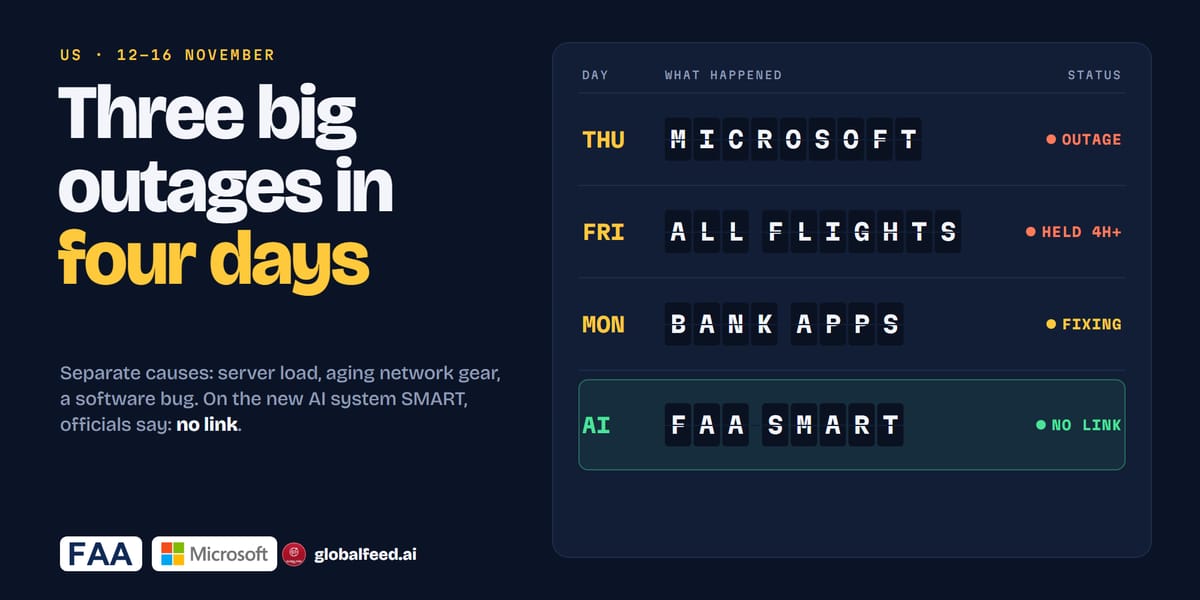
On Thursday, Outlook, Teams and Copilot were disrupted for hours. On Friday afternoon, every flight in the US was held on the ground for more than four hours. On Monday, customers of the country's biggest banks started reporting that they could not see their balances. Three incidents in four days raised one question across the US: are they connected, and did SMART, the AI-supported air traffic system rolled out nationwide three days before the ground stop, play a part? Here is what officials and companies have said so far, day by day.
Monday: what happened at the banks?
According to FOX Local, citing the Associated Press and Chase, customers of Chase, Bank of America, Wells Fargo, U.S. Bank, J.P. Morgan and Zelle reported online banking problems on Monday, 16 November. By 2 p.m. ET, Downdetector showed more than 4,700 reports for Chase, 2,000 for Bank of America and over 1,000 each for U.S. Bank and Wells Fargo. Newsweek reports that Capital One users also reported issues. Most complaints concerned web logins, balances, transfers and payments.
Chase confirmed the problem. A spokesperson said that due to a technical issue some transactions were taking longer than usual, but customers still had access to their accounts and funds. The bank described it as a technical bug and said it was not cyber-related. Some Chase app users saw the message "Some services aren't available. We're working on them." Wells Fargo's website said online banking was temporarily unavailable. The banks did not announce a common cause, and as of Monday evening there was no announcement that services had fully recovered.
Friday: why did flights stop?
The banking trouble came three days after the Federal Aviation Administration (FAA) called a nationwide ground stop on Friday afternoon. According to Newsweek, flights stayed on the ground for more than four hours. The FAA attributed the disruption to instability in aging network equipment, and Transportation Secretary Sean Duffy said it involved old air traffic infrastructure. Officials said there was no sign of a cyberattack.
What does the AI system SMART do?
The timing turned attention to the FAA's new system. As the Associated Press reports, SMART (Strategic Management of Airspace, Routes and Trajectories) is an AI-supported planning tool that brings about 200 data streams, including weather, flight paths, traffic flow and controller staffing, into one view. Experts at a single site near Washington use it to spot congestion or bad weather early and send recommendations to the FAA command center, which relays them to controllers. Humans still decide: for now the system recommends and does not run flights.
The early results look promising. The FAA says that in the first test around Washington this fall, SMART helped reroute 180 flights and saved an average of 10 minutes and 80 gallons of fuel per flight; one Tampa to Dallas flight was 42 minutes shorter. The system was built by the startup Air Space Intelligence (ASI) under a contract worth $875 million over 12 years. It went live for all 22 air traffic control centers on 10 November, three days before the ground stop.
Officials say the two are not linked. Homeland Security Secretary Markwayne Mullin said on Friday there was no indication the communications problems were tied to the new system, and top Transportation Department and FAA officials repeated that on Saturday. ASI said the ground stop was not caused by SMART, any ASI product or its integration with the FAA. The debate continues: in October, House Democrats asked the Government Accountability Office to audit the software, saying frontline aviation staff had little input into its development.
Thursday: the Microsoft outage
The week's first big disruption was at Microsoft: Outlook, Teams and the AI assistant Copilot were affected for hours. Microsoft said several servers went offline and the remaining infrastructure was overloaded, apologized to customers and said the cause was unrelated to cybersecurity or AI. We covered the Microsoft, Claude, Workday and FAA disruptions in detail in our 14 November story; this piece follows the new chapter that came on Monday and the debate around SMART.
What the week shows
Based on what has been said so far, the three incidents have no common cause: server load at Microsoft, old network equipment at the FAA and a software bug at Chase. None was linked to a cyberattack or to AI. Still, the week showed how much daily life runs on software, and why redundant infrastructure and fast, clear communication matter. New AI tools like SMART are watched closely for the same reason: they promise shorter flights and less fuel, and they earn trust through transparent oversight. The banks have not yet explained the cause in detail; we will update this story when they do.
Were you affected by any of this week's outages? Tell us in the comments.
Sources: FOX Local / AP, Newsweek, AP / NBC Chicago

