
The open model that gets your email address right: how Salesforce SOV-Transcribe-1 works
Salesforce's open speech recognition model SOV-Transcribe-1 ranks first among open models and leads on critical entities. We explain what it does, how it is built and how to try it.

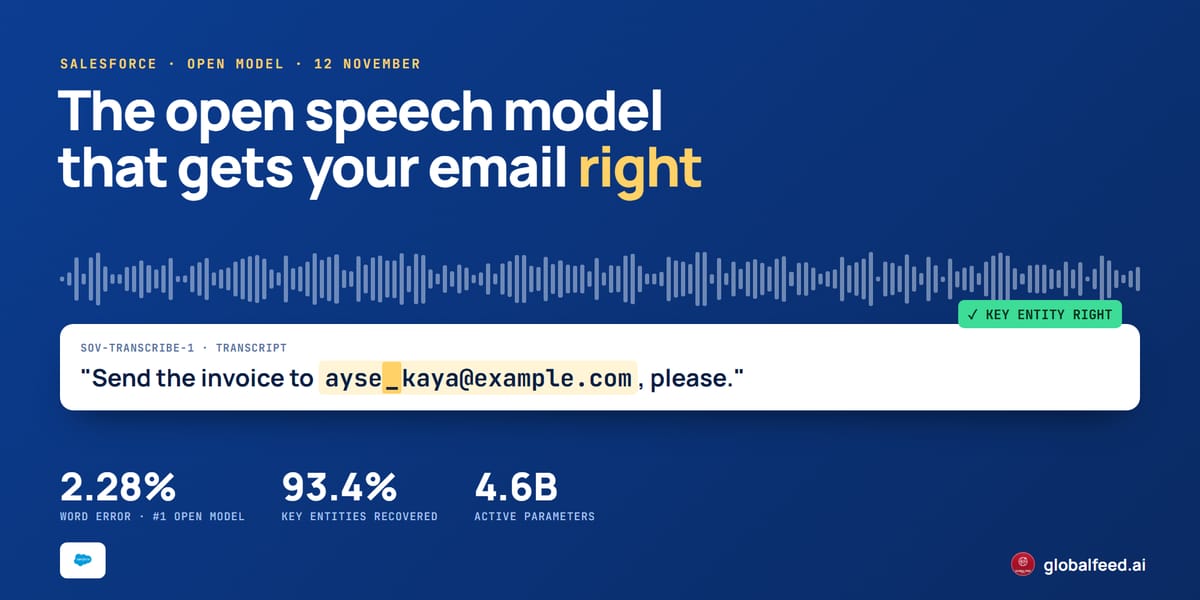
Imagine dictating your email address to a voice assistant. The transcript is nearly perfect, but one underscore is missing, and the agent sends the message to the wrong address. On 12 November Salesforce released SOV-Transcribe-1, an open speech recognition model built to cut exactly these errors. It ranks first among open-weight models for non-streaming speech-to-text on Artificial Analysis (seventh overall) with a 2.28% word error rate, and it is the best open model at capturing critical entities such as phone numbers and emails. The weights are Apache 2.0 on Hugging Face, so a company can run it without audio ever leaving its servers.
Some words matter more
Word error rate treats all words equally, but for a voice agent a few words carry the task: an email, an account number, a command. A mostly correct transcript can hide an error that becomes a wrong tool argument downstream.
What it can do
On VoiceCodeBench, which passes a recording only if every target entity is right, it passes 76.3% of recordings and recovers 93.4% of entities, second of 23 systems and first among open models. On AppTek call-center dialogues across 14 English accents it averages 8.21% WER and is lowest on 8 accents. On HALAS, real earnings-call audio where models tend to hallucinate, it scores 25.69%, ahead of all other open models. It transcribes verbatim by default but follows instructions such as writing numbers as digits, scoring 5.05% on Preference-ASR, second overall. Given a clip's keywords, its keyword F1 on Contextual Earnings-22 rises from 71.9 to 96.8, and stays at 94.0 even with a full hour of mostly distracting keywords.
How it was built
Per the model card, it combines OpenAI's open Whisper large-v3 audio encoder, an audio projector and Google's open Gemma 4 26B A4B mixture-of-experts language model: 26.6B parameters in total, about 4.6B active per step. Salesforce calls it a speech-augmented language model, which is why it can follow instructions and use context. At 2.28% WER it beats NVIDIA Nemotron 3.5 Transcribe (2.81%) with the same active parameters and Mistral Voxtral Small (2.77%) with six times more. Training data and steps are not yet described; a technical report is coming. Supported languages are English, French, German, Spanish, Italian, Portuguese and Dutch.
How to try it
pip install "transformers>=5.19,<5.23" torch librosa accelerate

from transformers import AutoModelForMultimodalLM, AutoProcessor
model_id = "salesforce-sovereign-intelligence/SOV-Transcribe-1"
processor = AutoProcessor.from_pretrained(model_id, trust_remote_code=True)
model = AutoModelForMultimodalLM.from_pretrained(model_id, trust_remote_code=True, device_map="auto")
It runs with Hugging Face Transformers and vLLM (a plugin until native support lands), handles audio files up to 30 minutes and supports speculative decoding with a separate draft model.
Sources: Hugging Face: Introducing Salesforce SOV-Transcribe-1, SOV-Transcribe-1 model card

