
The image model that learned to see by painting: how Open Vision Banana works
UTN's open Open Vision Banana teaches an image generator to segment objects and estimate depth by painting them. Here is how it was trained and what did not work.

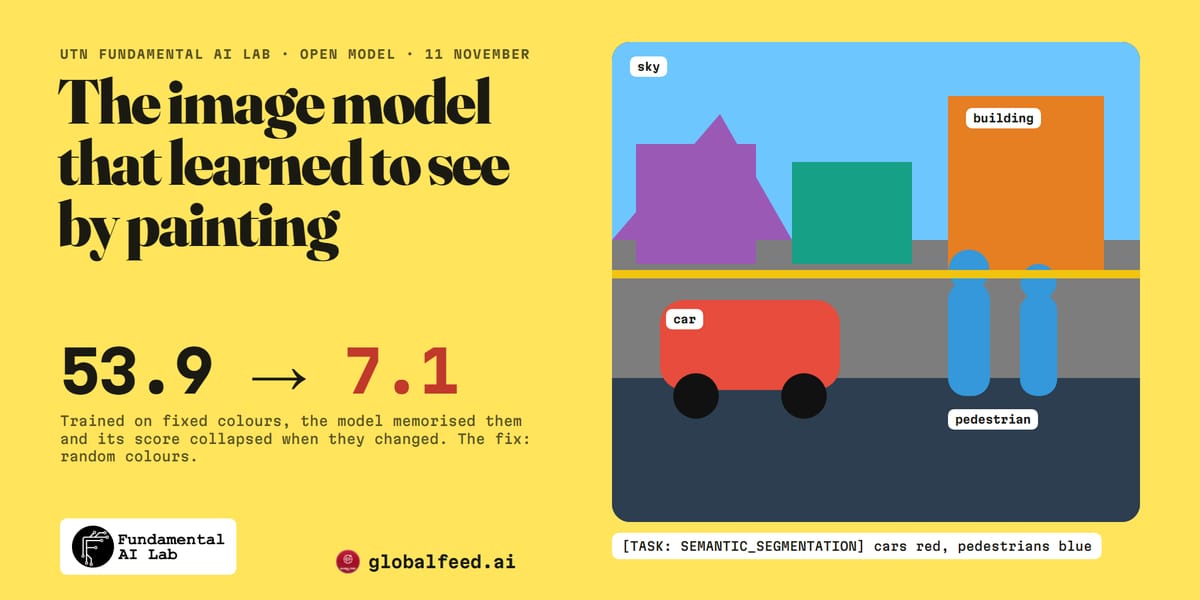
Image generators can paint a cat, a city or a meal, which means they already know, in some form, what sits where in a picture. Can that knowledge be used to understand images? The Fundamental AI Lab at the University of Technology Nuremberg (UTN) answers with Open Vision Banana, published on 11 November: an image generator that learns segmentation, depth and surface normals by painting them, with the whole recipe open.
Understanding by painting
Instead of a separate model or head per task, one model does everything by drawing. Give it a photo and an instruction such as "paint the cars red and the pedestrians blue" and it returns the painted photo; a fixed decoder turns the colours back into a mask. Depth becomes a grey image, brighter when closer, and surface normals become an RGB image. The earlier Vision Banana showed the idea with the proprietary Nano Banana Pro and closed data and code; this work rebuilds it from an open base model, public datasets, released training code and released weights, and measures which design choices matter.
How it was trained
The base is Black Forest Labs' FLUX.2 [klein] Base at 4B and 9B, with no new heads, trained with its own flow-matching loss while the VAE and text encoder stay frozen. Existing public labels were converted into colour targets: 2.1M pairs for zero-shot models and 3.8M for models that also see benchmark training splits, mixed with Pico-Banana-400K editing data and PD12M images so the model keeps its drawing skills. One 100K-step stage ran at batch 192, taking about 73 hours on 16 GH200 GPUs for 4B and 79 hours on 32 GPUs for 9B, and final weights average 2 to 5 late checkpoints. The ablations, detailed in the paper, are the most useful part: fixed class colours scored 53.9 on Cityscapes but collapsed to 7.1 when colours changed, so colours are random per sample; a 64-colour palette beat 200 colours; tuning only the last 4 blocks failed; LoRA matched full tuning on geometry but trailed by about 12 points on semantic segmentation; and the model learns where objects are before it learns the right colour.
That last finding led to legend ensembling: paint the same image several times with different random colour legends and take a per-pixel vote, with no retraining. It lifts the 9B model on Cityscapes from 65.4 to about 74, and the 6.3% of low-agreement pixels hold 57.6% of the errors, giving a free confidence map.
Results and how to try it
The best version scores 76.4 on Cityscapes against Vision Banana's 69.9, the zero-shot 9B reaches 37.4 on SA-Co/Gold (ahead of OWLv2 and DINO-X, behind SAM 3 at 54.1) and 97.4% δ1 on NYUv2 depth, while text-to-image scores drop by 0.03 to 0.05. To run it, install diffusers, load a FLUX.2 klein Base pipeline, swap in the transformer from FunAILab/Open-Vision-Banana and use bf16, guidance 3.5 and 28 steps with a task tag such as [TASK: SEMANTIC_SEGMENTATION]. The 9B transformer is about 36 GB and the 4B about 15.5 GB; BFL says the 4B base fits in about 13 GB of VRAM. Code is Apache 2.0 on GitHub; weights are free for research and non-commercial use under the FLUX Non-Commercial License.
Sources: arXiv: Open Vision Banana, Full paper, Project page, GitHub, Hugging Face model, FLUX.2 klein Base 4B

