
The 2.3B open model headed into Windows: how was Microsoft's Aion trained?
Microsoft has released Aion 1.0 Instruct, the successor to Phi Silica, under MIT. We cover its data, hybrid attention, training steps, benchmarks and how to run it in a browser.

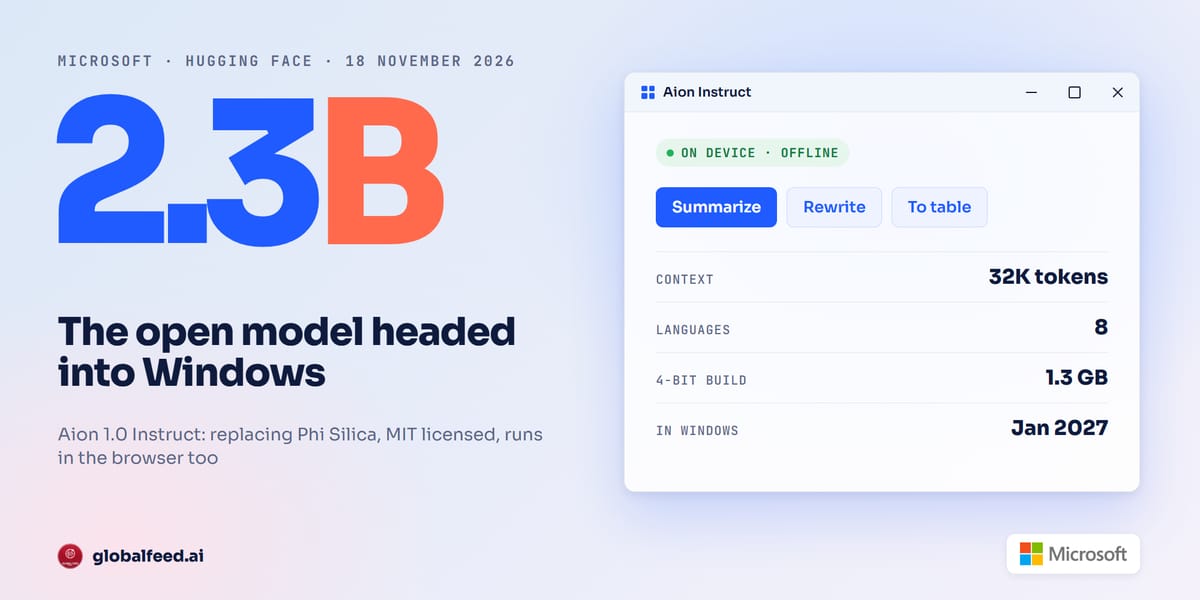
Imagine summarizing an email, rewriting a paragraph in a more formal tone or turning a long thread into a table on your PC, with the model doing the work never touching the internet. Windows has carried a small language model for this for some time: Phi Silica. Microsoft has now published the model that will replace it, for anyone to download. Aion 1.0 Instruct, built by the Windows Applied Sciences Group, arrived on Hugging Face on 18 November as an open model under the MIT license. It has about 2.3 billion parameters, works in 8 languages, reads 32K tokens at once and can call tools.
According to the model card, a further optimized version of Aion, paired with Microsoft's content moderation model, will become the Windows OS small language model by the end of January 2027. Microsoft calls the Hugging Face release an introduction to what is coming and a way to collect feedback. Here is how Aion is built, what it was trained on, what it is good at, and how to try it today in a browser or on your own machine.
What an operating system model does
An OS model plays a different role from a chat assistant. Its job is to let apps do everyday text work on the device, quickly and at no cost. Microsoft's sample app lists those jobs: summarize text, summarize a conversation, rewrite, rewrite with a custom instruction and convert text to a table. A notes app, a mail client or an accounting program can call this through the Windows App SDK without running a model on its own servers. With 32K tokens of context, the card says, multi-page documents, long email threads and technical specifications can be processed entirely on-device.
The timeline is set. Per Microsoft Learn, Aion starts rolling out to Windows Insider devices in December 2026, alongside Phi Silica, with a registry key for side-by-side testing. In January 2027 it reaches retail devices and Phi Silica is removed. Unlike Phi Silica, Aion needs no Limited Access Feature token.
How it was trained: data, architecture, steps
Data. Aion's training data extends the data used for Phi Silica. It combines publicly available documents filtered rigorously for quality with newly created synthetic data for math, coding, common-sense reasoning and general world knowledge. Multilingual data is about 6% of the total. The knowledge cutoff is December 2025.
Architecture. It is an instruction-tuned causal language model with 28 layers, a hidden size of 2048 and an MLP size of 8192. Attention is grouped-query, with 24 query heads sharing 8 key/value heads. The notable choice is the hybrid pattern: 21 layers look only at a 2,048-token sliding window, while 7 layers see the full text. Think of a reader who mostly focuses on the last few pages but regularly flips back to see the whole book. RoPE handles position, with YaRN scaling by a factor of 16 on the full-attention layers to reach 32,768 tokens. The vocabulary has 200,029 tokens, and input and output embeddings are tied.
Steps. After pretraining came instruction tuning and safety alignment. For on-device use, the WebGPU build was exported from a quantization-aware-trained checkpoint: linear layers in 4-bit blocks of 32, the shared embedding in 4-bit blocks of 64, activations and KV cache in FP16, for about 1.3 GB. On Windows, output carries an invisible watermark to support EU AI Act compliance, and apps customize the model with LoRA adapters trained in Foundry Toolkit.
What was tried and what did not work. Edge's on-device APIs ran Phi-4-mini (4B) for a year, and its hardware needs limited the devices it reached; Aion was made smaller to run on weaker GPUs and even CPU-only machines. The card states plainly that the model was not trained to excel at world knowledge. Phi Silica LoRAs are not compatible and must be retrained. The card names cross-prompt injection resistance (XPIA) among the safety metrics to improve.
Benchmarks
Microsoft reports MMLU 55.15, MMLU-Pro 33.35, MMMLU 45.51, GPQA 28.18, GSM8K 74.91, GSMPlus 49.56, MATH-500 48.00, IFEval 83.90, IFBench 32.00, Multi-IF 64.70 and chrF++ 43.18. The highest number is instruction following, which is exactly what an OS model needs; the more modest knowledge scores match the card's own description of a helper that works on the text it is given.
The sample repository also ships a prompt guide on how small models fail: they may follow instructions inside the input, explain instead of answering, or change answers when option order changes. Its advice is to quote user text as data, end with an answer-only instruction and change one thing at a time.
How to try it
In the browser, the INT4 WebGPU build is a single ONNX graph that runs on any ONNX Runtime build with the WebGPU execution provider, including ONNX Runtime Web. Edge Canary and Dev have also run a pre-release Aion behind the Prompt and Writing Assistance APIs since June. In Python, the main model loads with Transformers and trust_remote_code=True, and GGUF and NPU builds are listed too. On Copilot+ PCs with Snapdragon, Intel Lunar Lake or AMD Ryzen AI, the sample app lets developers test chat, image description, text intelligence and their own LoRAs; it is meant for developer validation only.
Sources: Aion 1.0 Instruct model card, WebGPU build, Sample app and transparency notes, Prompt guide, Phi Silica transition timeline, Microsoft Edge blog

