
Teach a robot by letting it watch video first: how does Runway's open Praxis-1 move an arm?
Runway's open robot model Praxis-1 sees the camera feed, imagines the next seconds as video and moves the arm at the same time. We walk through its four-stage training.

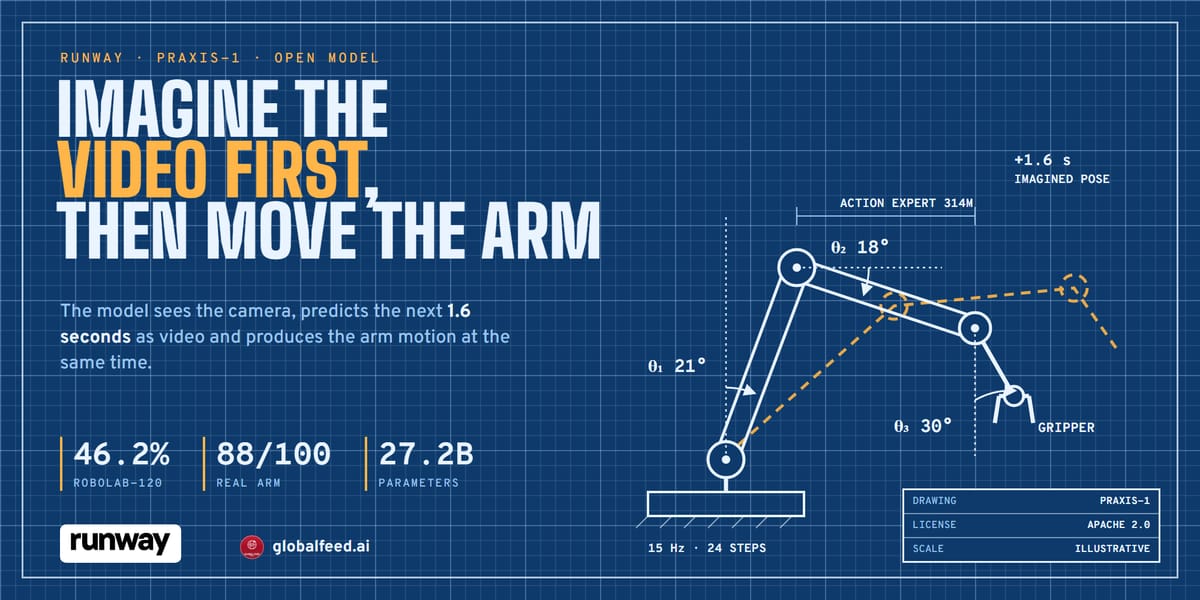
Imagine teaching a robot to put a coffee cup on a tray. The classic route is to guide the robot by hand thousands of times and record every move. Runway started somewhere else entirely: it took the model that has been generating video for years, taught it to watch how the world moves, and then to pass that motion on to a robot arm. On 11 November it released the result, Praxis-1, as an open model anyone can download. Looking at a camera feed, it imagines the next few seconds as video and produces the arm's motion at the same time.
Runway calls this a world action model. Typical robot models read the image and the command and output actions directly. Praxis-1 first pictures the next state of the scene, and its actions draw on that picture. The bet is simple: robot data is scarce and expensive, while video showing how objects behave is abundant. The model is released under the Apache 2.0 license on Hugging Face and GitHub; downloading only requires agreeing to share your Hugging Face details.
The basics
Praxis-1 is a 27.2B-parameter mixture-of-experts diffusion transformer, 54.4 GB in bf16. Only about 2.8B parameters of the video backbone are active per token. A separate action expert of about 314M parameters produces the motion. Each call outputs a 1.6-second action chunk (24 rows at 15 Hz) together with a few future video frames. Checkpoints include praxis-1-droid (single arm), praxis-1-yam (bimanual), praxis-1-so101 (low-cost arm) and praxis-1-base, plus NVFP4 and LeRobot variants. Runway says it runs on NVIDIA hardware from H100 and B200 to RTX 5090, RTX PRO 6000 and Jetson Thor; the default bf16 build runs on a single 80 GB H100.
How it was trained
1. Video pretraining. It starts from Runway's own video foundation model, trained on twelve generation tasks with clips up to 20 seconds. A frozen Wan2.2 VAE handles images and a frozen Qwen3.5-2B encoder reads instructions.
2. Embodied-video mid-training. The model moved to chunk-causal video at 15 fps. By token share the mix was 58% egocentric human video, 20% general video, 18% real-robot video and under 1% gameplay. Human hands are represented as 21-joint 3D poses.
3. Joint video and action training. A 16-layer action expert was attached. It reads eight backbone blocks, while the backbone never reads the expert; the action loss still trains the backbone through those reads. The action gradient ramped from zero to full over the first 1,500 updates, and about 30% of batches stayed video-only. Both streams use rectified flow with equal loss weights. Each MoE layer has one shared and 128 routed experts, with 8 chosen per token and DeepSeek-V3-style balancing. Muon and AdamW were the optimizers.
4. Embodiment fine-tuning. For DROID, about 277 hours of successful episodes ran for 50k steps on 128 H100s. RT-1, a robot absent from pretraining, took about 95 hours of data and roughly 28 hours on 32 H100s.
What did not work. Putting action tokens inside the backbone showed no clear gain and cost more. Blending old and new action plans in real time made the arm oscillate. A fused MoE kernel regressed on H100 and B200 and is off by default. One ablation found web video and teleoperated robot video ended at almost the same placement error after fine-tuning: 16.1 cm against 16.0 cm.
What the numbers say
On NVIDIA's RoboLab-120 leaderboard (120 tabletop tasks, 10 trials each), DROID-tuned Praxis-1 scored 46.2%, ahead of FLUX 3 Action (42.9%), Cosmos 3 Nano (36.8%), π0.5 (28.0%) and GR00T N1.6 (7.3%). That makes it the top world action model and top open robot foundation model there; four entries, including a zero-shot frontier-model agent and closed systems, rank higher overall. On a real Franka FR3 at Positronic, it completed 88 of 100 trials on FLUX 3 Action's own ten tasks, against 80. On SimplerEnv RT-1 it reached 80.0% against the published RT-1 result of 52.4%. NVIDIA's NeMo Automodel recipe took LIBERO-Spatial from 0 to 90.2% with full fine-tuning and 91.4% with LoRA.
The GitHub repo includes full fine-tuning (eight GPUs) and LoRA (one 80 GB GPU) scripts, and LeRobot supports the model natively. Results are Runway's and NVIDIA's own measurements, and the report notes that look-alike objects, vague instructions and long multi-step tasks remain hard.
Sources: Runway announcement, Runway technical report, GitHub repository, Hugging Face collection

