
SenseNova-Loop-9B leaves preview: what changed in the looped model since October?
The model that runs the same layer block twice is now a full release. We cover the jump in agent benchmarks, the 512K context and the one-to-four loop training experiment.

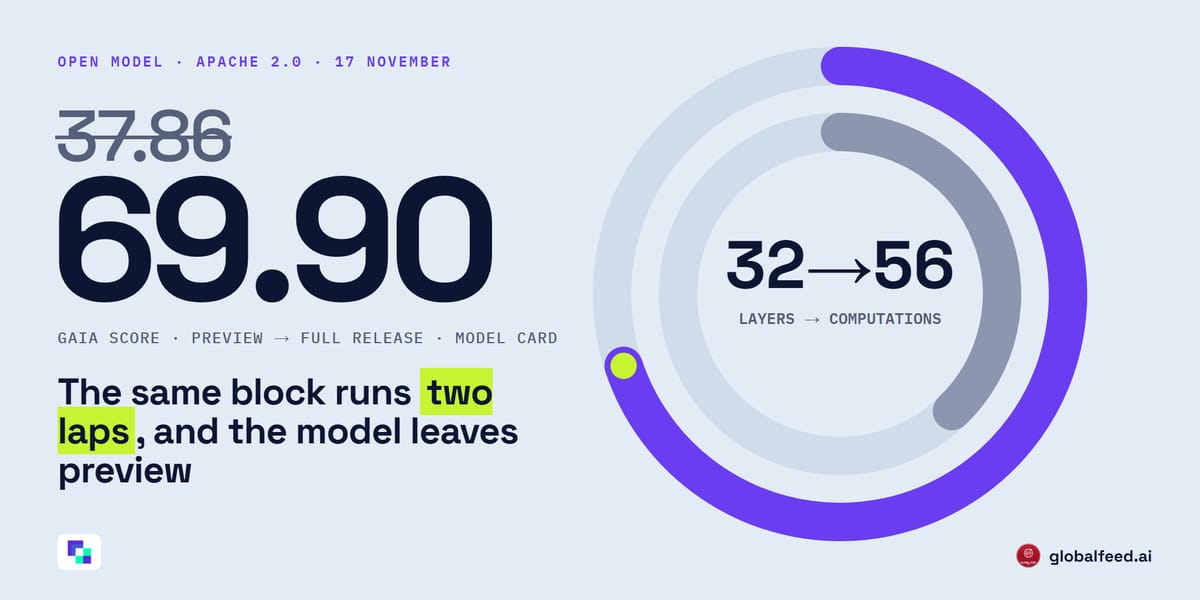
Read a book a second time and you catch details the first pass missed. Same book, same reader; the only difference is that the second reading builds on the first. SenseNova's looped language model works on exactly that idea, and on 17 November it dropped the preview label. SenseNova-Loop-9B is now a full release on Hugging Face under Apache 2.0, so it can be downloaded, used commercially and fine-tuned; accessing the files only requires accepting the page's conditions while logged in. On 18 November official 4-bit AWQ and GGUF builds followed.
We covered the preview on 31 October in "runs the same layer block twice". In three weeks the architecture stayed the same. What changed is task performance, context length and ease of deployment. According to the new table on the model card, the release beats the preview on all seven benchmarks shown.
What changed since the preview
The biggest jumps are in agent work. GAIA rises from 37.86 to 69.90, Terminal-Bench 2.1 from 40.45 to 59.55, AutomationBench from 14.33 to 36.67, NL2Repo from 19.91 to 41.36 and T³-Banking from 18.56 to 30.93. AIDABench moves from 58.62 to 65.31 and BIRD from 71.38 to 72.34. Against Qwen3.8-27B, a model about three times larger, it ties on AutomationBench (36.67), edges ahead on AIDABench (65.31 vs 65.01) and has the top GAIA score in the table (69.90 vs 66.99), while trailing on NL2Repo (41.36 vs 44.60), Terminal-Bench 2.1 (59.55 vs 63.40) and T³-Banking (30.93 vs 36.08).
Context grows from training sequences of up to 262,144 tokens to support for 512K tokens. Deployment gets lighter too: with 4-bit weights the files take about 4.9 GB, and the card estimates about 10 GiB of GPU memory at 64K context and about 15 GiB at 256K with an 8-bit KV cache.
What the loop does
The model has 32 layers. Input passes through layers 0 to 3, then the 24-layer block from 4 to 27 runs twice with the same parameters, then layers 28 to 31 and the output head. It stores 32 layers but computes 56 per step, which the team describes as about 14.6B inference-equivalent parameters. Two choices keep the passes stable: three of every four layers use linear attention and one uses full attention, with loop boundaries aligned to those groups, and a two-stream connection called mHC carries information in two parallel lanes whose mixing is constrained by Sinkhorn normalization with 20 iterations.
How it was trained
The card lists text, images, code and tool-use trajectories as training data, with context extended to 512K tokens. The backbone is BF16, the mHC routing parameters FP32. There is no technical report yet, so data volume and step counts are not public. The most instructive part is a loop-count experiment: the same 9B model trained and run with one to four loops, data and settings fixed. Going from one to two loops lifts LiveCodeBench V6 from 63.22 to 67.30 and Workbuddy-office from 65.08 to 75.98, so most of the gain comes from the first repeat. Four loops reach 68.34 on LiveCodeBench and 70.72 on AIDABench data visualization (+8.10% and +8.55% over one loop), while QA and office tasks peak at three. Both releases use two loops to keep responses fast; the team plans "dynamic loops" that spend more passes on harder inputs, and larger looped models. Fine-tuning examples live in OpenSenseNova/torchtitan and draft-model training for speculative decoding in SenseSpec.
How to try it and known limits
A single-GPU Transformers example needs trust_remote_code=True; LightLLM works today, while SGLang and vLLM support still comes from open pull requests. The GGUF builds (Q4_K_M, Q5_K_M, Q8_0, BF16) are the easiest local route. The team notes the model can miss requirements with many complex tool definitions, is inconsistent on some coding and long agent tasks, and may need two or three rounds for complex 3D web pages. All scores come from SenseNova's own model card.
Sources: SenseNova-Loop-9B model card (Hugging Face), SenseNova-Loop GitHub repository, SenseNova-Loop-9B GGUF builds, Preview release (Hugging Face)

