
Qwen4-Max is here: a 2.4 trillion parameter flagship that cuts the cost per task by 62%
The first Qwen 4 model is out with a new MoE architecture, 1M-token context, native vision and lower prices. How it is built and what it can do.

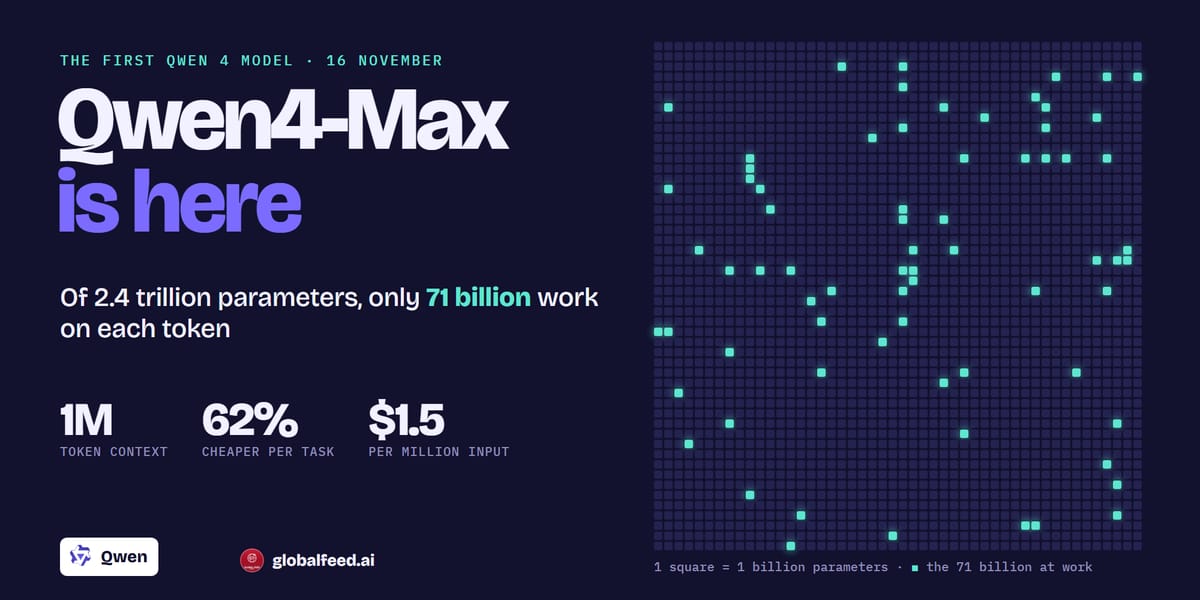
The first model of the Qwen 4 family is officially out. Alibaba's Qwen team announced Qwen4-Max on 16 November: a new 2.4-trillion-parameter mixture-of-experts (MoE) architecture with native vision and a one-million-token context window. It is available today through the API on QwenCloud and can be tried in Qwen Studio, QwenWork and Qoder. The number the team puts first is cost: on its own work benchmark, the average cost per task fell from $4.43 to $1.67, a 62% drop.
Qwen4-Max-Preview appeared on 12 November with a two-week trial window, and we wrote up what was known then. That page had no size, training details or benchmark results. Today's announcement fills most of those gaps. Here is how the model is built, what it does better and how to try it.
Qwen4-Max at a glance
- 2.4 trillion parameters, 71 billion active per token, plus a 328-billion-parameter N-gram embedding layer.
- Text, image and video input; 1M-token context and up to 393K output tokens.
- QwenCloud pricing as of 16 November: $1.5 per million input tokens, $4.5 per million output tokens, $0.075 for cached input.
- Compatible with OpenAI and Anthropic API formats; tool calling, web search, structured outputs and batch jobs.
- Smaller Qwen4 models will be released as open source; no date yet.
How it is built
Qwen4-Max is a sparse MoE model: of its 2.4 trillion parameters, only 71 billion work on each token, a bit like a large hospital where every patient sees only the few relevant specialists. The team says the Qwen 4 series redesigns attention, residual connections and embeddings. Three Gated DeltaNet layers compress history into a fixed-size state before each Qwen Sparse Attention (QSA) layer, which uses a lightweight indexer to pick only the relevant micro-blocks of context, cutting attention and indexing costs on long inputs. Gated Residual uses four parallel residual branches with dynamic read and write gates to improve information flow and training stability. An N-gram embedding at the second layer looks up local token patterns, adding 328 billion parameters of capacity for very little extra compute.
The team reports that pre-training at this scale ran without a single loss spike. On its base-model tests across knowledge, code, QA and STEM, Qwen4-Max-Base scored the lowest bits per byte of five checkpoints, about 5 to 13% better than Qwen3.8-Max-Base while activating 25% fewer parameters. No figures were given on the size of the training data.
Fewer tokens, lower bill
On the team's Work360 benchmark, which covers 26 domains, 182 subdomains and 721 specialised fields, Qwen4-Max scored 52.69 versus 47.74 for Qwen3.8-Max while using about 24% fewer tokens at Xhigh effort and 35% fewer at High. On Terminal-Bench 4.0 the reduction is about 48 to 49%. Combined with lower prices, especially for cached input, the average cost per task dropped by 62%.
Next to the strongest rivals
In the 16-benchmark chart the team posted on X, Qwen4-Max leads Agents' Last Exam v1.1 with 46.7 (rivals at 43.4), HLAB-Vals 1.1 with 21.3, AutomationBench-AA with 72.5 and BioMysteryBench with 85.0, and sits level with the best models on DeepSWE v1.1 at 75.7. The jump from the previous generation is large: on Agents' Last Exam, Qwen3.8-Max scored 27.9. A few rivals still lead on tests such as Terminal-Bench 4.0, and Qwen4-Max delivers its results at a much lower price.
What it can do
The showcases point to long, tool-heavy work: building scenes in Blender, making playable games in Unity, Unreal Engine and Godot from one brief, cutting the manual programming time for an automotive part from about 475 to 24 minutes, sorting 198 messy legal files into an 86-page pre-IPO due diligence report, and running for 48 hours to design and synthesise a new coolant molecule in an automated lab. The team is also open-sourcing the Qwen-Live-Delivery-Plugin, which lets long tasks deliver usable versions early while the user stays in control.
How to try it
Qwen Studio is the easiest place to start. Developers can call qwen4-max on QwenCloud with OpenAI- or Anthropic-style clients, turning on thinking with enable_thinking. The team calls Max only the first look at Qwen 4 and says smaller open-source models trained with the same techniques are on the way. The benchmark figures here come from Qwen's own blog and charts; independent results have not been published yet.
Sources: Qwen blog, QwenCloud model page

