
Orange's Wolof-Qwen3 models: how was AI taught a language with little text online?
Orange completed five open models from 0.6B to 14B for Wolof, spoken by 23 million people. The fine-tuning, DPO and merging steps, what did not work, and the results.

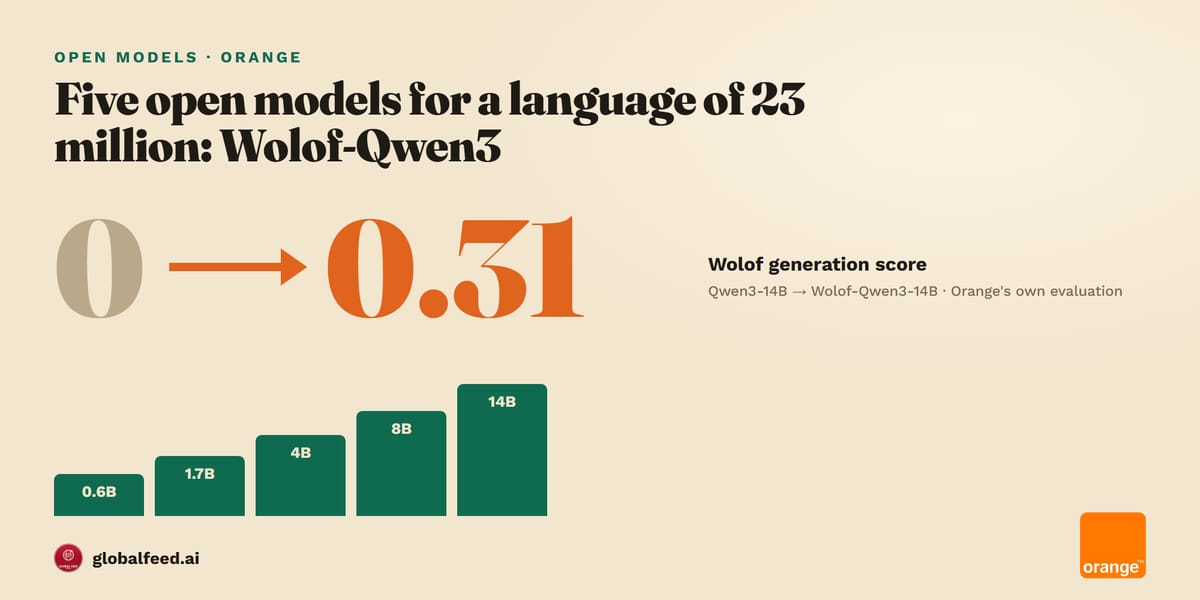
French telecom group Orange has completed its family of open models for Wolof, the language spoken by 23 million people, mostly in Senegal. With the 0.6B and 1.7B versions added to Hugging Face on November 16, the family now spans five models from 0.6 billion to 14 billion parameters. All are built on Alibaba's Qwen3 series and can chat, translate, answer questions and summarize in Wolof as well as French and English. By Orange's figures, the largest member, Wolof-Qwen3-14B, lifts Wolof understanding to three and a half times the score of the Qwen3-14B it starts from, and Wolof generation from zero to 0.31.
It is a rare, step-by-step example of bringing AI to a low-resource language. Orange shared what it did, which data it used, what worked and what did not in its model cards and in an arXiv paper. Here is the recipe.
The problem: 23 million speakers, a few hundred thousand examples
Large language models learn languages roughly in proportion to how much text exists online. English, French or Chinese have billions of pages; widely spoken but little-written languages like Wolof have very few. Even a strong general model then answers a Wolof question with gibberish or drifts into French. In Orange's table, Qwen3-14B scores exactly 0 on Wolof generation.
Orange's motivation is concrete: customer service in Senegal. The model card cites local deployment, data governance and operating cost as reasons to run a model on its own servers instead of relying on a closed API. According to the paper, the models are now being tested in internal customer-care pilots.
How it was trained
Orange did not train from scratch. It took a strong existing model and adapted it to Wolof in three steps, each documented with numbers on the 14B card.
1. Wolof-centric supervised fine-tuning (SFT). The model saw about 446,000 examples, 109.4 million tokens in all, in four groups: 182,000 French-Wolof translation instructions (10 million tokens), 215,000 general instruction examples translated into Wolof (78.8 million tokens covering QA, summaries, dialogue, knowledge, code and reasoning), 7,000 multi-turn Wolof conversations (5.7 million tokens) and 44,000 English tool-use and function-calling examples (14.9 million tokens). Part of the data was machine-translated into Wolof. The mix includes permissively licensed public datasets and internally prepared data; raw customer conversations are not released. Training ran 3 epochs at a peak learning rate of 2×10⁻⁵, with an effective batch of 1,024 and 2,048-token sequences. This is the only stage that uses Wolof data.
2. Preference alignment (DPO). Next the model trained on 233,804 answer pairs showing which response is better, drawn from the DOLCI set and covering instruction following, general knowledge, code, math, safety and long context. Ninety-eight percent are in English and none in Wolof, so this stage restores general assistant skills worn down during fine-tuning rather than teaching more Wolof.
3. Model merging. The last step is strikingly simple: three checkpoints are averaged in equal parts. The original Qwen3-14B, the Wolof fine-tuned version and the post-DPO version each contribute a third of the parameters, balancing the new Wolof skills, the original model's broad knowledge and the assistant behaviour from DPO. Think of three cooks pouring their soups into one pot; a bit of each one's strength survives.
Training ran on single nodes with NVIDIA H100 80GB or H200 140GB GPUs. The main fine-tuning run was measured at 1.6 kg of CO₂ equivalent.
What did not work is written down too
The cards openly say the recipe does not pay off at every size. For the smallest model, the Wolof-Qwen3-0.6B card says DPO and merging were tried but did not raise the overall score above fine-tuning, so the released version is the SFT checkpoint alone. Its overall score stays at the base model's 0.20; Wolof understanding rises from 0.06 to 0.12 and generation from 0.03 to 0.17, while instruction following drops from 0.38 to 0.13. A small model has to give up old skills to make room for a new language.
The 14B model pays a price as well: instruction following falls from 0.67 to 0.58 and function calling from 0.70 to 0.35. The card attributes this mainly to unnecessary tool calls and says the model should not be treated as ready for unsupervised agent systems.
Results
Orange evaluated the models on 63 tasks, 35 involving Wolof and 13 built from in-house data, with scores normalized so 0 is random guessing and 1 is the maximum. For the 14B model: overall from 0.32 to 0.47, Wolof understanding from 0.10 to 0.36, Wolof generation from 0 to 0.31, conversation from 0.33 to 0.44 and safety from 0.54 to 0.73. Interestingly, English and French also rise slightly; French generation goes from 0.45 to 0.55. The model beats its base on 23 of 24 public Wolof tasks in the detailed comparison, and the paper says the 8B and 14B models are competitive with much larger commercial systems.
How to try it
The models run in a few lines with the Transformers library. The card includes ready sample code with a Wolof system message and question; suggested settings are temperature=0.6, top_p=0.95 and top_k=20, with deterministic decoding recommended for classification and extraction. The community has started publishing GGUF and ONNX conversions, which make it easier to try the models on a laptop or in a browser.
The models are free for research and non-commercial use under CC-BY-NC-SA 4.0; commercial use goes through separate terms with Orange.
In an independent assessment, the real value here is the shared recipe more than any single model: a strong base model, a few hundred thousand partly translated examples, English preference data and a simple average can bring a low-resource language a real step forward, and the same path looks usable for other languages with little written text online.
Sources: Wolof-Qwen3-14B model card, Wolof-Qwen3-0.6B model card, Orange paper (arXiv)

