
OpenAI and Cisco release Shirudo: what guards a server before the patch?
Open-source Shirudo puts signed eBPF shields on running Linux systems without a restart; in a test, Codex wrote the shield.

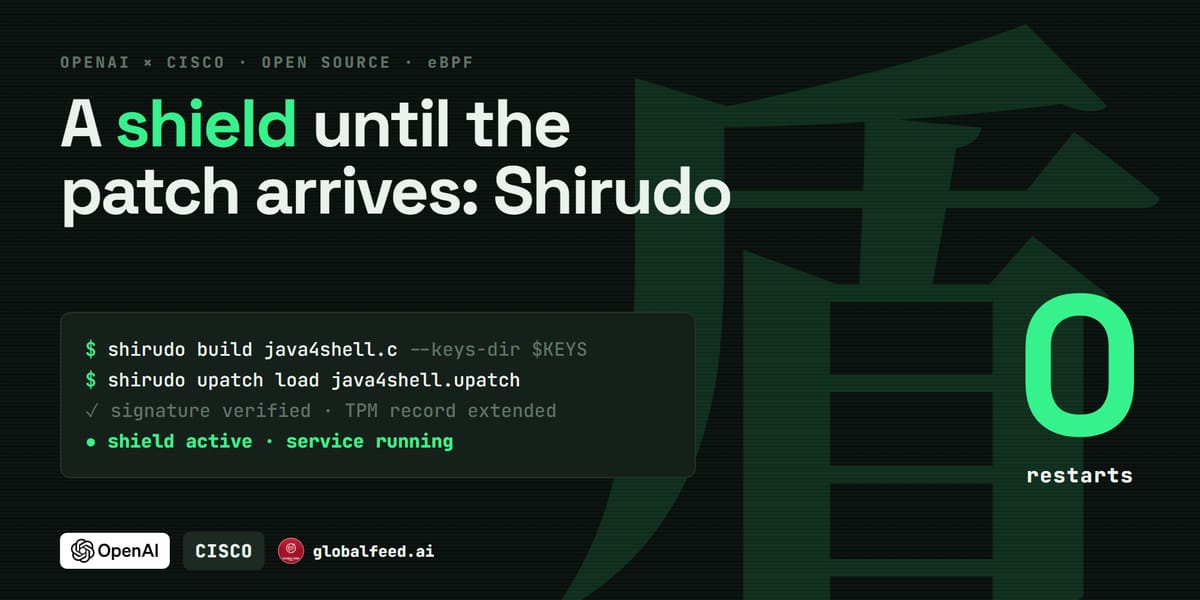
The moment a vulnerability goes public, every server operator enters an awkward waiting period. A patch has to be written, tested and rolled out, and OpenAI notes that this can still take days or weeks. Attackers do not wait. On November 23, OpenAI and Cisco released an open-source answer to that gap called Shirudo, Japanese for "shield." It puts temporary protections on a running Linux system without a restart.
The hard part is precision. OpenAI points out that an exploit and legitimate traffic often use the same Linux operation, so blocking that operation outright can take a service offline. Shirudo instead loads small, targeted shields that look only for the attack pattern, protect the system until the real patch lands, and are then removed.
How a shield works
Shirudo is built on eBPF, a Linux technology that attaches small programs to specific points in the kernel so they can observe activity and step in when needed, all without recompiling the kernel. The project's docs call these programs "upatches." Every shield is signed and verified before it loads, and the kernel only accepts BPF programs from signed loaders. Even root on the target cannot tamper with the shields without the operator's signing key.
Each change also leaves evidence. When the loaded set changes, a per-boot register in the machine's TPM security chip is extended, and "shirudo attest" exports that record for offline verification. Unloading a shield is itself a signed directive. Cisco's Isovalent team stresses that Shirudo runs no permanent daemon: operators publish signed packages to an OCI registry, targets pull them with one-shot commands, and telemetry goes to OpenTelemetry collectors. Isovalent describes Shirudo as rooted in Tetragon, the eBPF security tool it open-sourced in 2022, and calls it "a rewrite of Tetragon designed for agents."
A shield written by Codex
That agent focus is deliberate. Thomas Graf and Liz Rice of Isovalent argue that agents should be able to develop mitigations "at machine speed with code." OpenAI adds that security teams keep control: they can watch how a proposed shield would affect applications before enforcing it.
In a controlled test, Codex generated a shield against a Java4Shell exploit and applied it to a running Elasticsearch 9.5.5 service without a restart. That shield was Java bytecode that adds input validation to the Base64 decoder, verified in userspace and loaded by configured JVMs at startup. In Isovalent's example, the shield counts exploitation attempts so the team can investigate.
How to try it
Shirudo is on GitHub under BSD-2-Clause, with BPF programs dual-licensed BSD/GPL. The quickstart needs an x86-64 or arm64 Linux host with KVM (a Lima VM on a Mac), plus clang and LLVM 23, OpenSSL 3.5, tpm2-tss and LuaJIT. The flow is "shirudo build" to compile and sign, "shirudo upatch load" to apply, and "shirudo upatch list" to check. Isovalent also offers a browser-based lab.
The project is pre-release. Production targets need a kernel carrying Shirudo's patches and a TPM 2.0 chip. OpenAI calls the work "a first step" toward infrastructure that adapts to threats, and it plans a webinar on December 15.
Sources: OpenAI announcement, Isovalent (Cisco) post, GitHub repository, Quickstart

