
MemT-1.0-Pro puts memory inside the model: how does it remember without growing?
MemTensor's 554B open model runs on a fixed-size memory; how memory is written, the 34B-token training, what failed and the results.

Long-running assistants usually remember in one of two ways: they re-read the whole history on every query, or they store it in a separate database and retrieve pieces. MemTensor is trying a third route: building memory into the model's own computation. Weights for its largest model, MemT-1.0-Pro, have been on Hugging Face since November 20: 554 billion parameters, 59 billion active per token, on NVIDIA's Nemotron-3-Ultra. The family also includes Nano (36B, on Qwen3.6-35B-A3B) and Flash (288B, on DeepSeek-V4-Flash).
How native memory works
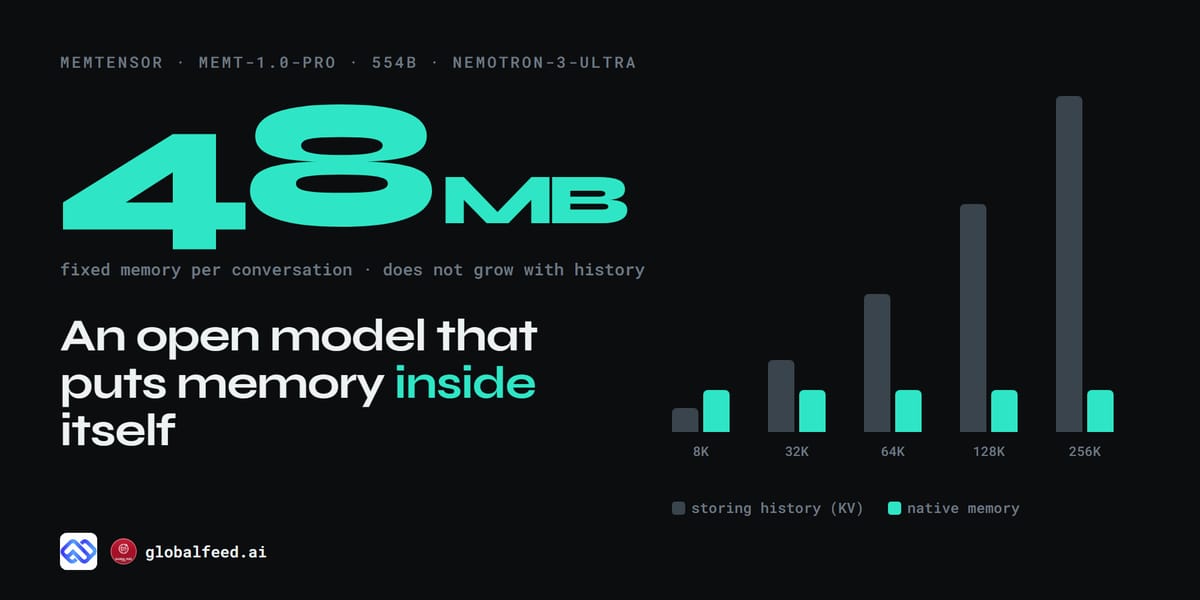
Per the technical report, each memory layer has a "local memory," a multi-channel state that starts at zero for every conversation, and a trained "hyper memory" of gates that decide what to write, erase and read. Memory runs as a parallel branch beside the backbone's unchanged attention, updated token by token with a Gated DeltaNet-2 rule. In Pro it sits in 12 full-attention layers and holds about 12.6 million state values per conversation, 48 MB in FP32, no matter how long the history grows. The measured gains are for Nano: at a 128K-token history, about 66 times less per-conversation storage than full context and a 1.86x end-to-end speedup, rising to 3.99x at 256K. At short histories Nano is slower; the two break even around 32K.
How it was trained
The backbone is frozen and only the memory modules train, 4.23 billion parameters in Pro. The backbone is first prepared on 126.5K trajectories (2.4B tokens), then serves as the full-context teacher. Training uses 34 billion tokens: 20 billion of continued pre-training with memory carried across segments, and 14 billion of post-training with forward-KL distillation from the teacher, which sees the full history as text. Part of the data comes from MemOS's anonymized interaction patterns. Pro ran 10,729 optimizer steps. Ablations on Nano (average 46.97) show what failed: turn-level instead of token-level updates drops it to 40.98, skipping post-training to 36.28, and plain Gated DeltaNet-2 was "not stable in general."
Results
Across 11 memory benchmarks Pro averages 53.08, first among parametric-memory methods, ahead of Flash (50.60), Nano (46.97) and Temp-LoRA (38.08). Text-based systems still lead: MemOS scores 72.08, and the report notes they stay ahead on precise retrieval from long histories. Pro stays within 0.11 points of its backbone on general capability. With coding experience written into Nano's memory, the share of tasks solved in all three runs rises 7.6 points on SWE-bench Verified and 8.3 on SWE-bench Multilingual.
How to run it
The GitHub example runs Pro on 8 NVIDIA GPUs with SGLang via "sh start_memt_pro.sh"; Nano is the practical starting point. Weights are released under OpenMDW-1.1, following the Nemotron backbone. The report's main limitation: a fixed-size state also means fixed capacity, so precise recall can lose detail as history accumulates.
Sources: Hugging Face model card, MemT-1.0 technical report, GitHub repository

