
Hydrogen, an open science model trained on lab notebooks, tops a research benchmark
Deep Principle retrained GLM-5.3 on lab records and discovery trajectories. The model catches its own mistakes in rehearsal and finds new materials in fewer tries.

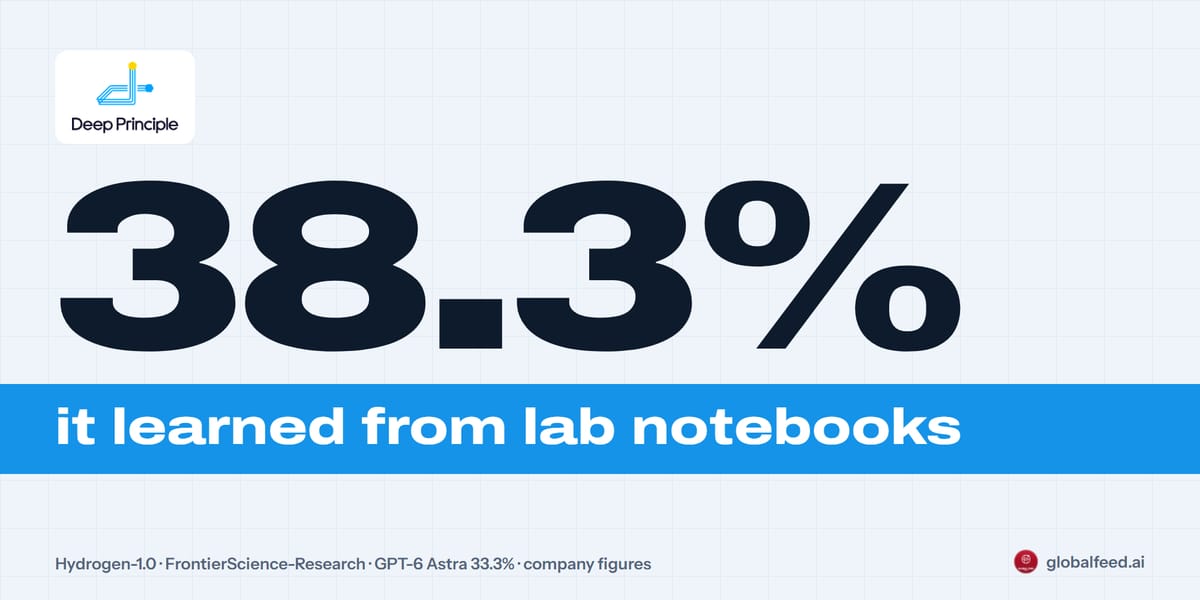
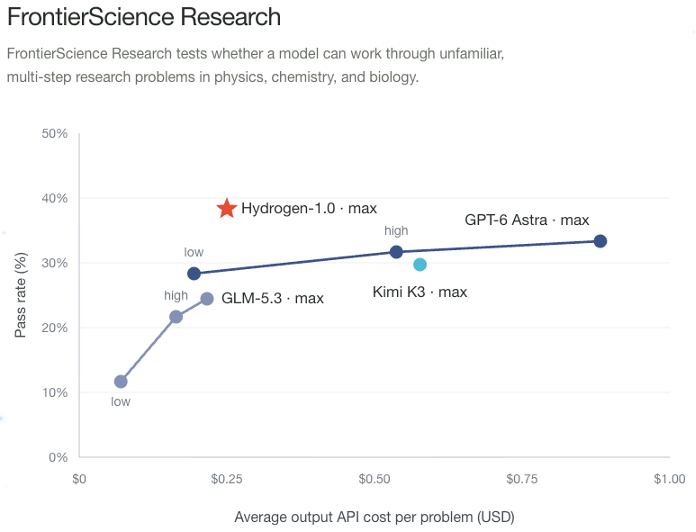
Teaching a model from a chemistry textbook is one thing; teaching it from a lab notebook is another. A notebook records what a scientist wanted to learn, how the experiment was set up, what happened, where it went wrong and what came next. Chinese research company Deep Principle retrained Z.ai’s open model GLM-5.3 on exactly that kind of record and released the result, Hydrogen-1.0, as an open model on 2 November. According to co-founder Chenru Duan’s announcement on X, it scores 38.3% on FrontierScience-Research, a test of unfamiliar, multi-step research problems, against GPT-6 Astra’s 33.3%. The license is MIT, so commercial use is allowed.
What this is about
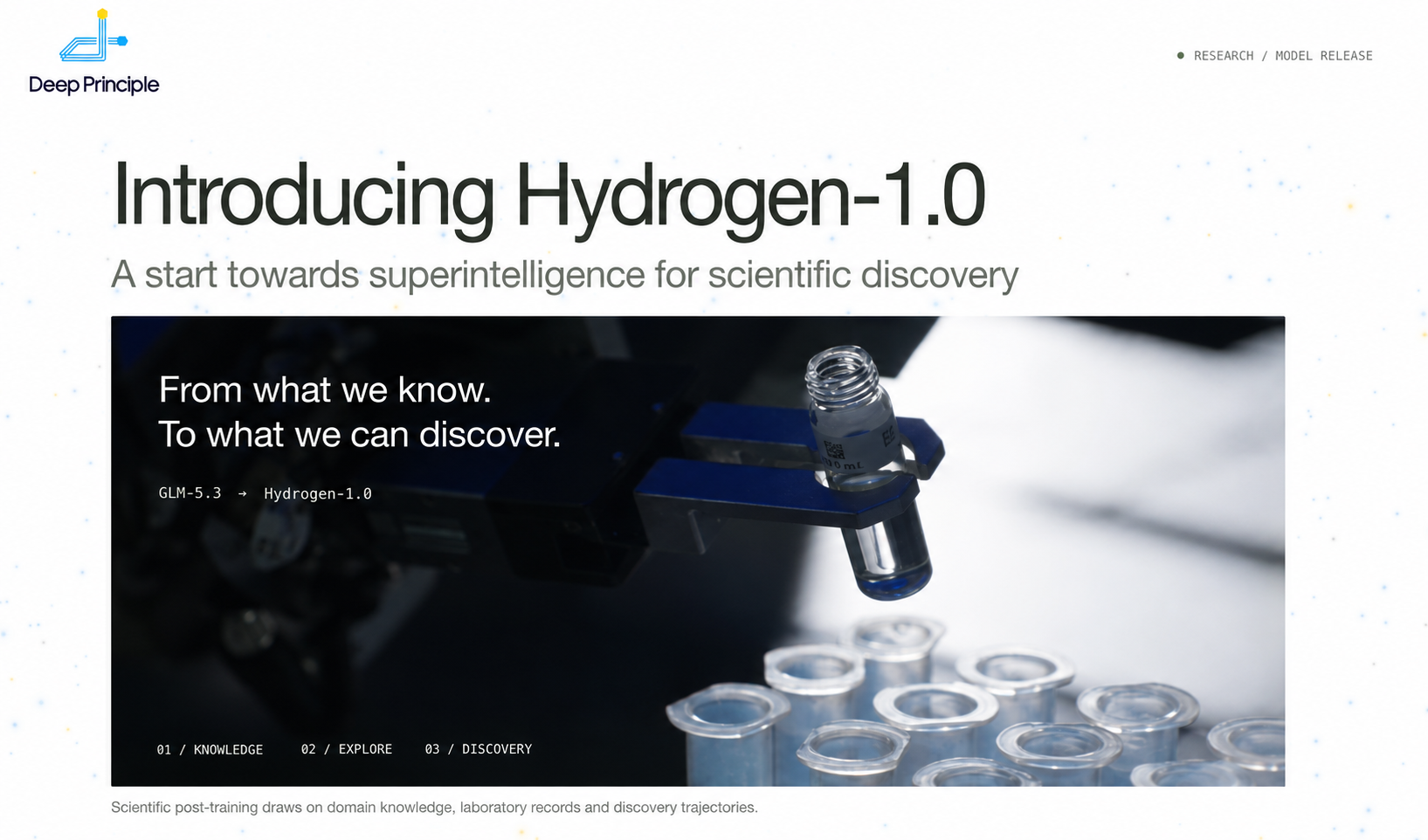
AI’s contribution to scientific discovery has started to become concrete. Deep Principle’s blog cites two examples: OpenAI’s agents producing a proof about the Navier-Stokes equations, and Anthropic identifying an enzyme system with CRISPR-like repeats through genomic analysis. The company’s point is that the models behind them are closed. Researchers cannot inspect them, adapt them to their own labs or test their methods. Hydrogen-1.0 aims to fill that gap with an open model, focused on chemistry, materials science and life sciences.
The model is built on GLM-5.3, with a one-million-token context and a 128K-token output limit. Alongside the full-precision weights, Hugging Face hosts NVFP4 builds for NVIDIA Blackwell and MXFP4 builds for AMD’s MI350 series. The card says it was tested with SGLang on 8 GPUs. If you don’t want to host it, there is an API through NeuroSpark and the company’s AI scientist product, Mira.
What it can do in the lab
On the company’s internal tests against GPT-6 Astra at maximum thinking, Hydrogen-1.0 leads on scientific computing (76.9% vs 71.8%) and one-step reaction prediction (90.5% vs 85.7%). Astra stays ahead on structure elucidation from NMR spectra (30.0% vs 26.7%). On GPQA Diamond, Hydrogen scores 93.0% and, per the blog, roughly matches the open model Kimi K3.
The blog’s examples say more than the numbers. Asked a materials question, the model writes Python to build a polyethylene melt to study a plastic bag at molecular scale, runs a GROMACS simulation, finds and fixes a topology error itself, restarts, and analyses density, packing, diffusion and chain dimensions over a 40-nanosecond trajectory. In another it maps a reaction network of 27 molecules through 30 plausible reactions around an Ireland-Claisen rearrangement. In a third it narrows seven possible products of 2-bromonaphthalene down using an NMR spectrum.
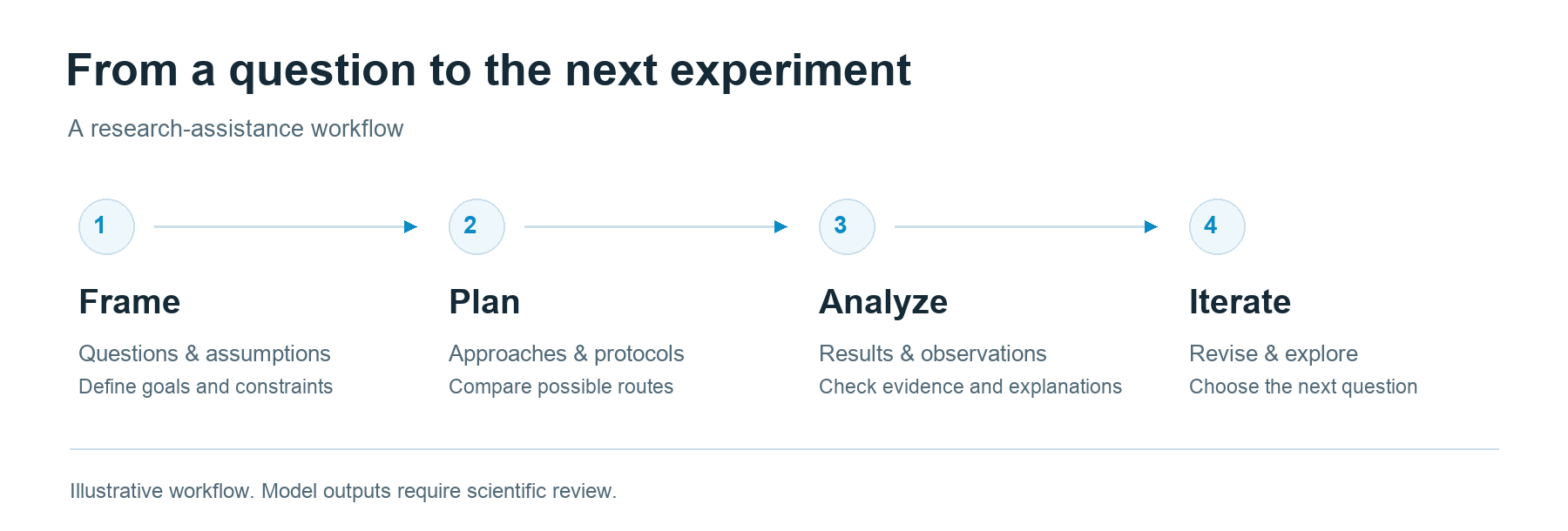
Rehearsing the experiment first. One of the most striking examples involves lab robots. Hydrogen-1.0 writes a JSON protocol for a 12-vial Suzuki coupling study. The protocol first goes through a virtual rehearsal, which catches the model trying to aspirate without a fresh pipette tip. The model fixes the step order, the protocol compiles again, and only then does it move to the run. Duan puts it plainly: “AI taking over the lab has tons of risks”; the rehearsal catches the mistake before materials and time are spent.
An edge in experiment planning. On 117 shared questions about experiment design and planning, Hydrogen-1.0 scores ahead of Kimi K3. GPT-6 Astra and Claude Opus 5.5 could not be included, because, according to the blog, both rejected more than half the requests.
Finding new materials in fewer tries
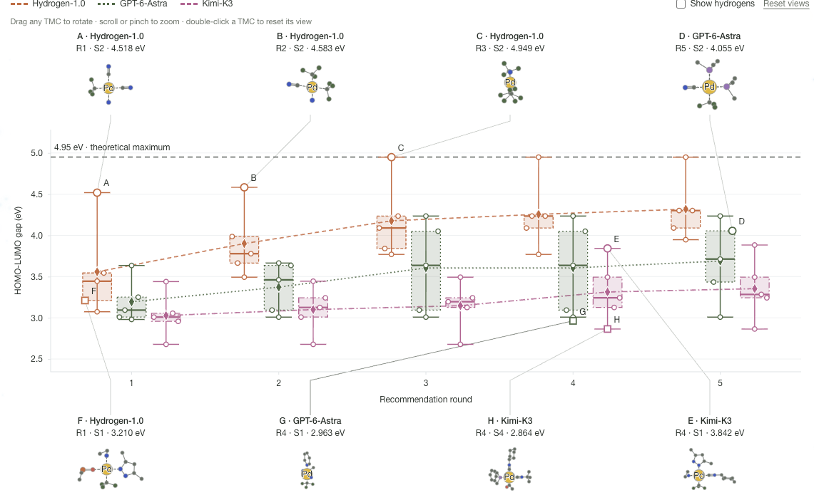
The company’s boldest result is about materials discovery. In a search for transition metal complexes with the largest HOMO-LUMO gap, each model starts from the same pool and proposes new candidates over five rounds, seeing only the results of its own picks. By round five, the mean best-so-far gap is 4.318 eV for Hydrogen-1.0, 3.689 eV for GPT-6 Astra and 3.353 eV for Kimi K3. In other words, the model homes in on materials with the target property in fewer attempts.
How it was trained
Training has two stages: supervised fine-tuning and reinforcement learning. The data comes in four layers. First, domain knowledge from chemistry, materials science and life sciences. Second, task-specific feedback from the company’s scientists on research scenarios. Third, electronic lab notebook records kept with Mira’s agent-assisted documentation, with intent, procedure, observations and outcome linked together. Fourth, discovery trajectories: the whole chain of decisions from candidate selection and synthesis route to evaluation and the next attempt, including failed candidates and revised hypotheses. The supervised stage supplies worked examples of reasoning, experiment planning, protocols and result analysis; the RL stage teaches the model to decide better using feedback on research outcomes. Full datasets and training recipes are not released.
Infrastructure. Training runs on Megatron and SGLang across both NVIDIA CUDA and AMD ROCm. Long reasoning examples are packed without truncation and only the model’s answer is supervised. Sample boundaries are enforced so sparse attention does not leak between packed examples. When memory is tight, Muon optimizer state sits in CPU memory on CUDA, and on disk during forward and backward passes on ROCm.
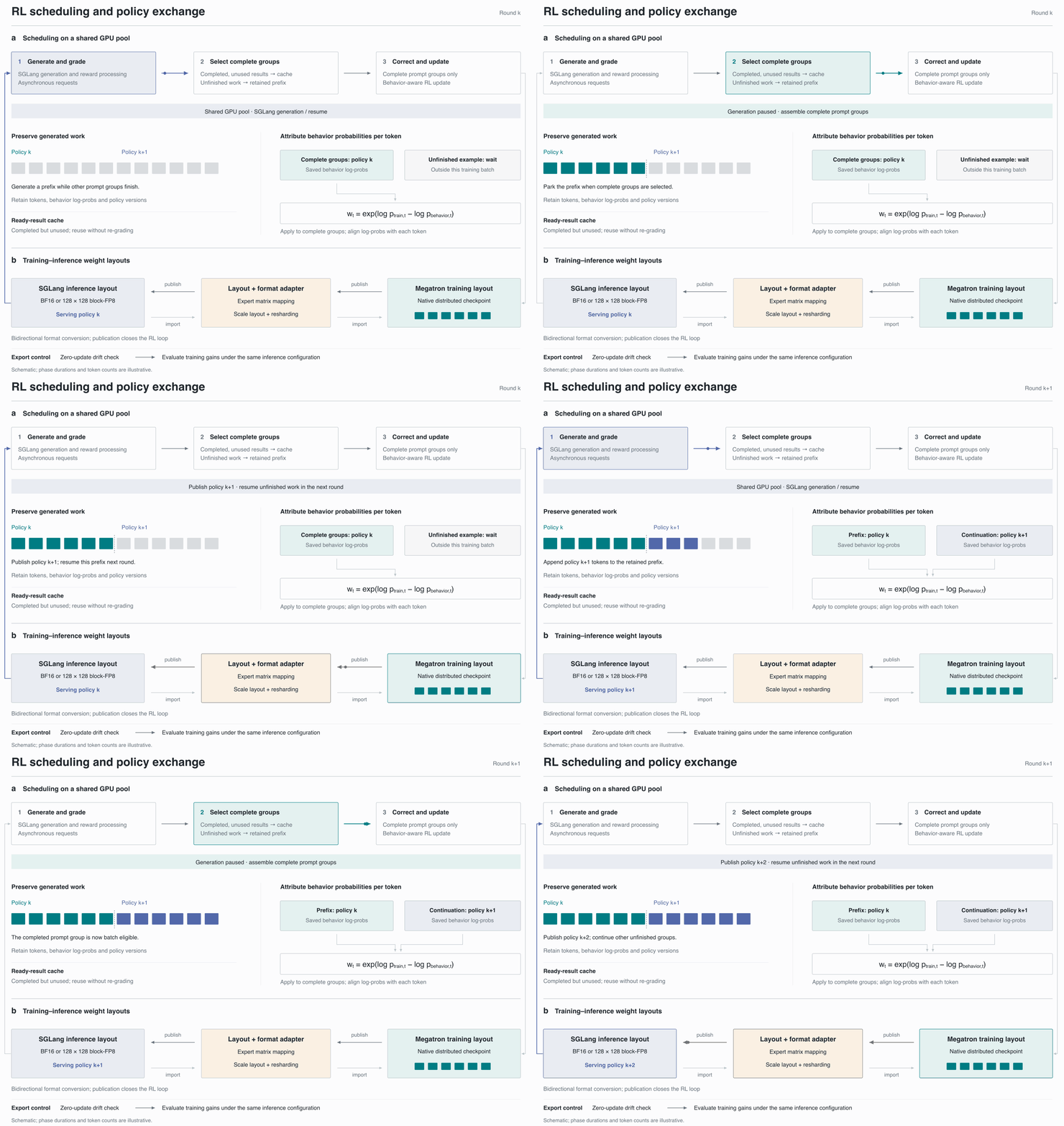
Not throwing away unfinished answers. During RL a shared GPU pool alternates between generation and training. Unfinished responses keep what they have generated and continue in a later round; every token stores which model version produced it and with what probability, and the correction uses that. Before attributing an evaluation change to training, the drift caused by format conversion and quantization alone is measured separately with zero updates. Deep Principle worked with UniPat, Mind Lab and NeuroSpark on this.
For university labs and R&D centres working in chemistry, materials or drug research, this is an MIT-licensed science assistant they can run on their own servers without sending data out. The model is large and needs an 8-GPU server, but it can also be tried through the API. For teams that keep digital lab notebooks, the message is even more interesting: good records kept today may become the most valuable data for tomorrow’s models in their field.
All scores are Deep Principle’s own evaluations, and the internal tests use the company’s own research scenarios. The model card also states plainly that outputs need scientific review and cannot alone justify decisions affecting health or safety. There is no independent measurement yet, and we have not run the model ourselves.
Sources: Hydrogen-1.0 tech blog, Model card, Chenru Duan on X, GLM-5.3, NeuroSpark API

