
How was Rumble-2-Flash, an open half-billion-parameter speech model for 40+ languages, trained?
Reson8's Rumble-2-Flash, open-sourced with Hugging Face, learned from a larger model that graded every token it wrote. We explain how speech recognition works, the results and how to run it yourself.

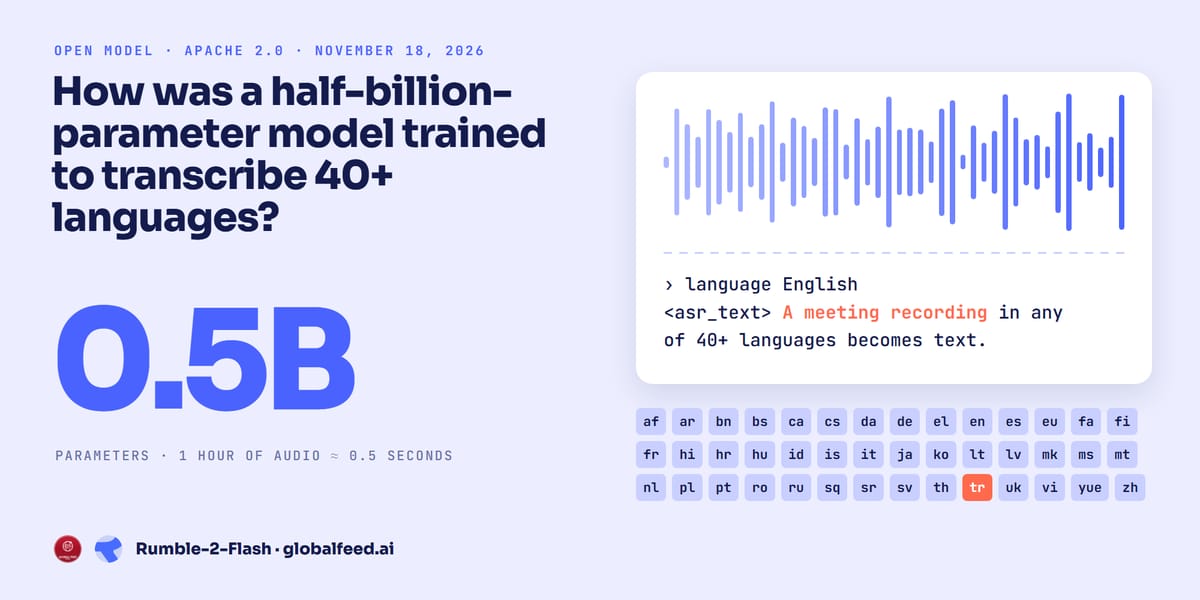
Transcribing meetings, voice notes or hours of support calls is usually thought to need big models and big servers. On 18 November Dutch speech company Reson8, in a post published with Hugging Face, released a model that tests that idea: Rumble-2-Flash. It has half a billion (0.5B) parameters, transcribes speech in 40+ languages and is open under Apache 2.0, so it can be downloaded, built into commercial products and fine-tuned.
According to the published results it competes with models 3 to 60 times its size: a 6.96% average error rate on the multilingual track of Hugging Face's Open ASR Leaderboard, and about half a second for an hour of audio on full batches.
How speech recognition works
Audio is first turned into a mel spectrogram, a picture of which frequencies are strong at each moment (128 bands in this model). An audio encoder reads that picture and turns it into 13 steps per second; a small language model then writes the text token by token. Rumble-2-Flash uses Alibaba's open Qwen3-ASR architecture, 18 encoder layers and 14 decoder layers, which is why it runs on day one in Transformers and vLLM with no custom code. It detects the language on its own and offers switches for digits versus words, filler words and verbatim repeats.
How it was trained
The team wanted to know how small a model could get before accuracy dropped. They distilled Rumble-2, their larger production model, into Rumble-2-Flash with on-policy distillation. The student does not memorize transcripts written by the teacher. It transcribes the audio itself, and the teacher grades that transcript token by token, giving its own probability for what should come next at every position. The student is corrected on exactly the mistakes it makes, with feedback on every token instead of one score per clip.
On-policy distillation normally needs teacher and student to share a tokenizer, and these two do not. The team used Hugging Face's GOLD method, which merges tokens where the two tokenizers split text differently, compares shared tokens directly and matches the rest by sorted probabilities. The repo also ships an auxiliary CTC head, one linear layer on the encoder output trained jointly with the model, which gives very fast but much less accurate transcripts without the language model. Speaker separation and live streaming were deliberately left to the bigger model, and the training data has not been described.
Results
On the Open ASR Leaderboard the model averages 6.96% WER across Chinese, German, French, Italian, Spanish, Portuguese, Hindi, Dutch and English, ahead of omniASR-LLM 7B and Whisper large-v3, and 6.6% on the English track. On AppTek's 302-hour call-centre test with 14 English accents it scores 7.86%, level with NVIDIA's 30B Nemotron 3.5 Transcribe (7.78%); only Qwen3-ASR 1.7B does better (7.4%). On ten lower-resource languages Reson8 reports 17.6% against 39.8% for Whisper Large V3, for example 13% against 72% in Maltese. Turkish is on the supported list, but no Turkish score has been published.
How to try it
The model file is about 1 GB. Install torch, transformers and accelerate, load Reson8/Rumble-2-Flash with AutoProcessor and AutoModelForMultimodalLM, and pass a file path, URL or list to apply_transcription_request. For batch work, vllm serve Reson8/Rumble-2-Flash exposes an OpenAI-compatible endpoint. The bundled ctc_head.py script gives a fast rough transcript and also has a CPU option. Figures come from the Reson8 and Hugging Face post and the model card.
Sources: Rumble-2-Flash announcement (Hugging Face blog), Rumble-2-Flash model card, Reson8 open model page, Open ASR Leaderboard, GOLD: on-policy distillation for any model family

