
How did a fake Claude Code extension reach Cursor's marketplace? The trail leads to Fireworks
Cursor has published the full chain behind the tampered Claude Code builds in its marketplace. What was not affected, what Cursor changed and what to check on your machine.

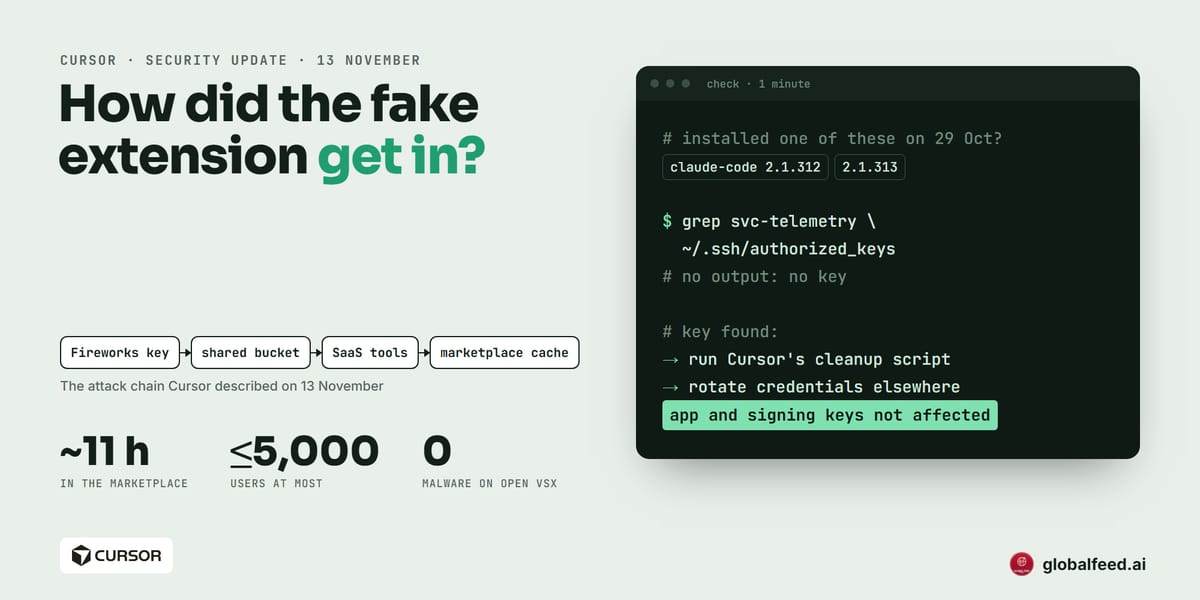
On 13 November Cursor published an update on its two-week investigation and explained, step by step, how a fake build of Anthropic's Claude Code extension ended up in its marketplace on 29 October. We covered the first day of the incident in an earlier story: versions 2.1.312 and 2.1.313 of Anthropic.claude-code sat in Cursor's VS Code extension marketplace for about 11 hours and may have reached at most 5,000 users. The new account traces the start of the chain to Fireworks, the AI infrastructure company Cursor shared data with.
How the chain started
According to Cursor, an attacker obtained an access key Cursor had issued to Fireworks; Cursor says the key was exposed by Fireworks. It opened a read-only storage bucket used to share data, holding limited coding agent traces, mostly from 2025, from sessions not in Privacy Mode that Cursor was permitted to use for training. A few traces contained unredacted credentials, and less than 0.01% of customers had API credentials exposed. With those, the attacker reached some SaaS tools Cursor uses, including archived non-production repositories, limited support data and some credentials users had sent to support. On 29 October a stolen credential let them place the tampered extension directly on the cache that serves Cursor's marketplace.
Fireworks describes its side in its own security bulletin and a 9 November update: it detected unauthorized use of internal credentials on 6 October, brought in Palo Alto Networks Unit 42, and links the activity to a financially motivated "LLMJacking" group that sells unauthorized access to language models.
What was not affected
Cursor says prompts and code from Privacy Mode users were not affected, and agent traces were exposed for fewer than 0.05% of other users, all notified directly. Production systems, the Cursor app and its official updates were not affected; release signing keys were not exposed, and all other extensions were verified. Open VSX, the extension's source, never had the malware, and Cursor states that Anthropic did not publish the copy and that this was not a vulnerability in Anthropic's product. The last attacker activity seen was on 1 November, and it was blocked.
What Cursor changed
Cursor moved all inference off Fireworks and deactivated its key, rotated every exposed credential and, as a precaution, all internal credentials, rebuilt its extension marketplace, restricted where credentials can be used, added secret scanning across its repositories, redeployed production infrastructure and brought in outside forensics experts.
What to check on your machine
This applies if you installed or updated to Anthropic.claude-code 2.1.312 or 2.1.313 from Cursor's marketplace on macOS or Windows on 29 October between about 2:27am and 1:35pm PT. The payload added an SSH key labeled "svc-telemetry" to authorized_keys; on macOS, grep -qs svc-telemetry ~/.ssh/authorized_keys && echo found || echo none checks for it, and the Windows command is in Cursor's security notice. If the key is there, run Cursor's remediation script for your platform; uninstalling the extension alone may not be enough. Rotate credentials reachable from that machine from a trusted system. Cursor's first notice adds that enabling SSH needs admin rights the extension lacked on most machines, so on those the attacker could not log in through the tunnel. Questions go to security@cursor.com.
Sources: Cursor: An update on our recent security incident (13 Nov), Cursor: Security notice for Anthropic.claude-code 2.1.312 and 2.1.313, Fireworks: October 2026 security incident, Fireworks: Update on October 2026 security incident (9 Nov)

