
From the cloud to the desktop: where are NVIDIA and Microsoft taking AI at Ignite?
At Ignite, NVIDIA and Microsoft announced Vera Rubin on Azure, open-model post-training in Foundry, Jetson in Azure Local and Windows 365 Cloud PC streaming.

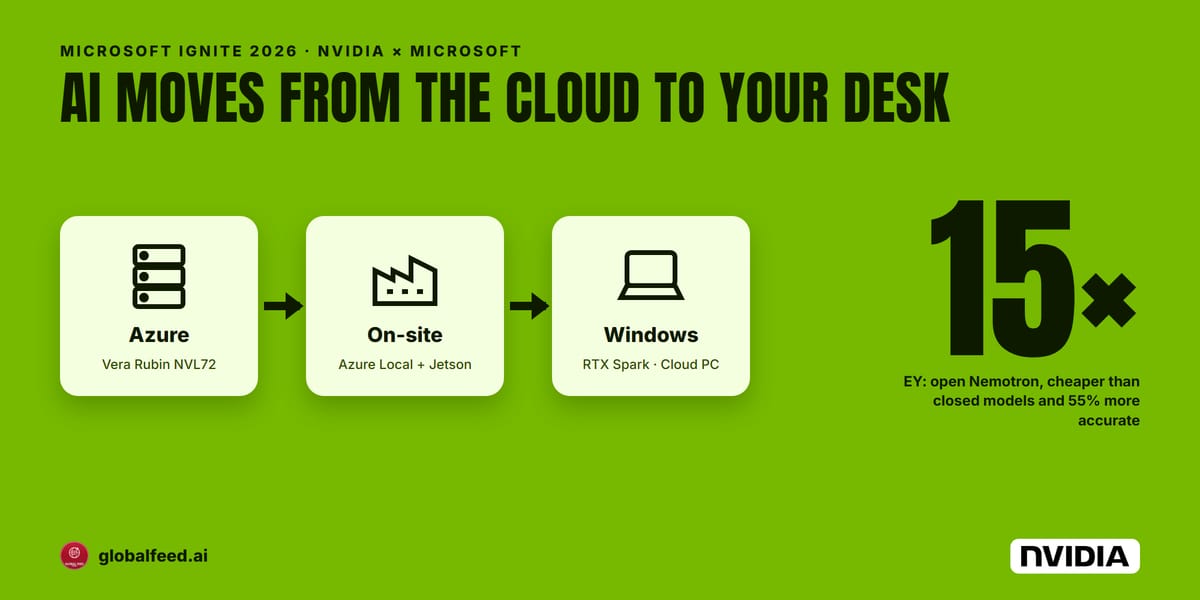
At Microsoft's annual Ignite conference, NVIDIA and Microsoft made a set of announcements that bring AI under one roof from the data centre to the factory floor and on to Windows PCs. NVIDIA's blog post of November 19 groups them under five headings: next-generation servers on Azure, customising open models for a company, AI that runs where the data lives, tools for scientific research, and the NVIDIA software Microsoft uses for its own models.
The common thread is that companies do not run AI in one place. Some work happens on big cloud clusters, some in their own data centres, some on a factory robot or the PC on an employee's desk. This article goes through what each announcement means and who it may be useful for.
Vera Rubin on Azure
NVIDIA's newest server system, Vera Rubin NVL72, is now running in Azure data centres, and access to virtual machines built on it is expanding through Azure's Vera Rubin preview. NVIDIA describes it as infrastructure designed for long reasoning, agentic applications and large-scale model training and inference.
The two companies are also working to extend confidential computing from single servers to rack-scale AI infrastructure. The aim is to protect sensitive models and data even while they are being processed, letting customers verify the computing environment before releasing a sensitive model, dataset or key. NVIDIA says this is for organisations working with proprietary or regulated data, and the work is still in progress. On the energy side, the companies are collaborating on NVIDIA MaxLPS to get more performance from available power.
NVIDIA also points to Azure's recent benchmark results: in MLPerf Training v6.1, Azure scaled to 10,240 GPUs with GB200 NVL72 systems on DeepSeek-V3, the largest scale in the round. In MLPerf Inference v6.1, according to Signal65, Azure's GB300 NVL72 systems led cloud submissions on DeepSeek-R1 interactive throughput by more than 10%.
Training an open model for your company
This may be the most concrete part for business. Microsoft Foundry's serverless Programmed Training gives developers control over post-training while Foundry manages the infrastructure, so a company can focus on its own data, evaluating model answers and improving behaviour. Foundry Managed Compute now supports deploying custom models, joining customisation and deployment in one service.
According to NVIDIA, EY used Programmed Training to adapt NVIDIA's open Nemotron models for classifying corporate purchasing records. On its evaluation dataset, accuracy rose by 55% and cost fell 15 times compared with proprietary frontier models. It is the kind of example that shows a small open model, trained for a specific task, competing with large general models.
The Nemotron 3.5 family on Foundry is growing too. Nemotron 3.5 Super is aimed at long-running agents in coding, research and business workflows, and Lightning at apps that need fast responses and tool use. They are joined by Nemotron Embed and Rerank for retrieval, Nemotron Parse for pulling structured data from documents and Nemotron Content Safety for detecting harmful content. Nemotron 3.5 Bolt for high-throughput reasoning and Transcribe for speech recognition are listed as coming soon.
Taking AI to the data
Options are also growing for organisations that want to run outside the cloud. Nemotron 3.5 support in Foundry Local is expanding, bringing reasoning, coding and tool-using agents to Azure Local environments. Azure Local will support RTX PRO 6000 Blackwell GPUs from hardware partners and expand to NVIDIA Jetson Thor and Jetson Orin edge platforms, which means industrial work such as machine vision, robotics and autonomous operations can run on a company's own site. NVIDIA's physical AI models, including Cosmos, are coming to Foundry Local.
On the desktop, Ignite demos show large language models running locally on Windows PCs powered by NVIDIA RTX Spark. For organisations using Cloud PCs, Direct Stream is coming to GPU-accelerated Windows 365 Cloud PCs: up to two 4K streams at 60 frames per second with low latency, even over challenging networks. A limited preview is open for sign-ups, with public preview planned for early 2027.
Agents for science
The NVIDIA BioNeMo Agent Toolkit and ALCHEMI Toolkit are joining the Microsoft Discovery catalogue, bringing models for life sciences, drug discovery and materials and chemistry to Microsoft's agentic research platform. BioNeMo Agent Toolkit lets scientists run computational biology workflows in natural language, with agents coordinating the tools and model calls. The first integration uses the RFD4-Proteina model, developed with the University of Washington's Institute for Protein Design, to generate candidate protein structures and amino acid sequences for laboratory validation.
Inside Microsoft
The last part concerns Microsoft's own work. Microsoft AI uses NVIDIA Dynamo inference software to generate rollouts during the reinforcement learning stage of post-training, with Dynamo managing requests, model updates and failure recovery across a large GPU fleet. Bing search models run on RTX PRO 6000 Blackwell GPUs. NVIDIA adds that its Ignite booth features live demos with a GB300 NVL72 rack and RTX Spark devices.
Who it is for
Many of the announcements are in preview or coming soon: the confidential computing work is ongoing and the Cloud PC streaming moves to public preview in 2027. What can be tried today is training open Nemotron models on your own data through Foundry and deploying them in the same service. For factories that want AI on their own site and organisations working with regulated data, Azure Local and Jetson support are worth watching.
Sources: NVIDIA blog post

