
From 90 days to 30: how Google and Anthropic are rewriting the vulnerability disclosure clock
Google Project Zero on November 13 and Anthropic on November 16 shortened their vulnerability disclosure windows. Project Zero steps down to 30 days by 2028; from January 1, 2027 Anthropic will use 30 days for high and critical bugs and 45 for the rest. The reason: AI is finding bugs faster.

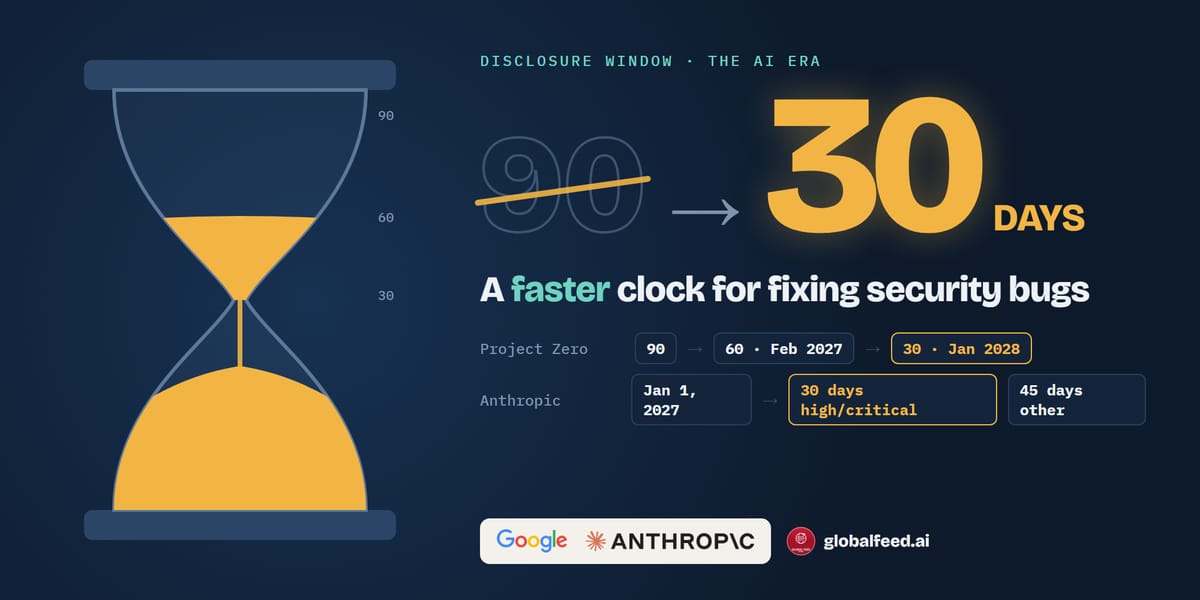
When a security researcher finds a flaw in a piece of software, the usual practice is to tell the vendor privately first, give it time to ship a fix, and publish the details only after a set period. For more than a decade the software world has largely treated that period as 90 days. In the second week of November two prominent names in the field rewrote the calendar independently and in the same direction: Google's bug-hunting team Project Zero on November 13, and Anthropic's Frontier Red Team on November 16. Both give the same reason. AI is finding vulnerabilities far faster than before, so fixes need to move faster too. The good news: both teams pair the new pace with transition schedules and tools to help maintainers.
What is coordinated vulnerability disclosure?
Coordinated disclosure means a vulnerability is reported only to the software's owner first, and the details stay private until a fix is ready or a deadline passes. Think of a broken lock in an apartment building: whoever notices it tells the building manager, the manager gets time to replace it, and then everyone is informed. The deadline does two things. It gives the vendor time to fix, and it keeps a known flaw from sitting quietly forever.
Project Zero's new schedule: "Full X"
According to Project Zero's November 13 post, the team had followed a "90 + 30" policy since 2021: 90 days for the vendor to fix, plus 30 days of "soak time" for the patch to roll out. The new policy is called "Full X". Details are published X days after the vendor is notified, whether or not a fix has shipped. The rollout is gradual: X is 90 from now, moves to 60 on February 2, 2027, and to 30 on January 3, 2028. The team's current policy page lists the same dates.
Most special cases are gone, including the grace period and the variant policy. Three exceptions remain: bugs actively exploited in the wild follow Google's broader policy and are disclosed after 7 days; details already made public by others may be released at the team's discretion; and details are shared early if the vendor asks. Rare exceptions such as Spectre and Meltdown are still possible; the policy page says this has happened five times in the last 12 years.
Why now?
Project Zero gives three reasons. First, language models have sped up how quickly attackers find and exploit bugs, and raised the chance that several parties find the same one. Second, once a patch ships, working out the bug from the patch now takes very little time, so in the team's view the 30-day soak period no longer means much; what matters is how fast users install the update. Third is volume: the team writes that it now finds several vulnerabilities a week in targets where it once found a few a year. Negotiating "is it fixed, does a grace period apply" for every bug is unmanageable at that scale, so the new policy is simple enough to automate.
Why not jump straight to 30 days? The team asked the vendors it reports to most. They warned that a sudden change could expose unfixed bugs while they are still improving their processes, so the gradual schedule was chosen to be challenging but realistic. In October Project Zero also published a guide to emergency patching systems that large vendors use to fix a small number of bugs much faster than their normal release cycle.
Anthropic's change: 30 and 45 days
Anthropic's November 16 announcement covers vulnerabilities Claude models find in open-source software. The window drops from 90 to 30 days for high- and critical-severity issues and to 45 days for everything else. The new timelines apply to reports sent on or after January 1, 2027; reports already in progress keep their deadlines. Two more changes: if a maintainer does not respond, escalation to an external coordinator moves from 30 to 15 days, and the wait after a patch before full technical details are shared drops from 45 to 30 days. The 7-day window for actively exploited bugs is unchanged.
Anthropic also spells out flexibility. For hard-to-deploy software such as critical infrastructure, or flaws that need a specification or RFC change, the timeline is agreed with the vendor. AI findings that have not had human review are outside this policy. The company's previous policy, the March 6, 2026 version, had a 90-day window with a possible 14-day extension. Anthropic's disclosure dashboard showed 5,087 vulnerabilities disclosed across 680 open-source projects as of November 2, with 629 patched, numbers that show why fix speed is on the agenda.
Support for maintainers
Anthropic acknowledges that shorter windows can add pressure on maintainers. It says it will keep sending actionable guidance with each report, plus a patch or mitigation where possible, and will agree on a sustainable pace before sending many findings to one project. Maintainers of critical open-source projects can apply to OSS Scanner, a free service that scans their code regularly and sends findings directly, which we covered in October. The Claude for Open Source Program offers eligible maintainers and contributors six months of Claude Ultra at no cost, and security professionals can apply to the Cyber Verification Program.
What changes for a software company or maintainer?
The most concrete change is the calendar, and the transitions running into early 2027 for Anthropic and 2028 for Project Zero give teams time to prepare. First, watch the security inbox: at Anthropic, unanswered reports will go to an outside coordinator after 15 days. Second, build a fast release path that can ship a single security fix without waiting for the normal cycle. Third, push automatic updates, because as Project Zero stresses, the sooner a patch reaches users, the sooner they are protected. Patch suggestions included with reports can speed things up too.
How to write a SECURITY.md for your own project
If you run an open-source project, writing down in advance how researchers should reach you makes this whole process easier. According to GitHub's docs, open the repository's "Security and quality" tab, click "Security policy" under "Reporting" in the left sidebar and choose "Start setup" to create a SECURITY.md file. A good SECURITY.md covers:
- Supported versions: a short table of versions that get security fixes.
- How to report: ask reporters not to open a public issue, and point them to GitHub private vulnerability reporting or a dedicated security email.
- Response time: a clear promise for the first reply, such as a few business days.
- Disclosure timeline: your target for fixing and publishing; aligning with the new industry schedule makes life easier.
- Credit: whether reporters are thanked in release notes.
Also enable "Private vulnerability reporting" under Settings, "Security and quality", "Advanced Security": researchers then get a "Report a vulnerability" button on the repository's Advisories page and can send findings to you privately. A few minutes of setup can buy valuable time on a 30-day clock.
Both teams point the same way: as finding bugs gets faster, fixing them has to keep up. The gradual schedules and the tools offered to maintainers aim to make that shift manageable for everyone.
Sources: Project Zero: Policy and Disclosure 2026, Project Zero disclosure policy, Anthropic: updating CVD timelines, Anthropic CVD policy, Anthropic CVD dashboard, GitHub: adding a security policy, GitHub: private vulnerability reporting

