
Claude's zero data retention enters beta with EFS: where does monitoring happen?
Anthropic opened a public beta of Enterprise Frontier Safeguards, which keeps sealed data in the customer's own bucket; who sees what, and the permanent setup steps.

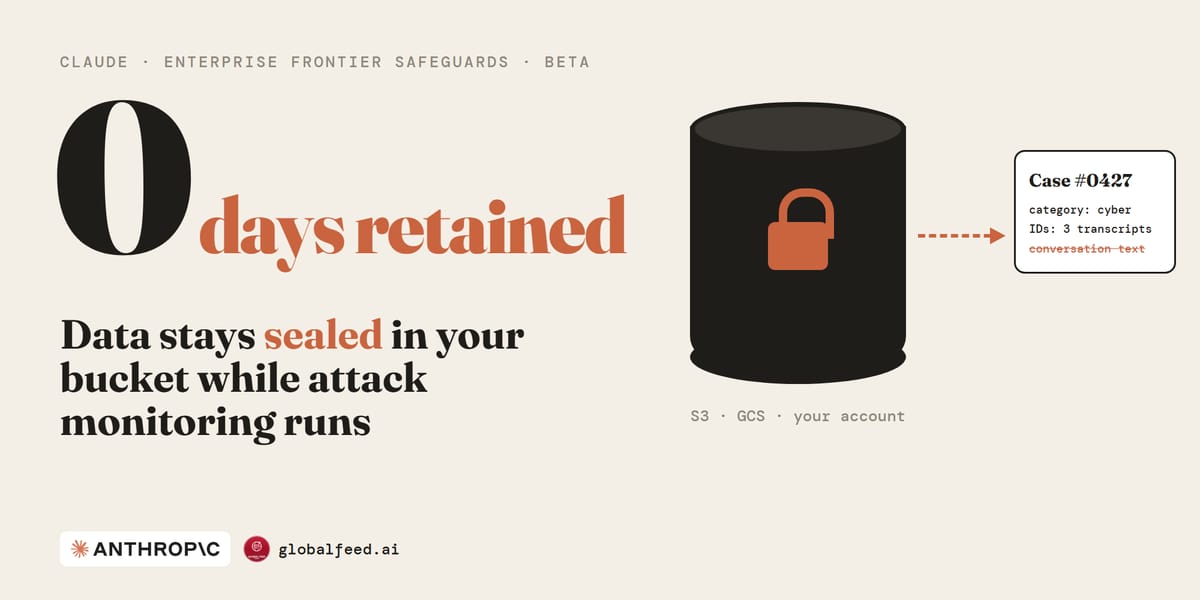
Large companies want two things from AI at once: their data stored nowhere, and models protected against misuse. Until now those goals pulled against each other. On November 23, Anthropic opened a public beta that combines them: zero data retention with Enterprise Frontier Safeguards (EFS). According to the page, neither Anthropic nor cloud providers retain the enterprise's data, while automated monitoring for multi-step attacks keeps running.
Anthropic first announced EFS in early September with a phased rollout. The November update makes it a beta that eligible organizations can try.
The gap in the old setup
Under legacy zero data retention (ZDR), Claude's real-time classifiers screened each request alone. Anthropic says sophisticated attacks often span many queries that look harmless one by one, and spotting the pattern requires history that ZDR does not keep. Starting with Fable 5, Anthropic introduced 30-day retention to correlate misuse across time and accounts. The docs say a legacy ZDR organization calling a model that requires 30-day retention gets a 400 error unless specifically authorized.
The data stays in the customer's bucket
With EFS, the customer brings its own Amazon S3 or Google Cloud Storage bucket. Inputs, outputs and model reasoning are written there as encrypted "Sealed Safety Data," which, per the docs, even the customer's own team cannot read, and Anthropic deletes its copy promptly. Automated monitoring scans a rolling window of that traffic for signs such as attempts at offensive cyber or biological capabilities and stolen credentials. When it finds a risk it opens a Safety Case listing the case ID, harm category, status and flagged transcript IDs, without the conversation itself. Only the customer's team can read the transcripts, and cases can feed SIEM tools.
Anthropic human review is always off under EFS, Anthropic sees only safety correspondence and monitoring metadata, and the company says it never trains on this data. Customer-managed keys are optional.
Who can use it, and the fine print
EFS runs on Claude Platform, Claude Platform on AWS, Amazon Bedrock and Claude on Google Cloud, with Microsoft Foundry coming soon. Anthropic charges nothing for it; the cloud provider bills storage. Model behavior, pricing and rate limits do not change. Access is not self-serve, and organizations with HIPAA readiness enabled are excluded.
EFS is enabled per workspace and not in the Default Workspace. Batch API and Managed Agents are not supported, and data stored by features such as Files API uploads is out of scope. A legacy ZDR workspace cannot be converted, and some steps, such as Access Transparency and attaching a customer key, are permanent. Anthropic says it built EFS with more than 100 customers, including a quarter of the Fortune 100, and quotes executives from Comcast, Stripe, Cisco, Wells Fargo and KPMG. The FAQ walks through setup.
Sources: Anthropic announcement, EFS docs, FAQ

